Home › Places › Wat Kasattrathirat
Wat Kasattrathirat: a riverside temple on the west bank looking across to Ayutthaya's city island
Wat Kasattrathirat Worawihan stands on the west bank of the Chao Phraya River, opposite the Rear Palace area and the Queen Suriyothai Chedi on Ayutthaya's city island. It was originally called Wat Kasattra, and researchers believe it was built in the middle Ayutthaya period. The temple was abandoned when the capital fell, then restored by princes of the Chakri dynasty, and it still has resident monks today.
This place through the eras
No evidence yet that this temple existed. The west bank of the river was open fields, later known as Thung Prachet.
Researchers suggest the temple was built in the middle Ayutthaya period, so it may already have existed in this era as Wat Kasattra. Thung Prachet behind it was a Hanthawaddy army camp in the war of 1563–1564, and across the river is where Queen Suriyothai, King Naresuan's grandmother, was cremated (1548). No record of the temple itself has yet been found for Naresuan's reign.
Wat Kasattra stood on the west bank of the river, near one of the few ferry crossings linking the west bank with the city island.
In late 1766, the chronicles say, the Burmese general Po Suphla sent troops to camp at Ban Pom and bombard the capital with cannon. The temple was badly damaged and was abandoned when the city fell in 1767.
In the early Rattanakosin (Bangkok) period it was restored and renamed Wat Kasattrathirat. In 1977 it was raised to a third-class royal temple of the Worawihan grade. Its main prang and ubosot are its highlights.
Origins and the temple's name
Wat Kasattrathirat stands in the Ban Pom area on the west bank of the Chao Phraya River. This stretch of river follows the old course of the Lopburi River that wraps around the city island, so the front of the temple faces the Rear Palace area and the Queen Suriyothai Chedi on the island bank, while behind it lies Thung Prachet, the wide open fields outside the capital.
The temple was originally called Wat Kasattra or Wat Kasattraram. A mid-19th-century map spells it Wat Krasattraram, and the map by Phraya Boran Ratchathanin of 1926 calls it Wat Kasattra. The word kasattra ("king" or "royal") leads many people to think the temple may have had royal patronage, but no evidence has yet been found to confirm who built it.
The researcher behind ayutthaya-history.com suggests, on the basis of its architectural style, that the temple was built in the middle Ayutthaya period, around 1488–1629. Most of the buildings you see today were built later, except for the ubosot (ordination hall) and the main prang.
This site in King Naresuan's time
No record has yet been found that mentions Wat Kasattra directly during the reign of King Naresuan. If the dating to the middle Ayutthaya period is correct, however, the temple probably already existed in his time.
What makes this spot interesting is the landscape around the temple. Across the river is the royal garden (Suan Luang) where Queen Suriyothai, King Naresuan's grandmother, was cremated after the war of 1548. It is also the site of Wat Sop Sawan, which one old document names as the place where Naresuan himself was cremated.
As for Thung Prachet behind the temple, the chronicles say it was the camp of the Hanthawaddy army in the war of 1563–1564. In the middle of these fields is Wat Worachet outside the island, another temple that has been proposed as Naresuan's cremation site. Wat Kasattrathirat itself also has a likeness of Somdet Phra Phonnarat, whom provincial tourism information describes as King Naresuan's teacher.
The main prang and the ubosot
The temple's main prang is stout and rounded, not tall and slender like many Ayutthaya prangs, and has no stairway up to its inner niches. The niches around the prang now hold small bell-shaped chedis, which researchers think are probably later repairs; they may originally have held Buddha images.
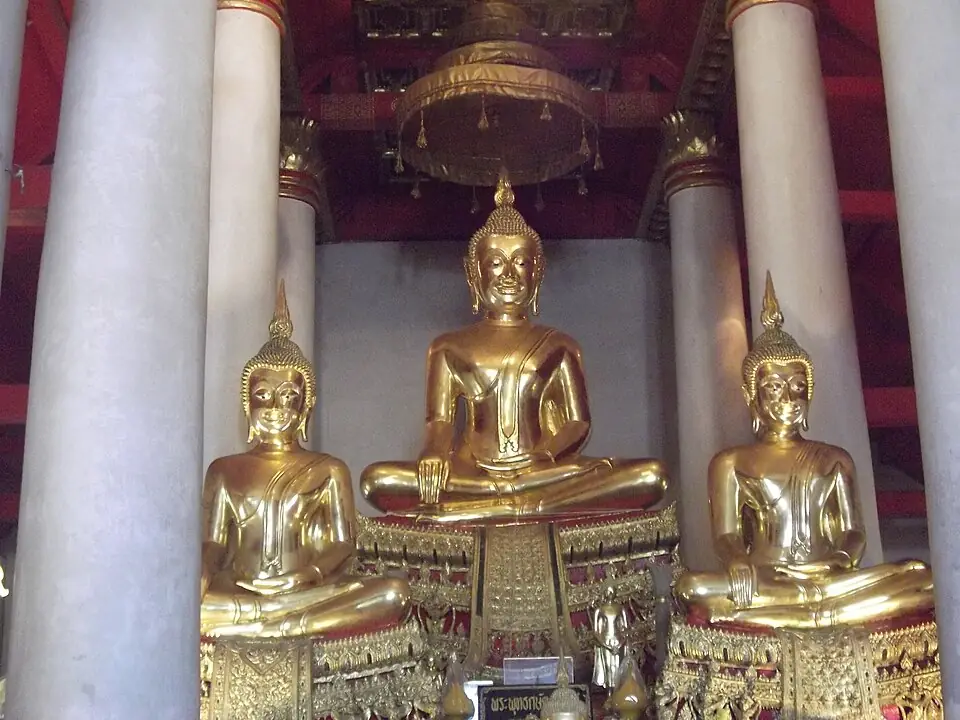
The ubosot is an old building that is still used for religious ceremonies. Around it are pairs of finely carved sema (boundary stones). The ceiling is painted with gold patterns on a red ground, and the marble floor, according to an article in Post Today, was a gift from King Rama V to a former abbot. The principal Buddha image is the Phra Phuttha Kasattrathirat, in the posture of Subduing Mara.
The temple also has Rattanakosin-period murals and several newer buildings built for the temple's present-day needs.
From war ruin to royal temple
In late 1766, while the Burmese army was besieging Ayutthaya, the chronicles say the Burmese general Po Suphla sent troops to camp at Ban Pom and bombard the capital with cannon. Lying close to the enemy camp, the temple was badly damaged; its people and monks had to flee, and it was abandoned after the city fell in April 1767.
In the early Rattanakosin period, princes of the Chakri dynasty restored the temple. An article in Post Today says that Krom Phra Ratchawang Bowon Sathan Phimuk (Prince Anurak Thewet) restored it and renamed it Wat Kasattrathirat, and that Prince Itsaranurak (Chao Fa Krom Khun Itsaranurak) restored it further in 1806 so that monks could reside there. Ayutthaya-history.com, however, credits the major restoration and the renaming to Prince Itsaranurak.
More buildings were added in later reigns, and, as Post Today reports, the temple was raised to a third-class royal temple of the Worawihan grade on 1 February 1977.
Wat Kasattrathirat through the eras
Here is the setting of this west-bank riverside temple in each era.
- Founding of the capital (1351–1488): no evidence yet that this temple existed; the west bank of the river was open fields outside the capital.
- Age of King Naresuan (1548–1605): Wat Kasattra may already have existed, if it was built in the middle Ayutthaya period. Across the river was the site of Queen Suriyothai's cremation (1548), and the fields behind were a Hanthawaddy army camp in the war of 1563–1564.
- Age of King Narai (1656–1688): a riverside temple on the west bank, near one of the few ferry crossings linking this bank with the city island.
- Second fall of Ayutthaya (1767): the Burmese army camped at Ban Pom to bombard the capital with cannon; the temple was badly damaged and abandoned.
- Today: a third-class royal temple with resident monks, where the main prang and the ubosot are still the highlights.
Getting there and visiting
The temple is on the west side of the Chao Phraya River, north of the road towards Suphan Buri. It is easy to reach by car or chartered tuk-tuk, and it lies on the same route as Wat Chaiwatthanaram and Wat Worachet outside the island.
A good spot is the riverbank in front of the temple, which looks across to the island bank near the Queen Suriyothai Chedi and helps you picture the river as both a transport route and a line of defence for the capital. As the temple has resident monks, dress modestly and behave respectfully around the ubosot.
Where historians still disagree
- Age and builder: no evidence has been found of who built the temple or when. The dating to the middle Ayutthaya period is based on its architectural style, and the name Kasattra leads some to believe it had royal patronage, but there is no confirming evidence yet.
- Who restored and renamed the temple: Post Today says that Krom Phra Ratchawang Bowon Sathan Phimuk renamed it and Prince Itsaranurak restored it in 1806, while ayutthaya-history.com credits the major restoration and the renaming to Prince Itsaranurak.
Visiting information
- Dress modestly, as the temple still has resident monks.
- Stop at the riverbank in front of the temple to look across to the city island.
- Continue on to Wat Chaiwatthanaram and Wat Worachet outside the island, which are on the same side of the river.
Frequently asked questions
What was Wat Kasattrathirat originally called?
It was originally called Wat Kasattra or Wat Kasattraram, and was renamed Wat Kasattrathirat when it was restored in the early Rattanakosin period.
When was Wat Kasattrathirat built?
No evidence of the year it was built has been found. Researchers suggest, on the basis of its architectural style, that it is a temple of the middle Ayutthaya period.
Is Wat Kasattrathirat connected with King Naresuan?
No direct record has been found, but the temple faces the site where Queen Suriyothai, King Naresuan's grandmother, was cremated, and it has a likeness of Somdet Phra Phonnarat.
Last updated 10 November 2026