Home › Places › Suriyothai Chedi
Queen Suriyothai Chedi (Wat Suan Luang Sop Sawan): A Memorial to King Naresuan's Grandmother
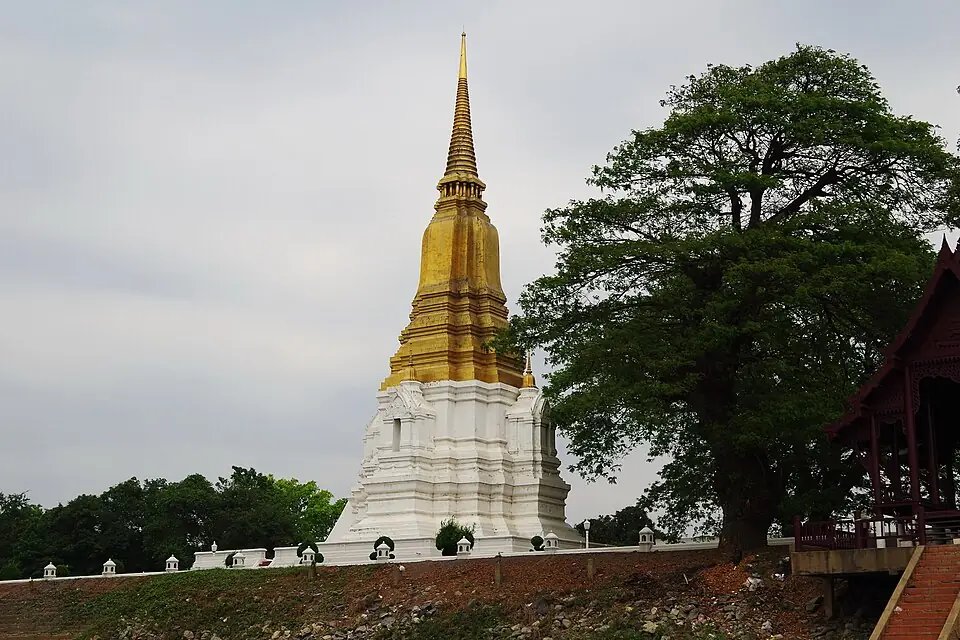
The Queen Suriyothai Chedi is a white, bell-shaped chedi with a golden spire on the western side of Ayutthaya's city island, on land that was once Wat Suan Luang Sop Sawan. According to the royal chronicles, this is the area linked to the cremation of Queen Suriyothai, who was killed on the back of her war elephant in the war of 1548. She was King Naresuan's grandmother, so this one spot ties together the stories of two generations of the same royal family.
This place through the eras
This chedi did not yet exist.
In 1548 a Hanthawaddy army came to attack Ayutthaya. Queen Suriyothai dressed as a man and rode a war elephant behind her husband, King Maha Chakkraphat, and died on her elephant while coming to his aid. According to the chronicles, Maha Chakkraphat had her cremated in the royal garden and then built Wat Sop Sawan and a memorial chedi (when the chedi seen today was built is still debated). Queen Suriyothai was Naresuan's grandmother, as the mother of Queen Wisutkasat, Naresuan's mother; he was born seven years after these events.
It was counted among the capital's important great chedis.
Abandoned after the fall of the city.
A bell-shaped chedi with redented corners, given a major restoration in 1990 and set in Suriyothai Park. King Rama IV is said to have used this chedi as the model for one of the great chedis at Wat Pho.
Background: the war in which Queen Suriyothai fell
In 1548, not long after King Maha Chakkraphat had come to the throne, the Burmese army of King Tabinshwehti marched in through the Three Pagodas Pass and made camp near Ayutthaya.
The royal chronicles relate that Queen Suriyothai dressed as a man and rode out to battle on an elephant alongside the king. When King Maha Chakkraphat's elephant was caught at a disadvantage by the elephant of the Lord of Prome, the queen drove her own elephant into the gap to block the attack and was cut down, dying on her elephant's back. A royal daughter who had ridden out with her was also killed in the same fight.
This war struck Naresuan's family directly. Maha Thammaracha, who would later become Naresuan's father, was captured by the Burmese together with Prince Ramesuan, and Ayutthaya had to hand over two war elephants to get them back before the Burmese army withdrew.
The cremation and the founding of Wat Sop Sawan
The chronicles record that the queen's body was taken to rest at the Suan Luang, a royal garden within the palace grounds on the western side of the city island. Once the fighting was over she was cremated, and a chedi and a wihan (assembly hall) were built on the spot. The temple was named Wat Sop Sawan (the name also appears in a second Thai spelling), in memory of the queen and her daughter.
The difficulty is that old maps show two temples on opposite banks of a canal: Wat Sop Sawan to the north and Wat Suan Luang to the south. The Fine Arts Department treats Suan Luang as what remains of Wat Sop Sawan and so calls the two together Wat Suan Luang Sop Sawan, but some researchers believe they were originally two separate temples.
According to the Phra Nakhon Si Ayutthaya provincial tourism information, the chedi on the Wat Sop Sawan side was pulled down in 1906 to make room for government buildings and an army camp, leaving only the large chedi on the Suan Luang side that we see today.
How it connects to King Naresuan
One of Queen Suriyothai's daughters, originally named Princess Sawatdirat, was raised to the title of Queen Wisutkasattri. She became the chief queen of Maha Thammaracha and the mother of Princess Suphankanlaya, King Naresuan and King Ekathotsarot. Queen Suriyothai was therefore Naresuan's grandmother.
Naresuan was born in 1555, about seven years after his grandmother's death. Yet her heroism, and the fact that his own father had been taken prisoner in the same war, formed the backdrop to the years in which he grew up.
Later, during the reign of Maha Thammaracha, a residence was built for King Ekathotsarot, Naresuan's younger brother, in the nearby area that afterwards became the Rear Palace (Wang Lang). This neighbourhood was therefore also home to princes of this dynasty.
This spot through the eras
Follow how this point on the map changed from one era to the next.
- Founding of the city (1351–1488): neither the temple nor the chedi existed yet. This was riverside land on the western side of the city island, near where the Chao Phraya River met the old course of the Lopburi River.
- Naresuan's era (1548–1605): the era opens with the death and cremation of Queen Suriyothai. According to the chronicles, Wat Sop Sawan and its memorial chedi were founded here.
- King Narai's era (1656–1688): the site lay within the Suan Luang and Rear Palace district, an area of royal residences. A map made in 1751 still shows Wat Sop Sawan and Wat Suan Luang on opposite banks of a canal.
- Second fall of Ayutthaya (1767): during the war of 1760, the chronicles mention temples in this area as strongpoints where cannon were set up to fire back at the enemy across the river. After the city fell, the temple was abandoned.
- Today: in the Rattanakosin (Bangkok) period the area became an army camp. The chedi underwent a major restoration in 1990, and the gilding of the whole chedi was completed in 1991.
What to see
The chedi is a bell-shaped stupa with indented (redented) corners, built of brick and stucco on a tall, multi-tiered base. Porches project from all four sides, each topped with a small miniature chedi, and a stairway on the north side leads up to a chamber inside. Some scholars consider it possibly one of the oldest surviving Ayutthaya-period chedis with indented corners.
The 1990 restoration uncovered relics of the Buddha, a Buddha image in the posture of subduing Mara, miniature chedis and gold vessels inside the chedi. These are now kept at the Chao Sam Phraya National Museum.
It is said that when King Mongkut (Rama IV) had the fourth great chedi built at Wat Phra Chetuphon (Wat Pho) in Bangkok, he used this chedi as its model. If you have been to Wat Pho, try comparing the shapes.
Don't confuse it with the Queen Suriyothai Monument at Thung Makham Yong, which is a modern memorial outside the city island. This chedi is the historic monument on the island itself.
Getting there and visiting
The chedi stands near U Thong Road on the western side of the city island. The area is still associated with a military unit, and the grounds around the chedi are fenced and usually closed, so most visitors view it from the garden on the east side.
Another lovely angle is from a boat on the Chao Phraya River, where the white chedi with its golden spire stands out on the bank. It is ideal for photos in the soft light of early morning or late afternoon.
Where historians still disagree
- The age of the present chedi: the traditional account of the Fine Arts Department and the provincial tourism office holds that the chedi descends from the memorial built in the reign of King Maha Chakkraphat. Art historians point out that the square base with indented corners is typical of late Ayutthaya. Michael Wright once proposed that it was built after 1765, while an article by a lecturer from the Faculty of Archaeology, Silpakorn University, in the journal NAJUA in 2014 suggested that the original memorial was the twin chedi demolished in 1906, and that the one seen today was built in the reign of King Rama VI.
- Who died on elephant-back: the Thai chronicles say it was Queen Suriyothai, but the Burmese chronicles do not record the death of a queen, and some Burmese-side documents say that the one who gave her life was Princess Borommadilok, a royal daughter.
- One temple or two: the Fine Arts Department sees Suan Luang as the remains of Wat Sop Sawan, but old maps show Wat Sop Sawan and Wat Suan Luang as separate temples on opposite banks of a canal. Some researchers therefore think the cremation site and the site of the memorial chedi may have been in different places.
- Model for the Wat Pho chedi: the claim that King Rama IV used this chedi as a model depends on whether the large chedi already existed at that time. If the proposal that the present chedi was built in the reign of King Rama VI is correct, the claim would have to be reconsidered.
Visiting information
- The grounds around the chedi are fenced and usually closed, so plan to view it from the garden on the east side or from a boat on the river.
- Dress modestly: this is a religious monument and a royal memorial.
- Stop by the Chao Sam Phraya National Museum to see the artefacts found inside the chedi.
- The midday sun is fierce; early morning or late afternoon is better for walking around.
Frequently asked questions
Does the Queen Suriyothai Chedi contain the queen's ashes?
Prince Damrong Rajanubhab believed it held her ashes, but the 1990 restoration found relics of the Buddha, Buddha images and offerings. No clear evidence of the queen's remains has been found.
How was Queen Suriyothai related to King Naresuan?
She was his grandmother: Queen Wisutkasattri, Queen Suriyothai's daughter, was King Naresuan's mother.
Who named the Phra Chedi Si Suriyothai?
In the reign of King Rama V there was a search for the site of Wat Sop Sawan as described in the chronicles. Later, King Vajiravudh (Rama VI) gave the chedi the name Phra Chedi Si Suriyothai.
Can you go up close to the chedi?
The grounds around the chedi are fenced and usually closed, but you can see and photograph it from the garden on the east side, or from a boat on the Chao Phraya River.
- PHRA CHEDI SRI SURIYOTHAI - Ayutthaya Historical Research
- WAT SUAN LUANG - Ayutthaya Historical Research
- Chedi Si Suriyothai - Southeast Asian Art Database, Princess Maha Chakri Sirindhorn Anthropology Centre
- Si Suriyothai Pagoda - Go Ayutthaya
- An Old Story Worth Retelling: Phra Chedi Si Suriyothai, Part 2 - NAJUA journal (in Thai)
- Queen Wisutkasattri - TruePlookpanya (in Thai)
Last updated 10 November 2026