Home › Biography
The Life of King Naresuan the Great
King Naresuan the Great is one of the best-known kings of Ayutthaya among Thais. He freed Ayutthaya from vassalage to Hanthawaddy in 1584 and fought the elephant duel that is still retold today. This article tells his life story in chronological order, and separates the episodes backed by solid evidence from those that are legend or still debated.
Birth and royal family
Naresuan was born in 1555 at Chan Palace in Phitsanulok, then the most important city in Ayutthaya's north. Thai sources agree on the year of his birth, but the exact day and month still cannot be worked out with certainty.
His father was King Maha Thammaracha, originally a nobleman named Khun Phiren Thep who descended from the Phra Ruang dynasty of Sukhothai. He took part in seizing power from Khun Worawongsathirat in 1548 and backed King Maha Chakkraphat's accession to the throne, and in return was given Phitsanulok to govern.
His mother was Queen Wisutkasat, a daughter of King Maha Chakkraphat and Queen Suriyothai. Queen Suriyothai, who died on the back of her war elephant in 1548, was therefore Naresuan's grandmother. He had an elder sister, Princess Suphankanlaya, and a younger brother, King Ekathotsarot, who fought at his side in almost every campaign.
The years in Hanthawaddy
In 1564 King Bayinnaung of Hanthawaddy invaded in the conflict that Thais call the War of the White Elephant. Phitsanulok was besieged until it ran out of food and disease broke out, so King Maha Thammaracha had to submit. Naresuan, then only about 8–9 years old, was taken to live in Hanthawaddy as a hostage.
In Hanthawaddy he got to know the Burmese language and the Burmese way of waging war at close quarters, which is often described as an advantage in his later wars.
The story Thais know best from this period is the cockfight with the Burmese Crown Prince (called Mang Sam Kiat in some versions), which Naresuan's rooster won. This is a legend handed down over the generations; no contemporary evidence confirms it.
Return home and rule over Phitsanulok
After Ayutthaya fell to Hanthawaddy in 1569, King Bayinnaung installed Maha Thammaracha as king of Ayutthaya, ruling as a vassal. Not long afterwards Naresuan was able to return home; according to the traditional story, his elder sister Princess Suphankanlaya went to live in Hanthawaddy in his place.
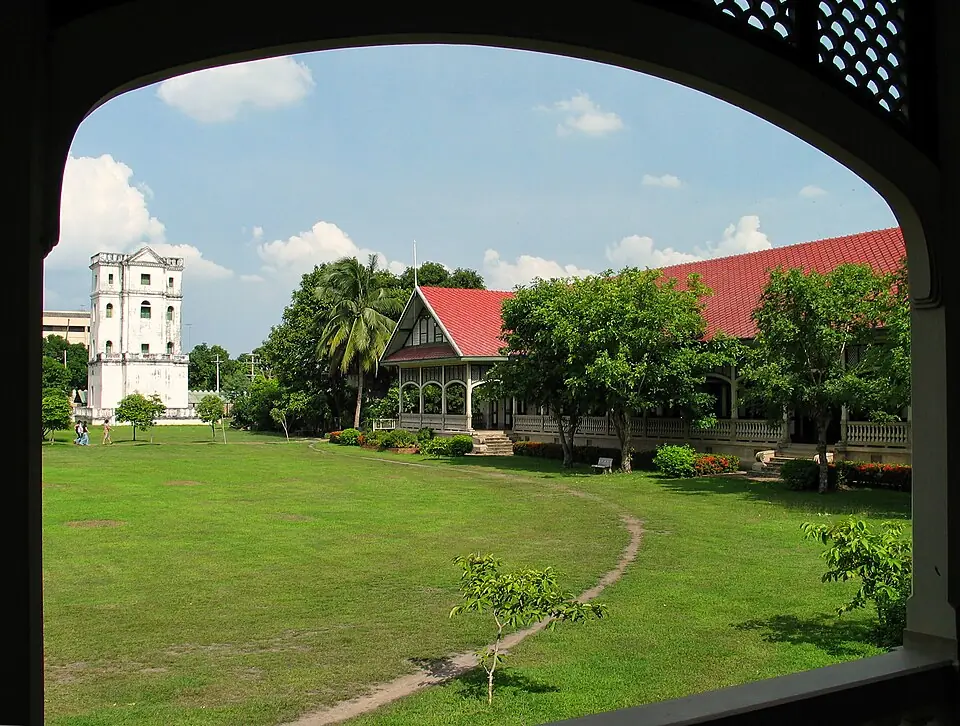
Around 1571, when he was about 16, he was made Uparat (viceroy and heir). He went to govern Phitsanulok and fought off Khmer armies on several occasions. Around 1577 King Maha Thammaracha had Chandra Kasem Palace, the Wang Na or Front Palace, built on Ayutthaya's city island as Naresuan's residence whenever he came down from Phitsanulok.
Declaring independence at Mueang Khraeng, 1584
In 1583 the city of Ava rebelled, and King Nanda Bayin summoned Naresuan to bring an army to help. According to the royal chronicles, the Hanthawaddy court planned for the Burmese Crown Prince to attack Naresuan's army by surprise. When the Thai army reached Mueang Khraeng in Mon country, around the sixth lunar month of 1584, Naresuan learned of the plan from the monk Phra Maha Thera Khanchong. He poured water from a golden ewer onto the ground and proclaimed that Ayutthaya had broken off its ties of friendship with Hanthawaddy.
As he withdrew, bringing Thai families back home with him, the Hanthawaddy army pursued him as far as the Sittaung River. The chronicles say that he fired a long gun across the river and killed Surakamma, the commander of the vanguard, and so the gun was named Phra Saeng Puen Ton Kham Maenam Sathong, 'the royal gun that shot across the Sittaung River'. This story comes from chronicles compiled later, so it should be read with a critical eye.
Defending the capital and coming to the throne (1584–1590)
After the declaration of independence, Hanthawaddy sent armies almost every year. In late 1584 the armies of Phraya Phasim and of Chiang Mai were driven back, and in 1585 Naresuan and Ekathotsarot routed the Chiang Mai army at Ban Sa Ket.
The largest campaign came in late 1586, when King Nanda Bayin himself led an army to besiege Ayutthaya. After about five months he had failed to take the city, and he withdrew in 1587. During the siege Chandra Kasem Palace served as the command post, and the chronicles tell of the daring raid on the enemy camp that gave rise to the name of the 'sword in the teeth' (Phra Saeng Dap Khap Khai).
When King Maha Thammaracha died in 1590, Naresuan came to the throne at about 35 years of age and made King Ekathotsarot his Uparat (viceroy and heir).
The elephant duel of 1593
In late 1592 King Nanda Bayin sent the Burmese Crown Prince (Mingyi Swa) at the head of another great army. The two sides clashed near Nong Sarai, in the territory of Suphanburi. According to the royal chronicles, the war elephants of Naresuan and Ekathotsarot charged into the middle of the enemy army. Naresuan called on the Crown Prince to come out and fight an elephant duel (yutthahatthi), then cut him down on the neck of his elephant, while Ekathotsarot defeated the lord of Chaparo.
The sources of the different sides do not agree. Burmese chronicles and some European records say the Crown Prince was killed by gunfire. Some historians, such as Barend Jan Terwiel (2013), think a formal challenge to an elephant duel is unlikely to have taken place. But all sides agree that the Crown Prince died in this battle and that the Hanthawaddy army had to retreat.
The Luang Prasoet Chronicle gives the date as Monday, the second day of the waning moon in the second lunar month of Chula Sakarat 954. This was once calculated as 25 January, but a later recalculation gives 18 January 1593. The year BE 2135 follows the old reckoning, in which the new year began in April; by today's count it would be BE 2136. Officially the battlefield is held to be at Don Chedi in Suphanburi province, but other sites have been proposed, such as Phanom Thuan district in Kanchanaburi province.
After the battle, the chronicles say, the king meant to punish the commanders who had failed to keep up with him, and Somdet Phra Phonnarat of Wat Pa Kaeo asked him to pardon them.
Expanding the realm and dealing with foreigners
After the victory at Nong Sarai, Ayutthaya went on the offensive. In 1593 Thai armies took Tavoy (Dawei) and Tenasserim (Tanintharyi), Naresuan marched on Longvek, the Cambodian capital, and several Mon towns switched their allegiance to Ayutthaya; in 1595 Chiang Mai submitted. He also led his armies as far as Hanthawaddy twice, around 1595–1596 and around 1599, but had to withdraw both times.
Abroad, Franciscan friars came and built a church in the Portuguese community in 1584, and Portuguese mercenaries fought in his wars. Around 1598 Spain sent an embassy from Manila to conclude a treaty of friendship and trade, and Dutch merchants of the VOC (the Dutch East India Company) were received at court in 1604, the start of Thai–Dutch relations.
Death at Mueang Hang, 1605
In 1605 Naresuan led an army north towards Ava. On the way he fell ill at Mueang Hang, and he died on 25 April 1605, aged about 50. Widely circulated Thai accounts say his illness was an abscess on his face. King Ekathotsarot reached him a few days before he died and afterwards escorted his body back to Ayutthaya.
Where Mueang Hang was is still debated. Some suggest it was in Fang district, some believe it was around Wiang Haeng district in Chiang Mai province, and the Tai Yai (Shan) people say it was in Shan State. Where his cremation took place in Ayutthaya is also still unresolved; read more in the article on Wat Worachettharam.
Legacy and Thai Armed Forces Day
Naresuan was given the title 'the Great' as the king who won back the kingdom's independence. His story is told in school textbooks, monuments and films, and has become part of Thailand's shared memory. Reading the evidence of several sides together does not diminish his importance; it helps us understand the history more fully.
Thai Armed Forces Day falls on 18 January in memory of the elephant duel. From 1980 it was held on 25 January; after the date was recalculated, the Cabinet resolved on 22 August 2006 to move it to 18 January.
Places linked to Naresuan in Ayutthaya
The following places are on this site's map, and each has its own article to read further.
- Chandra Kasem Palace (Wang Na, the Front Palace): his residence before he became king, and his command post in 1586
- Ancient Royal Palace: his residence throughout his reign, 1590–1605
- Wat Na Phra Men: linked to negotiations during the War of the White Elephant, according to the chronicles
- Wat Phu Khao Thong: King Bayinnaung's chedi, and the royal monument to Naresuan on the Phu Khao Thong Field
- Queen Suriyothai Chedi: a memorial to his grandmother
- Wat Worachettharam: the temple King Ekathotsarot built and dedicated to him, according to the Fine Arts Department sign
- Wat Yai Chai Mongkhon: Wat Pa Kaeo, the temple of Somdet Phra Phonnarat
- Baan Hollanda: the Dutch, who first made contact late in his reign
- Portuguese Settlement: the community whose soldiers fought alongside the Thais in this period
Where historians still disagree
- Was the elephant duel a formal challenge? The Thai royal chronicles say Naresuan called on his opponent to fight and the two elephants clashed, while Burmese chronicles and some European records say the Crown Prince was killed by gunfire. Some historians, such as Terwiel, think a formal duel is unlikely.
- The day and year of the elephant duel: it was first calculated as 25 January and later recalculated as 18 January 1593. The years BE 2135 and BE 2136 differ because of the old way of starting the new year (in April) versus the modern way (in January).
- The location of the Nong Sarai battlefield: officially it is held to be at Don Chedi in Suphanburi province, but some propose that it may lie in Kanchanaburi province, for example in Phanom Thuan district.
- Where Mueang Hang, the place of his death, was: proposals include the area of Fang district, the area of Wiang Haeng district in Chiang Mai province, and Shan State in Myanmar. A 2024 study based on the accounts of Tai Yai (Shan) people concludes that it was not Wiang Haeng.
- The details of the declaration of independence at Mueang Khraeng: an article in Silpa Wattanatham (Art & Culture) magazine asks whether some details may have been composed when the chronicles were revised in the Rattanakosin period.
- The site of the royal cremation: proposals include Wat Worachettharam on the city island, Wat Worachet outside the island (Wat Worachet Thep Bamrung) and Wat Sop Sawan. No inscription or other evidence settles the question.
Visiting information
- To follow in Naresuan's footsteps in a single day, try starting at Chandra Kasem Palace in the north-east of the city island, then head west to the Ancient Royal Palace and Wat Worachettharam.
- Ayutthaya's sun is strong almost all year round. Sightsee in the morning or late afternoon, and bring a hat, an umbrella and drinking water.
- Dress modestly when entering temples and ancient sites, and do not climb on chedis or the bases of ruins.
Frequently asked questions
Where was King Naresuan born?
He was born in 1555 at Chan Palace in Phitsanulok. His father was King Maha Thammaracha and his mother was Queen Wisutkasat.
When did the elephant duel take place?
The chronicles give the second lunar month of Chula Sakarat 954, which is BE 2135 by the old reckoning. Scholars have calculated that this corresponds to 18 January 1593.
Why is Thai Armed Forces Day on 18 January?
It commemorates the elephant duel. It used to be held on 25 January, but once the date was recalculated as 18 January, the Cabinet resolved in 2006 to change it.
Where did King Naresuan die?
He died on 25 April 1605 at Mueang Hang, while marching on Ava. But where Mueang Hang was is still debated: some place it in Chiang Mai province, others in Shan State in Myanmar.
- Naresuan - Wikipedia
- Battle of Nong Sarai - Wikipedia
- What led to the mistaken belief that the elephant duel fell on 25 January BE 2135 - Silpa Wattanatham (in Thai)
- What Happened at Nong Sarai? (B.J. Terwiel, Journal of the Siam Society, 2013)
- Mueang Hang: Where King Naresuan the Great Died, According to the Testimony of the Tai Yai - Journal of Humanities, Naresuan University (in Thai)
- The Life of King Naresuan the Great - TruePlookpanya (in Thai)
Last updated 10 November 2026