Home › Places › Wat Chaiwatthanaram
Wat Chaiwatthanaram: King Prasat Thong's Temple of Prangs on the Chao Phraya
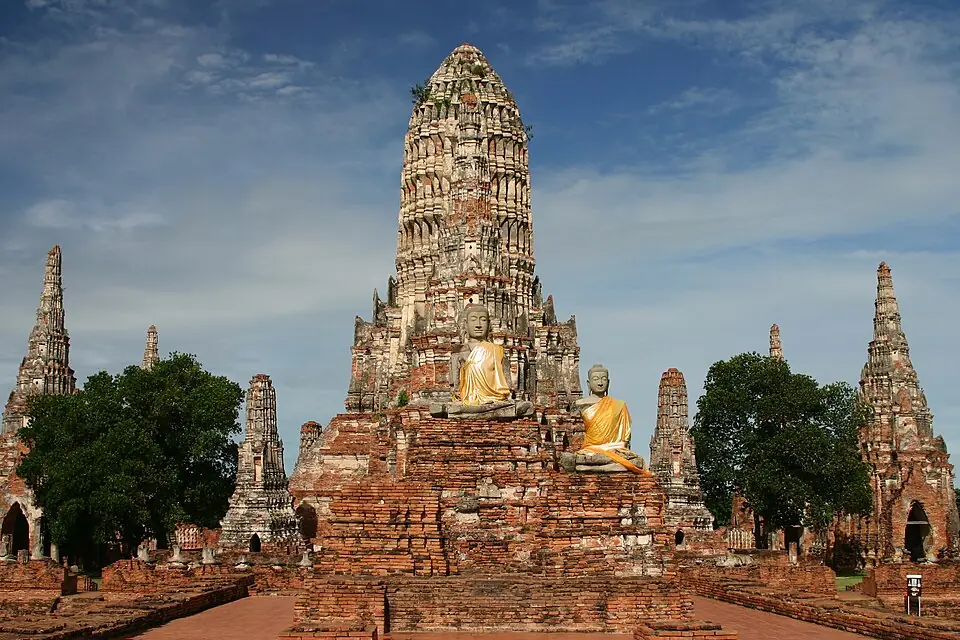
Wat Chaiwatthanaram is a great cluster of prangs (Khmer-style towers) on the west bank of the Chao Phraya River, outside Ayutthaya's city island. King Prasat Thong had it built in 1630. Its layout draws inspiration from Khmer art and models the universe as described in Buddhist cosmology. The temple was built about 25 years after Naresuan's time, which makes it a good example of how Ayutthaya's landscape changed from one era to the next.
This place through the eras
This temple did not yet exist.
This temple did not yet exist; it would be built in 1630, 25 years after Naresuan's death. Anyone passing this spot at the time would have seen only the riverbank.
King Prasat Thong had it built in 1630 on what is believed to have been his mother's former home. The main prang (Khmer-style tower) and the gallery are laid out as a model of Mount Meru, inspired by Khmer art.
Abandoned after the fall of the city.
Ayutthaya's most popular sunset viewpoint on the Chao Phraya River.
Background
King Prasat Thong (reigned 1629–1656) had Wat Chaiwatthanaram built in 1630, early in his reign; it is regarded as the first temple he founded after coming to the throne. Several versions of the royal chronicles, such as the Phan Chanthanumat (Choem) version and the Phra Chakkraphatdiphong (Chat) version, record its construction.
The temple stands on what had been the former residence of the king's mother. According to the Fine Arts Department's 3rd Regional Office in Phra Nakhon Si Ayutthaya, it was a royal temple of the forest-dwelling (araññavāsī) order of monks, and when it was completed the king appointed its abbot as a senior monk of that order.
There is more than one explanation for why it was built. Besides being dedicated to the king's mother and enhancing his prestige as a patron of Buddhism, Prince Damrong Rajanubhab suggested that it may also have commemorated a victory over Cambodia.
A layout that models the universe
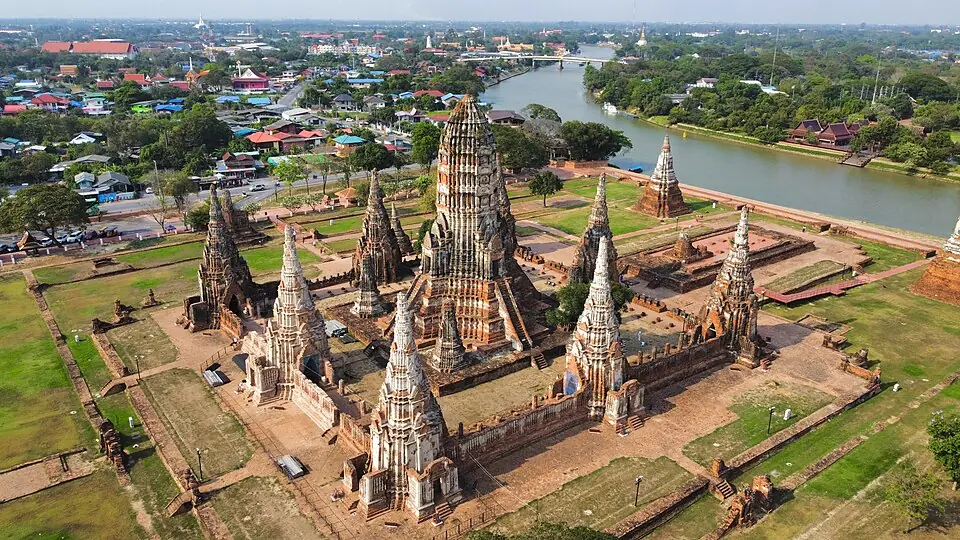
At the heart of the temple is the central prang, about 35 metres tall, standing on a large raised platform together with smaller prangs at its four corners. The central prang represents Mount Meru, the axis at the centre of the universe; Prof. Dr. Santi Leksukhum explains that the four corner prangs stand for the four continents.
The platform is enclosed by a square gallery (cloister), along which stand 8 meru towers at the cardinal points and the corners. Prof. Santi sees these merus as the wall that encircles the universe. Each meru once housed a crowned Buddha image, and the gallery was once lined with Buddha images in the posture of subduing Mara; most of these are now damaged.
Outside the gallery on the east side are the ubosot (ordination hall) and two more chedis with twelve indented corners. The whole temple is laid out on an east–west axis, facing east towards the river.
The return to a prang as the principal monument of a temple in this reign is seen as a revival of inspiration from Khmer art, and scholars regard this as the last large prang of the Ayutthaya period.
Why the temple didn't exist in Naresuan's time
King Naresuan died in 1605. Several more reigns followed, including those of King Ekathotsarot and King Songtham, and about 25 years passed before this temple was built. When you select Naresuan's era on the map, there are no prangs at all at this spot yet.
At that time this riverside land lay outside the city walls. Since it is recorded as the former residence of King Prasat Thong's mother, it was probably a residential area before the temple, but there is no clear evidence of what the houses of that period looked like.
This spot through the eras
This point on the map changed from riverside land into a royal temple, and then into a protected historic monument.
- Founding of the city (1351–1488): no temple yet; this was land on the west bank of the river, outside the city island.
- Naresuan's era (1548–1605): no temple yet. This area later became the home of King Prasat Thong's mother.
- King Narai's era (1656–1688): the temple had already stood for several decades, a royal temple on the river in the reign of its founder's son.
- Second fall of Ayutthaya (1767): the temple was destroyed along with the capital. Some suggest it may have been used as a strongpoint during the war. Afterwards it was abandoned; many Buddha images were beheaded and its bricks were carried off for reuse.
- Today: after a major restoration by the Fine Arts Department, it has been open to visitors since 1992, and it is one of Ayutthaya's most famous spots for watching the sunset.
From ruins to conservation
After lying abandoned for more than two centuries, excavation and clearing of the site began around 1958. From 1987 the Fine Arts Department restored it in phases, covering the central prang, the ubosot, the merus, the corner prangs, the walls, the stucco reliefs and the murals, and relocated houses that had encroached on the site. It was opened to the public in 1992.
On the north side of the platform are the bases of three chedis which, according to DASTA, are believed to have held the ashes of Prince Thammathibet (Chao Fa Kung), son of King Borommakot, together with Princess Sangwan and Princess Nim. This shows that the temple remained linked to the royal court until the last years of the kingdom.
The great flood of 2011 damaged the structures, which led to a 12-year conservation project (2012–2024) by the Fine Arts Department, the US government's Ambassadors Fund for Cultural Preservation (AFCP) and the World Monuments Fund. It included planning water management, building a flood wall and conserving the merus and the gallery, experimenting with doing without cement to reduce problems with damp and salt.
Visiting and watching the sunset
The temple is on the west bank of the river, opposite Siriyalai Palace, and can be reached from the city island by road or by boat. In the evening, looking from the front of the temple on the east side, the sun sets behind the cluster of prangs, silhouetting them against an orange sky. It is a hugely popular photo spot.
Evening events are often held towards the end of the year. For example, from late 2025 to early 2026 the Ministry of Culture held a night-time heritage event at this temple, with a light show and khon (masked dance-drama) performances. Check the latest schedule before you go.
The temple grounds are wide open with little shade, so bring water, a hat and an umbrella. If you come in Thai costume for photos, take care not to climb or sit on the monuments.
Where historians still disagree
- Why it was built: Fine Arts Department information stresses that it was built on the former residence of the king's mother, while Prince Damrong Rajanubhab suggested it commemorated a victory over Cambodia. Some sources also say she was the king's foster mother rather than his birth mother.
- How long construction took: the chronicles give 1630 as the year it was built, but some sources suggest that the whole complex may have taken many years to complete.
- Its role in the war of 1767: some have suggested, based on traces of reinforced walls and fragments of cannonballs, that the temple may have been used as a strongpoint, but there is no clear record to confirm this.
Visiting information
- Admission: THB 10 for Thai visitors, THB 80 for foreign visitors, at Fine Arts Department rates (as of 2025–2026); combined tickets covering several sites are also available
- Opening hours may differ when evening events are held, so check before you go.
- Arrive about an hour before sunset to give yourself time to walk around and choose your photo angle.
- Dress modestly, and don't climb or sit on the prangs or the Buddha images.
- Bring water, a hat and an umbrella, as the grounds are wide open with little shade.
Opening hours and admission fees may change, so please check before you go.
Frequently asked questions
Who built Wat Chaiwatthanaram, and when?
King Prasat Thong had it built in 1630, on the site of the former residence of his mother.
Is Wat Chaiwatthanaram connected with King Naresuan?
Not directly. The temple was built about 25 years after Naresuan's death; in his time there was no temple at this spot.
Why does Wat Chaiwatthanaram look like a Khmer temple?
Because its principal monument is a prang and its layout follows a cosmological plan inspired by Khmer art. Scholars regard it as the last large prang of the Ayutthaya period.
When is the best time to photograph Wat Chaiwatthanaram?
In the evening before sunset. Looking from the front of the temple on the east side, the sun sets right behind the cluster of prangs.
- Wat Chaiwatthanaram - Southeast Asian Art Database, Princess Maha Chakri Sirindhorn Anthropology Centre
- Wat Chaiwatthanaram and the Idea of the Wall of the Universe in the Ayutthaya Period - Silpa Wattanatham (in Thai)
- WAT CHAI WATTHANARAM - Ayutthaya Historical Research
- Wat Chaiwatthanaram - Designated Areas for Sustainable Tourism Administration (DASTA)
- 12-Year Wat Chaiwatthanaram Conservation Project Concludes - Thai Post (in Thai)
- Historical Park and Museum Fees - Ayutthaya Historical Research
Last updated 10 November 2026