Home › Places › Wat Tha Ka Rong
Wat Tha Ka Rong: The Riverside Temple That Became a Burmese Camp in the Fall of Ayutthaya
Wat Tha Ka Rong is a lively temple on the Chao Phraya River, west of Ayutthaya's city island. Many people know it for its floating market and for the Buddha image that worshippers come to ask for blessings. In history, though, the temple's name appears in the royal chronicles during the saddest chapter of the Ayutthaya kingdom, when the Burmese army camped here during the siege of the capital in 1767.
This place through the eras
The temple did not yet exist. The National Office of Buddhism's temple register dates its founding to 1732, in the late Ayutthaya period.
According to the temple register, the temple was built about 130 years after Naresuan's time. Some travel materials say the Burmese army camped here in the White Elephant War (1563–1564), the war in which Naresuan was taken to Hanthawaddy, but researchers who have checked the royal chronicles have found no passage to support this.
According to the temple register, the temple did not yet exist. Some say its octagonal bell tower is in King Narai-period style, which, if true, would mean a religious building may have stood here before the registered date, but there is no confirming evidence yet.
The royal chronicles relate that in the final siege, Burmese troops under Ne Myo Thihapate pushed forward and set up several camps around the capital, one of them at Wat Tha Ka Rong, complete with cannon. The Siamese sent out a volunteer flotilla to attack the camp, but it failed.
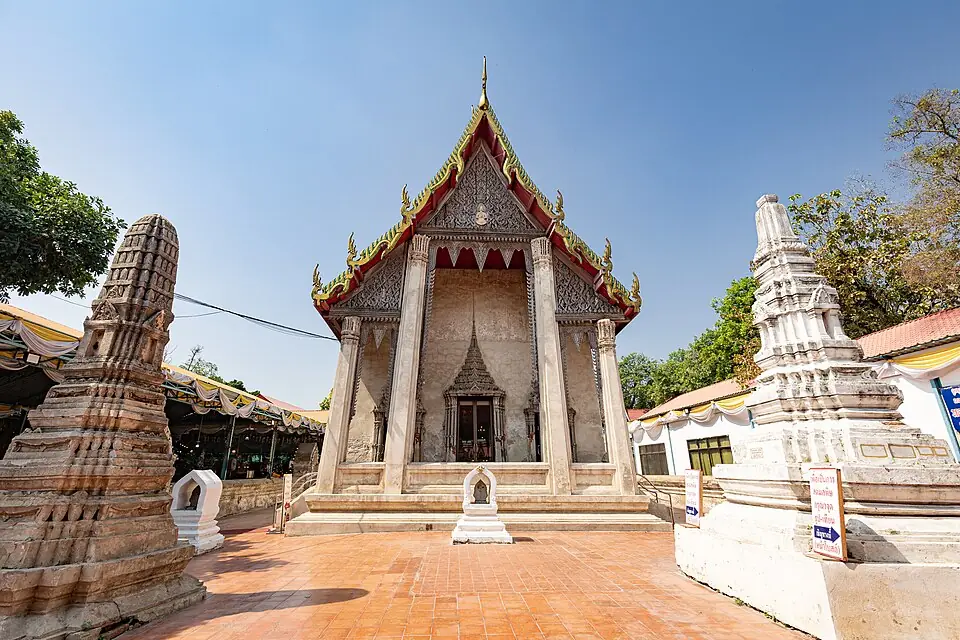
A busy temple. The ubosot (ordination hall) houses Luang Pho Yim (Phra Phuttha Rattana Mongkhon), and a floating market runs on the riverbank on weekends and holidays. A popular stop for visitors on the west side of the city island.
Origins and name
According to the temple register of the National Office of Buddhism, Wat Tha Ka Rong was built in 1732, in the late Ayutthaya period, and received a royal grant of land for its ordination hall (wisungkhamsima) in 1742. No document has been found that names its founder.
The temple stands on the riverbank on the western side of the capital, close to the point where several waterways meet, which made it a good position for controlling the boat routes on the north side of the capital. It was this geographic advantage that later turned the temple into an enemy camp.
In the English translation of the royal chronicles, the temple's name is rendered literally as a temple of crows crying out, matching the meaning of the Thai words ka (crow) and rong (to cry out).
The Burmese camp in the fall of Ayutthaya, 1767
Toward the end of the siege of Ayutthaya, the royal chronicles relate, Ne Myo Thihapate, the Burmese commander-in-chief, ordered his army to advance and set up several camps around the capital. One of these camps was at Wat Tha Ka Rong, where cannon were also positioned to put pressure on the city.
Wat Tha Ka Rong was not the only temple used this way. In the same period, the Burmese also placed cannon at Wat Na Phra Men, north of the city island. This shows that the riverside temples around the capital, with their wide grounds and closeness to the city walls, served as firing bases for bombarding the city from several directions, while the people of Ayutthaya were trapped under siege on the city island.
Prince Damrong Rajanubhab's history Thai Rop Phama (Our Wars with the Burmese) relates that the Siamese sent a flotilla manned by the six volunteer corps to attack this camp. A soldier performing a sword dance at the bow of a boat was shot and fell into the water, and the Siamese flotilla had to turn back. Not long afterwards, in April 1767, Ayutthaya fell to the Burmese.
Is it connected with King Naresuan?
There is no evidence that Wat Tha Ka Rong had any connection with King Naresuan the Great. According to the temple register, it was built about 130 years after his reign.
Some travel materials, however, say that this area was the camp of the Burmese army in the White Elephant War of 1563–1564, the war that led to the young Naresuan being taken to live at Hanthawaddy. Researchers who have checked the royal chronicles have not yet found any passage that supports this, so it should be treated as an unconfirmed story.
Wat Tha Ka Rong through the eras
The same spot on the map, in different eras
- Early Ayutthaya (1351–1488): the temple did not yet exist, according to the temple register
- Naresuan's era (1548–1605): no temple yet, according to the temple register; the story of a Burmese camp in the White Elephant War has no supporting evidence
- King Narai's era (1656–1688): still no temple, according to the register, although some say the bell tower is in the style of this period
- The fall of Ayutthaya in 1767: a Burmese camp and cannon position; the Siamese attacked it without success
- Today: a busy temple with a floating market and people coming to pay respects to the Buddha
What to see and visiting
The ubosot (ordination hall) houses the principal Buddha image, Luang Pho Yim, also known as Phra Phuttha Rattana Mongkhon. The temple also has an octagonal brick-and-stucco bell tower, which some say is in King Narai-period style, while most of the other buildings were probably built or rebuilt after the fall of the city.
On the riverbank, a floating market is held on weekends and holidays, with food and souvenirs sold from rafts. It is at its liveliest from late morning into the afternoon. Check the latest opening days before you go, as markets like this may change their days and hours with the season.
Where historians still disagree
- A Burmese camp in the White Elephant War: some travel materials say the temple grounds were a Burmese camp in 1563, but researchers who have checked the royal chronicles have not found any supporting passage, and some English-language sources even name King Tabinshwehti, who had already died before the White Elephant War.
- Age of the temple: the temple register gives 1732, but some sources believe a temple stood here earlier, and some say the bell tower is in King Narai-period style. There is no decisive evidence yet.
Visiting information
- It gets crowded on weekends and holidays; come in the morning if you want to pay your respects in peace
- Dress modestly when entering the ordination hall
- Check the floating market's opening days before you travel
Frequently asked questions
When was Wat Tha Ka Rong built?
The temple register says it was built in 1732, in the late Ayutthaya period, and received a royal land grant for its ordination hall in 1742.
Did the Burmese really camp at Wat Tha Ka Rong?
Yes, during the fall of Ayutthaya in 1767, as recorded in the royal chronicles. As for a Burmese camp here in the White Elephant War of 1563, no supporting evidence has been found.
Is Wat Tha Ka Rong connected with King Naresuan?
There is no evidence of a link. According to the temple register, the temple was built about 130 years after his reign.
Last updated 10 November 2026