Home › Places › Wat Lokayasutharam
Wat Lokayasutharam: The Largest Open-Air Reclining Buddha on Ayutthaya's City Island
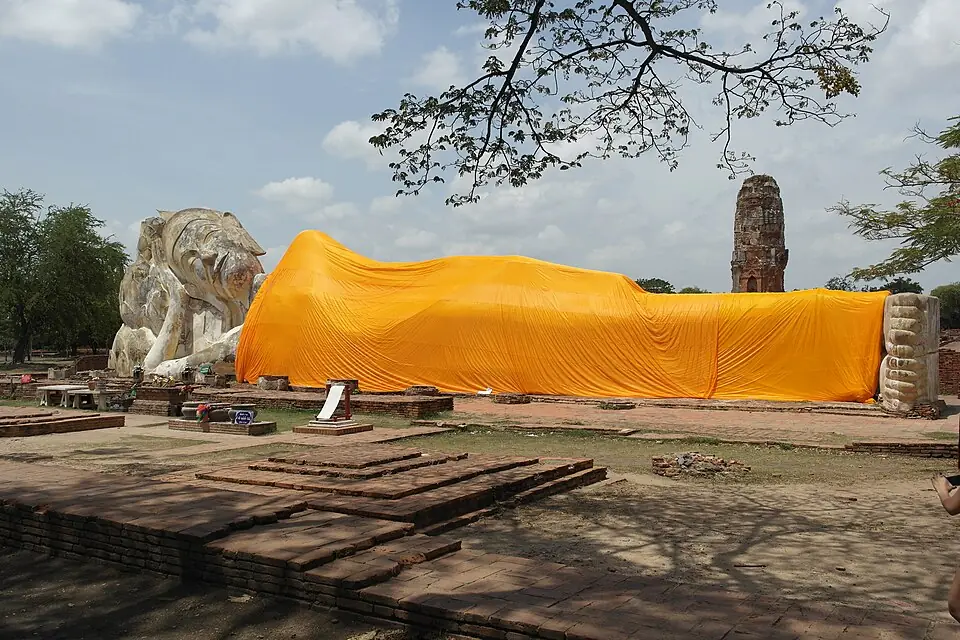
Wat Lokayasutharam is a ruined temple in the northwest of Ayutthaya's city island, behind the Ancient Royal Palace. Its highlight is a colossal brick-and-stucco reclining Buddha lying in the open air, the largest reclining Buddha on the city island. There is no record of who built the temple or when, but its art style and old maps let us trace its story era by era.
This place through the eras
There is no clear evidence of this temple yet, but the slate boundary stones (sema) found here are in Early Ayutthaya style, so a religious site may already have stood in this area.
From the raised arm supporting the head, scholars date the reclining Buddha to Middle Ayutthaya, so the temple probably already existed or was being built in this era. It lies behind the Ancient Royal Palace, where Naresuan came to the throne (1590), but no events at the temple are recorded in his reign. Wat Worachettharam, next door to the north, was built in 1605 in Naresuan's honour, according to the Fine Arts Department sign.
The temple is still in use. Kaempfer's map, surveyed in 1690, a few years after King Narai's death, shows three building spires and a small canal branching off to end just south of the temple.
The temple was abandoned along with the city after its fall. The great wihan (assembly hall) that once sheltered the reclining Buddha later collapsed, leaving only its octagonal pillars.
A restored historic site. The Fine Arts Department excavated it around 1954, repaired the reclining Buddha in 1956 and restored it again in 1989. The Buddha lies in the open air and is a popular stop.
Origins and name
Wat Lokaya Sutha lies within Ayutthaya Historical Park, behind the Ancient Royal Palace and Pratu Chai School. It is one of a group of restored ruins that sit close together, along with Wat Worachettharam and Wat Rakhang. No inscription or chronicle has been found that names its builder or the year it was built, so the temple's history has to rely mainly on the evidence of its art and of old maps.
The Ayutthaya provincial tourism website suggests the temple was built in the Middle Ayutthaya period. The researcher behind ayutthaya-history.com points out that the reclining Buddha is probably Middle Ayutthaya work, while some of the chedis (bell-shaped stupas) and prangs (Khmer-style towers) show Late Ayutthaya features. This suggests the temple stayed in use and was repaired and added to over several periods.
The temple's name is spelled slightly differently in documents from different periods. Old 19th-century maps write "Wat Lokay Sutha", while Phraya Boran Ratchathanin's map of 1926 writes "Wat Lok Sutha". Today it is usually called Wat Lokaya Sutha or Wat Lokayasutharam. No one has yet been able to explain for certain where the name comes from.
The great open-air reclining Buddha
The temple's reclining Buddha is built of brick covered in stucco. Its head points north, its face looks west, and its feet are to the south. Instead of a pillow, the head rests on a lotus flower. Sources disagree on its length: some say 37 metres, others 42 metres. All agree, however, that it is about 8 metres high.
Scholars use the raised arm propping up the head as one clue to its date, because this is a form found in Middle Ayutthaya work, around 1488–1629. The face you see today, however, may have been altered during modern restoration, so it should not be used on its own as evidence for dating.
Around the image stand 24 octagonal brick pillars, showing that a large wihan (assembly hall) once roofed over the reclining Buddha. There is no evidence of when the hall collapsed.
Modern care of the reclining Buddha began around 1954, when the Fine Arts Department, together with a liquor distillery that once stood in this area, excavated the site. In 1956 the reclining Buddha was repaired under the government of Field Marshal Plaek Phibunsongkhram, and in 1989 the Thamrongnawasawat family restored it again in memory of Luang Thamrong Nawasawat, a former prime minister.
How it connects to the age of King Naresuan
No document has been found that mentions Wat Lokaya Sutha during the reign of King Naresuan the Great (r. 1590–1605), so it should not be said that he built or visited this temple. Even so, if dating the reclining Buddha to Middle Ayutthaya is correct, the temple probably already existed, or was being built, during his lifetime.
What puts this temple on the Naresuan trail is its neighbour to the north, Wat Worachettharam, which the Fine Arts Department sign says King Ekathotsarot built in 1605 in honour of his elder brother. Most visitors therefore see the two temples one after the other, and get a picture of the area behind the palace in the years when Naresuan lived at the Ancient Royal Palace.
Wat Lokayasutharam through the eras
See how this spot on the map changes as you move through each era.
- Founding of the capital (1351–1488): There is no clear evidence of this temple yet, but the slate boundary stones (sema) found here are in Early Ayutthaya style, so a religious site may already have stood in this area.
- Naresuan's era (1548–1605): The reclining Buddha was probably built during Middle Ayutthaya. The temple lies behind the Ancient Royal Palace, where Naresuan came to the throne, but no events at the temple are recorded in this era.
- King Narai's era (1656–1688): The temple is still in use. Engelbert Kaempfer's map, surveyed in 1690, a few years after King Narai's death, shows three building spires and a small canal branching off to end just south of the temple.
- Fall of Ayutthaya (1767): The temple was abandoned along with the city. The hall sheltering the reclining Buddha later collapsed, leaving only its pillars.
- Today: A restored historic site. The reclining Buddha lies in the open air and is a popular stop for visitors to Ayutthaya.
What to see
Besides the reclining Buddha, take a walk around the grounds and you will see traces of a large temple that once had several buildings laid out along an east–west axis.
- The reclining Buddha: stand in front of the image on its west side for a clear view of the face and the lotus flower supporting the head.
- The octagonal brick pillars of the former wihan, which help you picture the reclining Buddha once lying under a roof.
- The remains of the main prang and the gallery (cloister) on the east side, laid out to represent Mount Meru in a Khmer-influenced plan.
- A Lanna-style chedi northwest of the reclining Buddha, with an indented-corner base and niches for Buddha images.
- Early Ayutthaya slate boundary stones (sema), a clue that this area may have been sacred ground for a long time.
Getting there and visiting
Wat Lokaya Sutha is behind the Ancient Royal Palace. You can reach it from Khlong Tho Road on the west side of the palace, or from U Thong Road on the west side of the island. It is not far from Wat Phra Si Sanphet and easy to reach by bicycle or tuk-tuk.
Most people combine it with neighbouring Wat Worachettharam and Wat Rakhang. Because the reclining Buddha lies in the open with no roof, mornings and late afternoons are cooler and give the best light for photos.
Where historians still disagree
- Length of the reclining Buddha: sources give different figures, both 37 metres and 42 metres, perhaps because they measured from different points or copied one another. The height of about 8 metres is consistent.
- Age of the temple: the provincial tourism website suggests it was built in Middle Ayutthaya. Some scholars see the reclining Buddha as Middle Ayutthaya work, but some chedis as Late Ayutthaya and the boundary stones as Early Ayutthaya, so the temple was probably built and added to over several periods.
- The present face: some have observed that the head may have been reworked during the 1956 restoration, so the face should not be used as evidence for dating.
Visiting information
- The reclining Buddha is in the open air, so bring a hat, an umbrella and drinking water.
- Dress modestly and do not climb on the Buddha image or the bases of the ruins.
- If you wish to offer flowers, incense or candles, use the area set aside for this.
Frequently asked questions
How long is the reclining Buddha at Wat Lokayasutharam?
Sources differ: some say 37 metres, others 42 metres. It is about 8 metres high and is considered the largest reclining Buddha on Ayutthaya's city island.
When was Wat Lokayasutharam built?
No record of the year it was built has been found. From the style of the reclining Buddha, scholars suggest it is Middle Ayutthaya work, and the temple was repaired and added to in later periods.
Is Wat Lokayasutharam connected to King Naresuan?
No direct evidence links them, but the temple stands next to Wat Worachettharam, which the Fine Arts Department sign says was built in Naresuan's honour, so the two are usually visited together.
Last updated 10 November 2026