Home › Places › Wat Samana Kot
Wat Samana Kot: A Five-Spired Chedi and the Puzzle of Chaophraya Kosa's Temple
Wat Samana Kot (in full, Wat Samana Kottharam) is an active temple in the old-temple district east of Ayutthaya's city island. Its highlight is an unusual main structure with five spires rising from a single base. The temple is often said to have been the family temple of two brothers who were leading nobles under King Narai, Chaophraya Kosathibodi (Lek) and Chaophraya Kosathibodi (Pan), but the evidence for this is not very strong.
This place through the eras
Excavations found that the main chedi was built over an early Ayutthaya-period chedi, and one bell-shaped chedi at the temple may date back to around the late 13th to mid-15th centuries, so there was probably already a temple here, though its name and founder are unknown.
Excavations suggest that the main chedi seen today was built late in the middle Ayutthaya period (c. 1488–1629), which overlaps with Naresuan's era, but there is no record of who built it or of any event at this temple during his reign.
The Fine Arts Department's information sign and local documents say that Chaophraya Kosathibodi (Lek) restored this temple in King Narai's reign and that it was known as Wat Phraya Phra Khlang, but some researchers think Wat Phraya Phra Khlang was probably a different temple in the same area.
An old document describing the topography of Ayutthaya lists this temple as one of five temples with a great relic chedi. The many redented corners of the chedi's base point to repairs late in the Ayutthaya period, perhaps in the reign of King Borommakot.
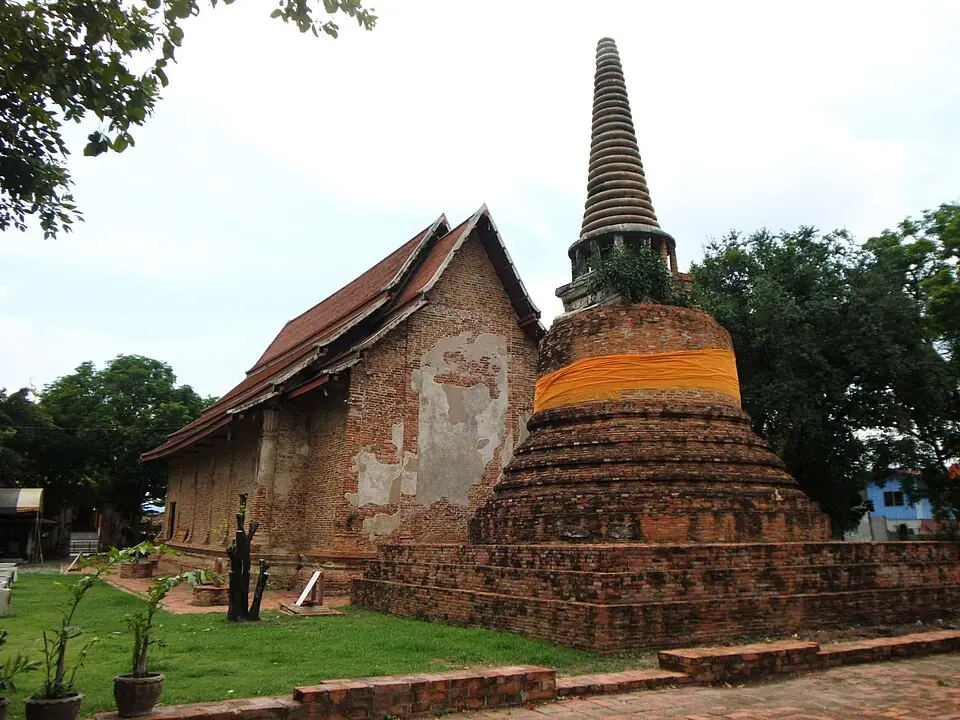
Still an active temple with monks. The ruins include a five-spired main chedi on a square base, a Sri Lankan-style chedi, and an ubosot (ordination hall) restored once more after the great flood of 2011.
Origins
No document says who built Wat Samana Kot or when. The best evidence comes from archaeological excavation, which found that the main chedi was built over an older chedi from the early Ayutthaya period, and that one bell-shaped chedi at the temple may date back to around the late 13th to mid-15th centuries. The temple therefore probably existed from the early days of Ayutthaya.
The royal chronicles do not mention this temple, but a document describing the topography of Ayutthaya, compiled after the fall of the city, lists it as one of five temples that had a great relic chedi (phra maha that), which shows that it was once an important temple of the eastern district. The temple received a royal land grant for its ordination hall (wisungkhamsima) in 1910, and monks still live in the monastic quarters south of the ruins.
Was it really the temple of Kosa Lek and Kosa Pan?
The information sign at the temple and the provincial tourist information centre state that Chaophraya Kosathibodi (Lek) restored this temple in the reign of King Narai, after returning from the Chiang Mai campaign of 1662, and that at the time it was known as Wat Phraya Phra Khlang (the Phra Khlang being the minister in charge of the treasury and trade). Later his younger brother, Chaophraya Kosathibodi (Pan), who served as ambassador to France, continued to support the temple, which is why it is believed to have been the family temple.
The same information also mentions the royal cremation in 1690 of the brothers' mother, who had been King Narai's wet nurse, which King Phetracha attended, and the German physician Kaempfer also recorded a funeral in the Phra Khlang's family that he witnessed that year.
However, some researchers who have examined the maps and Kaempfer's account in detail think that the Phra Khlang's temple mentioned by foreigners was probably another temple in the same area, such as Wat Pradu or Wat Rong Tham, and some sources link that funeral to Wat Choeng Tha instead. The belief that this was the Kosa family's temple should therefore be read with caution.
An unusual main chedi
The main structure stands on a square base, with a large central spire and four smaller spires at the corners, a five-spired layout that symbolises Mount Meru. The temple's sign calls it a prang (Khmer-style tower), but some scholars think it has more the character of a chedi. Some have compared it with Wat Chet Yot in Chiang Mai, although that comparison is also disputed.
The lower base has twenty redented corners and the upper base twelve. This has led scholars to suggest a major repair late in the Ayutthaya period, perhaps in the reign of King Borommakot. To the east stands a Sri Lankan-style bell-shaped chedi on a three-tiered base, while the wihan (assembly hall) survives only as a brick base, part of which now lies under the road.
Is it connected with King Naresuan?
No chronicle or contemporary record links this temple with King Naresuan the Great. What can be said is that excavations indicate the present main chedi was built late in the middle Ayutthaya period, a broad span that also covers his era, but it is not known in which reign it was built.
Researchers report that the information sign at the temple once stated that Chaophraya Kosa Lek went on the Chiang Mai campaign in Naresuan's reign. This is a mistake, because the campaign of 1662 took place in the reign of King Narai, so readers who come across statements like this should always check the dates.
Wat Samana Kot through the eras
The same spot on the map, across five eras
- Early Ayutthaya (1351–1488): an early Ayutthaya-period chedi already stood here, but the temple's name is unknown
- Naresuan's era (1548–1605): the main chedi may have been built within this broad period; no events are recorded
- King Narai's era (1656–1688): the temple's sign says Chaophraya Kosa Lek restored it, but this is still debated
- The fall of Ayutthaya in 1767: one of five temples with a great relic chedi, according to the topographical document; probably abandoned after the city fell
- Today: an active temple alongside restored ruins
Visiting
The temple is open to visitors free of charge. The ubosot was restored in the late 20th century and again after the great flood of 2011, and the top of the main chedi has been well repaired. The temple is close to Wat Kudi Dao, Wat Maheyong and Wat Ayothaya, so it fits well into a half-day route around the temples on the eastern side.
Where historians still disagree
- The Kosa family's temple: the temple's sign and provincial information say that Chaophraya Kosa Lek and Kosa Pan restored this temple, but some researchers think the Wat Phraya Phra Khlang recorded by foreigners was more likely Wat Pradu or Wat Rong Tham.
- Prang or chedi: the Fine Arts Department sign calls the main structure a prang, while some consider it a five-spired chedi.
- Model for the five-spired layout: some have suggested it was modelled on Wat Chet Yot in Chiang Mai, but others disagree.
- Map location: sources give coordinates about 400 m apart, so the point on this map is an approximate location.
Visiting information
- Admission: Free admission (as of 2026)
- Dress modestly, as monks still live at the temple
- Do not climb the chedis or the bases of the ruins
- You can continue on to nearby Wat Kudi Dao and Wat Maheyong
Opening hours and admission fees may change, so please check before you go.
Frequently asked questions
Who built Wat Samana Kot?
The builder is unknown. Excavations found an early Ayutthaya-period chedi beneath the main chedi, while the claim that Chaophraya Kosa Lek restored the temple in King Narai's time is still debated.
How is Wat Samana Kot connected with Kosa Pan?
The temple's sign says it was supported by the family of Chaophraya Kosa Lek and Kosa Pan, but some researchers think the Phra Khlang's temple was probably a different one.
Is Wat Samana Kot connected with King Naresuan?
No direct evidence of a link has been found. References to Naresuan on some information signs are probably a mix-up with King Narai's reign.
Last updated 10 November 2026