Home › Places › Chandra Kasem Palace
Chandra Kasem Palace (Wang Na): King Naresuan's Palace in Ayutthaya
Chandra Kasem Palace, which people in Ayutthaya call Wang Na (the Front Palace), was built around 1577 as a residence for Naresuan whenever he came down from Phitsanulok. It later became the palace of several viceroys, was abandoned after the fall of the city, and was revived under King Rama IV, eventually becoming today's Chandra Kasem National Museum.
This place through the eras
There was no palace here yet. According to studies of the city walls, in the city's early years this corner of the island was higher ground outside the walls, and the eastern wall still ran further west, away from the riverbank.
After the first fall of Ayutthaya (1569), King Maha Thammaracha saw this corner as a weak point that the enemy had used to close in on the capital, so around 1577 he had a fortified palace built here as Naresuan's residence and extended the city wall out to the riverbank (the chronicles record the year 1580). Whenever Naresuan came down to stay in Ayutthaya, he oversaw the defence of this corner of the city, and he used the palace as his command post when King Nanda Bayin besieged the city in 1586. When Naresuan came to the throne (1590), the palace became the residence of his younger brother, King Ekathotsarot, and from then on the palace of the viceroys.
King Narai lived in this palace for several years as viceroy before he came to the throne (1656). In this reign the palace was named Wang Bowon Sathan Mongkhon, and the post of viceroy later came to be called after the palace: Krom Phra Ratchawang Bowon Sathan Mongkhon.
When the Burmese besieged the city, the walls in this area were breached. The palace bore the brunt of the fighting, was burned to ruins and then abandoned. Later, bricks from the old capital were carried off to build Bangkok (under Kings Rama I–III).
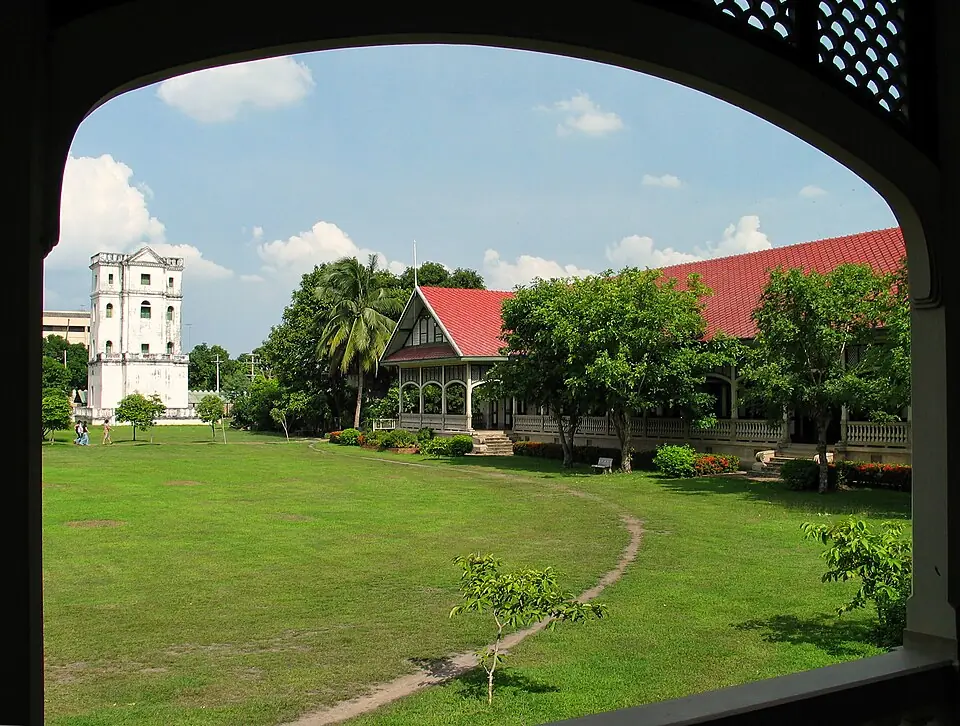
King Rama IV rebuilt it on the old building foundations (from c. 1851) as a residence for his visits to Ayutthaya, and gave it the name Chandra Kasem. Today it is Chandra Kasem National Museum; highlights are the Chaturamuk Pavilion and the Phisai Sanlak tower (an observation tower).
The origins of Chandra Kasem Palace
Around 1577, in the reign of King Maha Thammaracha, the king ordered a new palace to be built in the north-east corner of the city island, where the front moat, known as Khu Khue Na, met the river. It was to be the residence of his son Naresuan whenever he came down from Phitsanulok.
Because this palace stood in front of the royal palace, it was called Wang Na, the Front Palace, and it later became the official residence of the viceroy, a post commonly called Krom Phra Ratchawang Bowon Sathan Mongkhon. The name Chandra Kasem was given much later by King Rama IV.
Around 1580 the city wall on this side was extended out to the riverbank, as recorded in the Luang Prasoet Chronicle, so that the Front Palace was tightly enclosed by the city walls.
Its link to King Naresuan
Chandra Kasem Palace was built specifically for Naresuan, at a time when he was still the viceroy governing Phitsanulok and Ayutthaya was still a vassal of Hanthawaddy. Whenever he came down to Ayutthaya, he stayed at this palace.
After the declaration of independence in 1584, Hanthawaddy sent armies against Ayutthaya many times. The largest campaign came when King Nanda Bayin himself led an army to besiege Ayutthaya from late 1586, for about five months. During that time Naresuan used Chandra Kasem Palace as his command post, because it was close to the northern and eastern walls, where the enemy had set up camps right up against the city.
When Naresuan came to the throne in 1590 and moved to the royal palace, King Ekathotsarot, who was appointed viceroy, took up residence in this Front Palace.
The Front Palace after Naresuan's reign
From then on the Front Palace was the residence of the viceroy in almost every reign. Altogether eight kings and viceroys lived in this palace, among them King Narai the Great, who lived here for several years before coming to the throne.
Late in the Ayutthaya period the Front Palace was badly damaged by a great fire around 1744 and was rebuilt. When the city fell in 1767, the palace was burned and abandoned, leaving only fragments of walls and building foundations. Later, large quantities of brick from the ruined city were carried off to build Bangkok.
The palace revived in the Rattanakosin period
Around 1851 King Rama IV ordered a new palace to be built on the old site as a residence for his visits to the old capital, and named it Chandra Kasem Palace. The buildings put up at that time include the palace walls, the Phiman Rattaya group of royal halls, the Chaturamuk Pavilion and an observation tower called the Phisai Sanlak Hall.
Under King Rama V the Phiman Rattaya halls served as the offices of the Krung Kao administrative region (monthon). Later Prince Damrong Rajanubhab advised Phraya Boran Ratchathanin to gather antiquities in the palace, which became a museum of antiquities around 1902, before the Fine Arts Department raised it to the status of Chandra Kasem National Museum in 1936.
Under King Rama VI a clubhouse for the Wild Tiger Corps was built near Hua Ro Market; today it serves as the museum's storeroom and workshop. The palace buildings received an award for architectural conservation in 1994.
Chandra Kasem Palace through the eras
If you move through the map era by era, this spot changes a great deal, as follows.
- Founding era (1351–1488): this palace did not yet exist, and the evidence found so far does not show clearly what this corner of the city island was used for.
- Naresuan's era (1548–1605): the palace was built c. 1577 as Naresuan's residence and served as his command post in 1586. It later became the palace of King Ekathotsarot.
- King Narai's era (1656–1688): it was the viceroy's palace, and King Narai lived here before coming to the throne. The base of the observation tower seen today is believed to be an original base from this period.
- The fall of 1767: the palace was burned and abandoned, leaving only fragments of walls and building foundations.
- Today: Chandra Kasem National Museum, with buildings from the reign of King Rama IV standing on the site of the old palace.
What to see
Although most of the buildings you see were built in the Rattanakosin period, they stand on the plan and wall lines of the Ayutthaya-period Front Palace, so walking around helps you picture Naresuan's palace more closely.
- Chaturamuk Pavilion: a timber building on a brick-and-stucco base that was King Rama IV's residence and audience hall, and has displayed antiquities since the museum's early days.
- Phiman Rattaya halls: a group of four buildings that were King Rama IV's residence and once housed the offices of the Krung Kao administrative region.
- Phisai Sanlak Hall: a four-storey tower about 22 metres high that blends Thai, Chinese and Western styles, built for stargazing through a telescope.
- Galleries of antiquities: Buddha images, sculpture and art objects found in Ayutthaya and the surrounding area.
- Palace wall lines: traces of the walls that marked the boundary of the Front Palace.
Getting there and visiting
Chandra Kasem Palace is in the north-east corner of the city island, near Hua Ro Market and the Pa Sak River. From the historical park area in the west it is easy to reach by car or bicycle, and many visitors stroll on to Hua Ro Market after seeing the palace.
Inside there are exhibition buildings and wide lawns. Allow at least one to two hours, and check the latest opening days and times before you go, because the museum is closed on some days of the week and on public holidays.
Where historians still disagree
- The year the palace was built is given only as around 1577, following the royal chronicles; no inscription confirming the exact year has been found.
- Sources disagree on the year in which King Rama V had the palace used as the offices of the Krung Kao administrative region.
Visiting information
- Opening hours: Wednesday–Sunday 09:00–16:00; closed Mondays, Tuesdays and public holidays (2025 information; check before you go)
- Dress modestly, as this is a former royal palace and a state museum.
- Visit in the morning before it gets too hot, then carry on to Hua Ro Market nearby.
- Do not touch the antiquities, and ask staff before taking photos in the galleries.
Opening hours and admission fees may change, so please check before you go.
Frequently asked questions
What is Chandra Kasem Palace?
It was the Front Palace of Ayutthaya, built around 1577 as a residence for King Naresuan. It later became the viceroy's palace, and today it is Chandra Kasem National Museum.
Why is it called the Front Palace?
Because it stood in front of the royal palace, and it later became the residence of the viceroy, a post known as Krom Phra Ratchawang Bowon Sathan Mongkhon or simply Wang Na, the Front Palace.
Where does the name Chandra Kasem come from?
It was given by King Rama IV when he had the palace rebuilt on the old site around 1851.
When is Chandra Kasem National Museum open?
Information for 2025 says it is open Wednesday to Sunday, 09:00–16:00, and closed on Mondays, Tuesdays and public holidays. Check with the Fine Arts Department before you go.
Last updated 10 November 2026