Home › Places › Wat Senasanaram
Wat Senasanaram: the Thammayut temple behind Chandra Kasem Palace and the Phra In Plaeng Buddha from Vientiane
Wat Senasanaram Ratchaworawihan stands in the north-eastern corner of Ayutthaya's city island, behind Chandra Kasem Palace, which was once the residence of King Naresuan the Great. The temple was rebuilt in the reign of King Mongkut (Rama IV) on the site of Wat Suea, a temple of the Ayutthaya period, and it was the first Thammayut temple in Ayutthaya. Inside is the Phra In Plaeng, a bronze Buddha image brought from Vientiane.
This place through the eras
No evidence yet of a temple here. In the early years of the capital this corner of the island still lay outside the line of the original city wall.
No firm evidence yet that Wat Suea existed in this era, but the spot lies right behind Chandra Kasem Palace, built c. 1577 as King Naresuan's residence and used as his command post when King Nanda Bayin besieged the capital in 1586.
No firm evidence yet about a temple here in this era. The neighbouring Front Palace was King Narai's residence before he came to the throne, and the palace of the Maha Uparat (the viceroy).
In the Ayutthaya period a temple called Wat Suea stood here. After the city fell in 1767 it was abandoned.
King Rama IV built a new temple on the site of Wat Suea, completed in 1863, and named it Senasanaram. It was Ayutthaya's first Thammayut temple, and it houses the Phra In Plaeng Buddha brought from Vientiane and murals from the reign of King Rama V.
From Wat Suea to Wat Senasanaram
Before it became Wat Senasanaram, this site was an Ayutthaya-period temple called Wat Suea. Both an article in Post Today and the information compiled by ayutthaya-history.com give this name, but no evidence has been found of when Wat Suea was built. All that is known is that it was abandoned after the fall of the capital in 1767.
King Mongkut (Rama IV), who had Chandra Kasem Palace rebuilt as a residence for his visits to Ayutthaya, also had a new temple built on the site of Wat Suea. The work was completed in 1863, and the king named it Wat Senasanaram.
This was the first temple in Ayutthaya to belong to the Dhammayuttika Nikaya, the order that King Rama IV founded while he was still a monk. The temple's gateways therefore resemble those of Thammayut temples in Bangkok such as Wat Ratchabophit and Wat Ratchapradit.
What is its connection with King Naresuan?
No document has yet been found that links Wat Suea or Wat Senasanaram directly with King Naresuan. The link is its location: the temple stands right behind Chandra Kasem Palace, which King Maha Thammaracha had built around 1577 as a residence for Naresuan.
When King Nanda Bayin marched on the capital and besieged it in 1586, Naresuan used this palace as his command post for defending the city. The area that is now Wat Senasanaram was therefore close to one of the key command centres of that era.
According to ayutthaya-history.com, the original Wat Suea stood behind the palace and was absorbed into it when the palace grounds were enlarged. As for Khlong Senasanaram, the canal that encircles the temple, some sources say King Rama IV had it dug, while others say it was once the moat of the Front Palace. The close tie between the temple and the palace thus goes back through several eras.
The Phra In Plaeng and other important Buddha images
The Phra In Plaeng is a bronze Buddha image in the Lan Xang style, in the posture of Subduing Mara, with a lap width of more than two sok (Thai cubits). King Rama IV had it brought from Vientiane in 1858. He originally intended it to be the principal image of Wat Mahaphruettharam in Bangkok, but it was later enshrined at this temple instead. Its name comes from a legend that the god Indra took on human form to make it.
The ubosot (ordination hall) houses the Phra Samphutthamuni, a lacquered and gilded bronze Buddha image in the posture of Subduing Mara. Sources differ on its origin: some say it is an Ayutthaya-period image, others that it was brought from Vientiane.
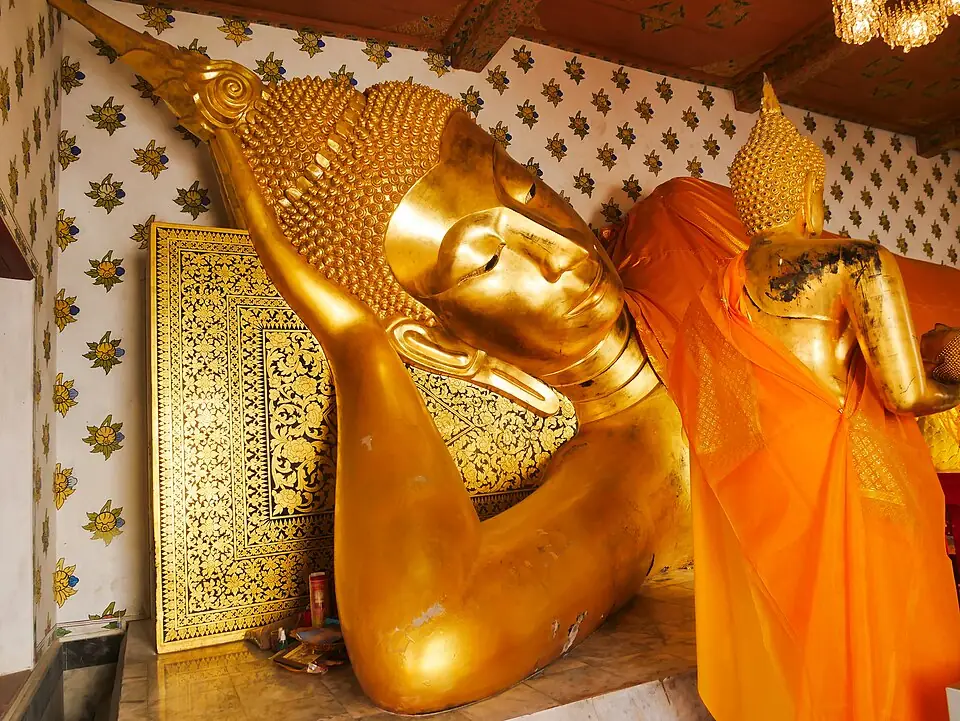
There is also a reclining Buddha brought from Wat Mahathat on the city island, made of several pieces of stone joined together and then lacquered and gilded. It lies in a wihan (assembly hall) built on the orders of King Rama V.
Murals and a role in education
The temple has murals from the reign of King Rama V, which an article in Post Today describes as showing the Royal Ceremonies of the Twelve Months, an assembly of celestial beings, important events of the reign and Jataka tales. They give a view of the country in Rama V's time through the eyes of the artists of that era.
King Rama V restored the temple in 1884 and presented it with a preaching pulpit and a teak boat. A school was set up in the temple in 1885, and for a time the temple became an important centre of education in Ayutthaya, for both primary schooling and teacher training. Today it is still one of the temples in the province that teach Buddhist scriptural studies (Pariyattidhamma).
Wat Senasanaram through the eras
Until the Rattanakosin (Bangkok) period, this point on the map tells its story through the neighbouring palace more than through the temple itself.
- Founding of the capital (1351–1488): no evidence yet of a temple here; in the early years of the capital this corner of the island still lay outside the line of the original city wall.
- Age of King Naresuan (1548–1605): no firm evidence yet that Wat Suea existed, but next door was Chandra Kasem Palace, built as Naresuan's residence and used as his command post in 1586.
- Age of King Narai (1656–1688): the neighbouring Front Palace was King Narai's residence before he came to the throne, and the palace of the Maha Uparat (the viceroy).
- Second fall of Ayutthaya (1767): Wat Suea was abandoned along with the capital.
- Today: a royal temple rebuilt by King Rama IV, completed in 1863, where monks still reside.
Getting there and visiting
The temple is behind the Chantharakasem National Museum (Chandra Kasem Palace), near Hua Ro Market, so it is easy to combine with a visit to the palace. It makes a good morning stop for anyone following King Naresuan's trail, before going on to Wat Na Phra Men or Wat Mae Nang Pluem in the north of the island.
The temple is still a royal temple with resident monks, so dress modestly and respect the monks' times of prayer.
Where historians still disagree
- Age of Wat Suea: sources say this was originally Wat Suea of the Ayutthaya period, but no evidence of the year it was built has been found, so it is impossible to say whether there was already a temple here in King Naresuan's time.
- Origin of the Phra Samphutthamuni: some sources say it is an Ayutthaya-period image, others that it was brought from Vientiane.
- Khlong Senasanaram: some sources say King Rama IV had it dug around the temple; others say it follows the line of an earlier moat of the Front Palace.
Visiting information
- Dress modestly, take off your shoes before entering the ubosot and the wihan, and do not touch the murals.
- Combine your visit with the Chantharakasem National Museum next door.
- Respect the monks' times of prayer and their daily duties.
Frequently asked questions
What was Wat Senasanaram originally called?
It was originally an Ayutthaya-period temple called Wat Suea. King Rama IV rebuilt it and gave it the name Wat Senasanaram; the work was completed in 1863.
Where does the Phra In Plaeng come from?
It is a bronze Buddha image in the Lan Xang style that King Rama IV had brought from Vientiane in 1858.
Is Wat Senasanaram connected with King Naresuan?
No direct record has been found, but the temple stands right behind Chandra Kasem Palace, once King Naresuan's residence, so the two are usually visited together.
Last updated 10 November 2026