Wat Maheyong: The Elephant-Ringed Chedi and King Bayinnaung's Royal Camp When Ayutthaya First Fell
Wat Maheyong stands in the fields east of Ayutthaya's city island. Most people know it for the chedi with stucco elephants standing all around its base, but its history matters just as much: this was King Bayinnaung's royal camp in the war in which Ayutthaya fell to Hanthawaddy in 1569, the event that put King Naresuan's father on the throne.
This place through the eras
The Luang Prasoet Chronicle records that Borommaracha II (Chao Sam Phraya) had this temple built in 1438; later chronicles give 1424, the year his reign began.
Wat Maheyong lay in the middle of this era's battlefields. In the War of the White Elephants (1563–1564), the Siamese army camped on Hantra Field was routed and fled back across the canal towards the temple. In the war that ended with the first fall of Ayutthaya, King Bayinnaung set up his royal camp here. When the city fell in 1569, King Mahinthrathirat went to the King of Hanthawaddy's pavilion in the temple to present himself before him. Afterwards King Maha Thammaracha, Naresuan's father, came to rule Ayutthaya.
No significant records of the temple have been found from King Narai's reign. The major restoration that brought it back to prominence came about 20 years after his reign.
King Thai Sa began a major restoration from around 1709 and had a residence built south of the temple to stay in during the work. The temple remained important until the fall of Ayutthaya in 1767, after which it was abandoned.
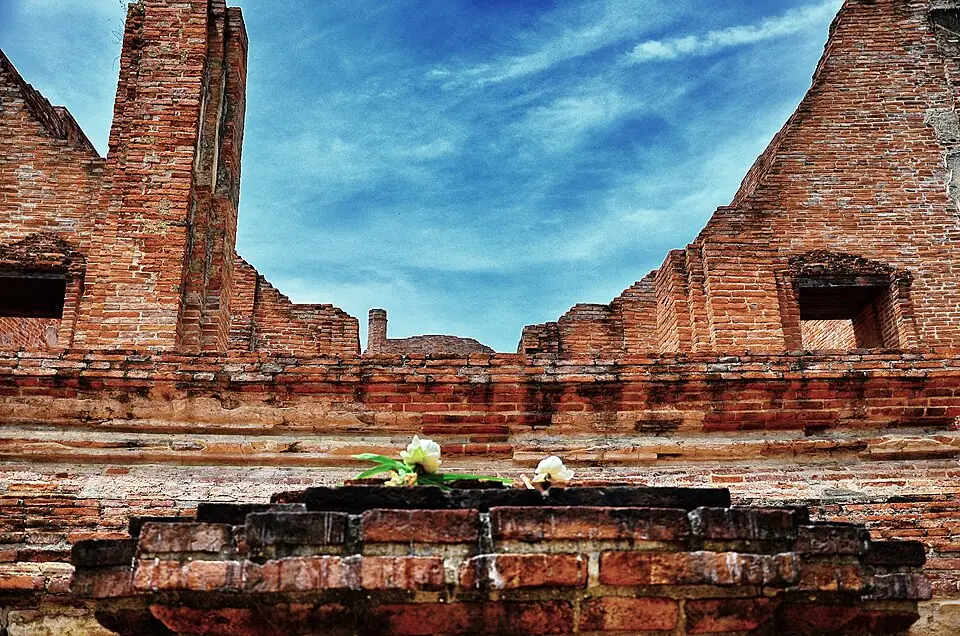
A historic site that shares its grounds with a meditation centre. Its highlights are a bell-shaped chedi on a square base ringed by some 80 elephant sculptures, and a large ubosot platform.
Origins and name
The Luang Prasoet Chronicle records that in the year 800 of the Lesser Era (Chula Sakarat), which corresponds to 1438, Borommaracha II, or Chao Sam Phraya, had Wat Maheyong built. Royal chronicles compiled later give the year as 1424, the year he came to the throne.
The temple's name is believed to come from a Pali word meaning a mound of earth, which fits its position on a rise above the surrounding fields.
A battlefield in the wars with Hanthawaddy
In the War of the White Elephants in 1563–1564, Chao Phraya Maha Sena set up camp on Hantra Field to meet the Hanthawaddy army. The forces of the Burmese crown prince attacked the camp twice until it broke, and the Siamese troops fled into Khlong Hantra and crossed over to the Wat Maheyong side. The chronicles record that many of the wounded drowned.
Five years later, in the war that ended with the first fall of Ayutthaya in 1568–1569, King Bayinnaung came and set up his royal camp at Wat Maheyong, with a pavilion for his residence inside the temple. When Ayutthaya fell in August 1569, King Mahinthrathirat went to present himself before the King of Hanthawaddy at this pavilion. He was then taken to Hanthawaddy along with members of the royal family, and died on the way.
What is its connection to King Naresuan?
What happened at Wat Maheyong in 1569 directly changed the fortunes of the royal line to which Naresuan belonged. After receiving King Mahinthrathirat, King Bayinnaung installed King Maha Thammaracha, Naresuan's father, as ruler of Ayutthaya, now a vassal of Hanthawaddy.
At the time Naresuan was still living at Hanthawaddy as a royal hostage, as he had been since the War of the White Elephants; he returned around 1571. Fifteen years later he declared independence at Mueang Khraeng. This temple is thus a place where defeat and the beginning of Naresuan's era meet, even though there is no record of him ever coming here.
The elephant chedi and King Thai Sa's restoration
According to the royal chronicles, King Thai Sa began a major restoration of Wat Maheyong around 1709. The work took several years, and he had a residence built south of the temple so that he could stay there and conduct state business while it went on. When it was finished there was a seven-day celebration, and the temple remained an important one until the end of the kingdom.
The main chedi is a bell-shaped stupa in the Sri Lankan style, set on a square base about 32 metres along each side. Around the base stand stucco elephants about a metre tall, 20 on each side, some 80 in all, similar to the elephant-ringed chedis of Sukhothai. Most of the elephants have lost their trunks and have been repaired. In front of the chedi is a large ubosot platform about 35 metres long.
Wat Maheyong through the eras
The same spot on the map, through the stories of five eras.
- Early Ayutthaya (1351–1488): a royal temple built on the orders of Chao Sam Phraya in 1438.
- Naresuan's era (1548–1605): a battlefield in the War of the White Elephants, and King Bayinnaung's royal camp when the city fell in 1569.
- King Narai's era (1656–1688): no significant records; the temple was probably run-down before its restoration in a later reign.
- The fall of Ayutthaya in 1767: an important temple, restored only about fifty years earlier, abandoned after the city fell.
- Today: a historic site alongside a meditation centre.
Visiting
Today the temple grounds are both a historic site and a meditation centre, where people regularly come to keep the Buddhist precepts and practise meditation, so visitors should speak quietly and dress modestly. Wat Kudi Dao is an easy walk away, and the two make a good pair for a morning visit.
Where historians still disagree
- Founding date: the Luang Prasoet Chronicle says BE 1981 (1438), but chronicles compiled later say BE 1967 (1424). Some sources also tell stories linking the temple's founding to legendary figures from before the city was founded, which no evidence supports.
- Date of King Thai Sa's restoration: some sources give 1711, while others say it began in 1709 and was celebrated around 1713, so these dates should be treated as approximate.
- Age of the elephant chedi: what we see today has been repaired many times, so it is not yet possible to say which parts date from the original construction and which from later restorations.
Visiting information
- Opening hours: 08:00–17:00 (as of 2026)
- The grounds are a meditation centre, so keep the peace and dress modestly.
- Do not climb the chedi or get up onto the elephant base.
- The morning light is lovely for photographing the elephant chedi.
Opening hours and admission fees may change, so please check before you go.
Frequently asked questions
When was Wat Maheyong built?
The Luang Prasoet Chronicle says it was built in 1438, in the reign of Borommaracha II; later chronicles say 1424.
How many elephants surround the chedi at Wat Maheyong?
There are about 80 stucco elephants around the base of the chedi, roughly 20 on each side.
How is Wat Maheyong connected with King Naresuan?
King Bayinnaung set up his royal camp at this temple in the war that ended with the fall of Ayutthaya in 1569. Afterwards he installed King Maha Thammaracha, Naresuan's father, as ruler of Ayutthaya.
Last updated 10 November 2026