Wat Kudi Dao: The Temple King Borommakot Restored While Still the Front Palace Prince
Wat Kudi Dao is a large abandoned temple in the fields east of Ayutthaya's city island. The ruins of its ubosot, wihan and chedi, still standing among the trees, have won it many admirers. The most clearly recorded part of its story belongs to the kingdom's final decades, when the younger brother of King Thai Sa, who later became King Borommakot, restored the temple and was ordained here.
This place through the eras
No one knows what this temple was called in the early period, but excavations found early-Ayutthaya building foundations beneath the ruins visible today, so a religious building probably stood here already.
The name Wat Kudi Dao does not appear in records from Naresuan's reign. The fields east of the capital here were a battleground several times in that era, for example when King Bayinnaung set up his royal camp at Wat Maheyong, only about 500 m away, in 1568–1569. But there is no evidence of any event at this temple itself.
Engelbert Kaempfer, who came to Ayutthaya in 1690, a few years after King Narai's reign ended, did not record a temple here. Some scholars therefore think the temple may by then have been so run-down that it was barely visible.
After the great restoration of 1711–1715 this was an important temple until the end of the kingdom. Its abbot, Phra Thep Muni, became Supreme Patriarch in the reign of King Ekkathat and died shortly before the city fell. After 1767 the temple was abandoned.
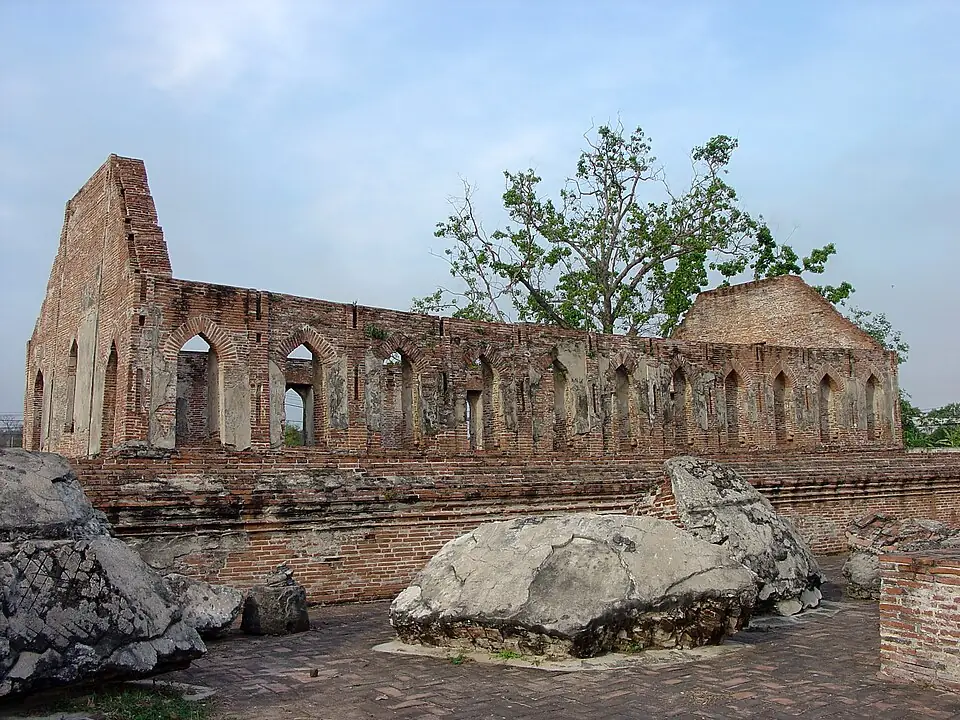
A historic site partly restored by the Fine Arts Department, with the remains of the ubosot, the wihan, a bell-shaped main chedi and, to the north, the two-storey Kammalian residence. It is quiet and peaceful, ideal for anyone who likes photographing ancient ruins.
Origins
No document tells us who built Wat Kudi Dao or when. The royal chronicles first mention the temple only in the reign of King Thai Sa (1709–1732), but archaeological excavations have found older building foundations, probably from the early Ayutthaya period, beneath the structures visible today.
This stretch of fields east of the city island has several old temples close together, such as Wat Maheyong, Wat Samana Kot and Wat Ayothaya. The name Wat Kudi Dao also appears in the Northern Chronicle, which those who argue for a city of Ayothaya before Ayutthaya often cite.
The Front Palace restoration, 1711–1715
According to the royal chronicles, in 1711 the Prince of the Front Palace, younger brother of King Thai Sa, began a major restoration of Wat Kudi Dao and had a pavilion built north of the temple where he could stay to oversee the work. Construction took almost four years and was finished in 1715, followed by a seven-day celebration.
At about the same time, King Thai Sa himself was restoring Wat Maheyong, only about 500 metres away. The two temples were therefore something like sister temples, looked after by the two royal brothers at the same time.
Later, in 1727, the Front Palace prince was ordained as a monk at this temple, with the abbot, Phra Thep Muni, as his teacher. He came to the throne in 1733 as King Borommakot.
Phra Thep Muni and the last years of Ayutthaya
When King Borommakot died in 1758, a dispute broke out over the succession. Phra Thep Muni was one of the senior monks who helped mediate until it was settled. Later, in the reign of King Ekkathat, he was appointed Supreme Patriarch.
During the final Burmese siege of the capital, monks from temples outside the walls had to move inside the city. This Supreme Patriarch died shortly before the city fell, and he had not yet been cremated because the fighting was still going on. After 1767, Wat Kudi Dao was abandoned.
What is its connection to King Naresuan?
As far as can be verified, no chronicle or contemporary record links Wat Kudi Dao directly to King Naresuan. What can be said is that in his era the fields east of the capital were where enemy armies made camp several times, for instance King Bayinnaung's royal camp at Wat Maheyong in 1568–1569. An old religious building may already have stood here, but its condition at the time is unknown.
Wat Kudi Dao through the eras
Follow the same spot through five eras on the map.
- Early Ayutthaya (1351–1488): early-Ayutthaya building foundations lie beneath today's ruins, but the temple's name is unknown.
- Naresuan's era (1548–1605): no record of the temple; these fields were a battleground and a place where enemy armies camped.
- King Narai's era (1656–1688): not mentioned in records, and Kaempfer did not mention it when he came in 1690.
- The fall of Ayutthaya in 1767: an important temple, restored less than sixty years earlier, abandoned after the city fell.
- Today: a partly restored historic site that you can explore up close.
What to see and visiting
The ubosot stands on the west side of the temple and is about 27 metres long; the wihan is on the east side, where some window arches and pillars can still be seen. Behind the ubosot is the large bell-shaped main chedi on a square base with indented corners; it has collapsed, and its spire lies on the ground.
North of the temple wall is the Kammalian residence, a two-storey building with arched window frames, in which some scholars see Islamic artistic influence. Go in the morning or evening, as the site is open and the sun is strong; you can walk on to Wat Maheyong on the same trip.
Where historians still disagree
- The temple's age: the royal chronicles first mention it only in King Thai Sa's reign, but excavations have found early-Ayutthaya building foundations and the Northern Chronicle names Wat Kudi Dao, so some propose that the temple is very old. Other scholars, however, consider that evidence of settlement in the eastern area before the city was founded is still scarce.
Visiting information
- Do not climb on the ruined chedi or crumbling walls, as they could collapse.
- Bring a hat, drinking water and insect repellent: the site is open fields with many trees.
- Plan to combine your visit with nearby Wat Maheyong and Wat Samana Kot.
Frequently asked questions
Who restored Wat Kudi Dao?
The Prince of the Front Palace, younger brother of King Thai Sa and later King Borommakot, restored it between 1711 and 1715.
Is Wat Kudi Dao connected with King Naresuan?
No direct link has been found. The clearly recorded history of this temple belongs to the late Ayutthaya period.
Where is the Kammalian residence?
To the north, outside the temple wall. It is a two-storey building with arched window frames.
Last updated 10 November 2026