Home › Places › Wat Worachettharam
Wat Worachettharam: The Temple Dedicated to King Naresuan and the Mystery of His Cremation
Wat Worachettharam is an abandoned temple on Ayutthaya's city island, west of the Ancient Royal Palace. A Fine Arts Department sign says it was built by King Ekathotsarot in 1605 and dedicated to his elder brother, King Naresuan. Yet the temple is also at the centre of an old mystery: where exactly was Naresuan's body cremated?
This place through the eras
This temple did not yet exist.
Naresuan died on 25 April 1605 at Mueang Hang, while marching to attack Ava. King Ekathotsarot brought his body back to Ayutthaya for a magnificent cremation and then built a temple on the cremation site. The Fine Arts Department sign says this is that temple, but historians still weigh it against two other sites: Wat Worachet outside the island (Wat Worachet Thep Bamrung) and Wat Sop Sawan.
A temple in the area near the palace, on the west side of the city island.
Abandoned after the fall of the city.
People like to bring figures of fighting cocks as offerings, following the story that Naresuan's rooster beat the Burmese Crown Prince's when he lived in Hanthawaddy. Whether his ashes are really enshrined here is still unresolved.
Origins and name
Wat Worachettharam stands west of the Ancient Royal Palace, in the same group of ruins as Wat Lokayasutharam and Wat Rakhang. The temple was once surrounded by a moat, which made it look like a small island in the middle of the city.
The temple's name can be translated as 'temple of the noble elder brother', which fits the story that King Ekathotsarot built it and dedicated it to his elder brother Naresuan. The Fine Arts Department sign at the temple says it was built in 1605, the same year Naresuan died.
The temple's name changes from one period's evidence to the next. An old map from around the mid-19th century calls it Wat Chettharam, while Phraya Boran Ratchathanin's map of 1926 adds the word 'Wora' to make Wat Worachettharam. This made its name sound the same as another Wat Worachet outside the city island, and is the source of confusion that persists to this day.
Its link to King Naresuan
Naresuan died on 25 April 1605 at Mueang Hang, while marching on Ava. King Ekathotsarot escorted his body back to Ayutthaya and held a magnificent royal funeral.
The royal chronicles say that after the funeral a monastery was built, with a great stupa enshrining relics of the Buddha, monks' quarters and walls, a complete set of the Buddhist scriptures (Tripitaka), and forest-dwelling (aranyawasi) monks invited to spend the rains retreat there. But the chronicles do not clearly name the temple, so historians have tried to match this description with temples whose ruins still survive.
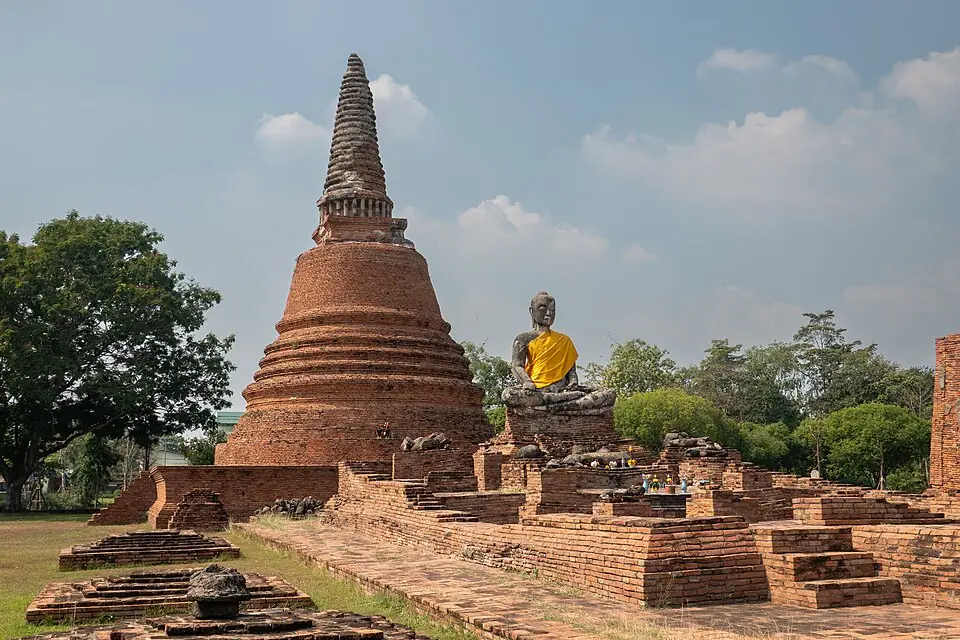
The main chedi of Wat Worachettharam is bell-shaped, in the middle-Ayutthaya style that was popular in Naresuan's time, which is one reason many people believe this temple is connected with him.
The mystery of the cremation and the royal relics
Where Naresuan's body was cremated, and where his ashes rest, have long been debated. At least three temples have been put forward: Wat Worachettharam on the city island; Wat Worachet outside the island, also called Wat Worachet Thep Bamrung, west of the city island; and Wat Sop Sawan.
Those who favour the temple on the island argue that it is close to the Ancient Royal Palace, and that at that time there was not yet a royal cremation ground at Sanam Na Chakkrawat. Earlier Ayutthaya kings also often built temples on cremation sites, as at Wat Phra Ram and Wat Ratchaburana. Another point is that the chronicles mention the fields of Wat Worachet outside the city as early as the war of 1563–1564, which shows that the temple outside the island already existed about 40 years before Naresuan died.
Those who favour the temple outside the island, such as Prayoon Uluchata, point out that the chronicles describe a temple of forest-dwelling monks, which suits a site outside the city, and that the temple outside the island is larger and has a large main prang. It should be noted that the Phan Chanthanumat (Choem) version of the chronicles does not say that the temple was built on the cremation site; only the Testimony of the Old Capital's People (Khamhaikan Chao Krung Kao) says that a royal crematorium was built first and the temple then built on that spot.
The Fine Arts Department has put up signs with much the same wording at both temples, and the sign at the temple outside the island admits that it is not yet possible to say for sure which site it was. The archaeological evidence shows that the two temples date from roughly the same period, but no inscription has been found that says which one King Ekathotsarot built. For now, the most honest conclusion is that there is no definite answer.
What to see
Wat Worachettharam has been restored as an ancient monument. Although the roofs of its buildings have all collapsed, the temple layout is still easy to read, making it a good choice for anyone who wants to see a quieter Ayutthaya temple than the big ones in the middle of the island.
- The large bell-shaped main chedi on a square base, with stairs on the north and south sides; its upper part is still fairly complete.
- The ubosot (ordination hall), whose roof has fallen but whose walls still stand, with a large Buddha image in the posture of subduing Mara and traces of ceramic bowls set into the gable.
- The base of the wihan (assembly hall) in front of the chedi, with a Buddha image in the posture of subduing Mara, and the bases of other buildings, including small subsidiary chedis.
- Traces of the moat that once surrounded the temple.
- Figures of fighting cocks left as offerings by worshippers in memory of the legend of Naresuan's cockfight, a custom that became popular after the film about King Naresuan was released.
Wat Worachettharam through the eras
If you look at this spot on the map era by era, you will see that the temple's meaning changes over time.
- Founding era (1351–1488): no evidence of this temple has been found; the area lay to the west of the palace grounds.
- Naresuan's era (1548–1605): according to the Fine Arts Department sign, King Ekathotsarot built this temple in 1605, after Naresuan's death.
- King Narai's era (1656–1688): it was probably still an active temple, but Kaempfer's map, made in 1690, does not show it. Researchers suggest the mapmaker may not have been able to reach the area behind the palace.
- The fall of 1767: the temple was abandoned along with the city, but its name was still remembered and appeared on maps decades later.
- Today: a restored ancient monument in the historical park, and a place of worship for people who revere King Naresuan.
Getting there and visiting
Wat Worachettharam is west of the Ancient Royal Palace. You can reach it by a small road on the west side of Khlong Tho, and another road behind the group of ruins leads out to U Thong Road. It is easy to get to by bicycle or tuk-tuk.
Most visitors combine it with Wat Lokayasutharam, with its huge reclining Buddha, nearby. If you want the full picture of the debate, also take a ride out to Wat Worachet outside the island, west of the city island; the difference in size and in the style of the chedis is easy to see.
Where historians still disagree
- Where King Naresuan was cremated: proposals include Wat Worachettharam on the island (close to the palace, while the temple outside the island already existed by 1563–1564), Wat Worachet outside the island, or Wat Worachet Thep Bamrung (larger, and described in the chronicles as a temple of forest-dwelling monks), and Wat Sop Sawan. No inscription settles the question.
- Where his ashes were enshrined: some believe they are in the chedi of Wat Worachettharam, but some researchers think the ashes of Ayutthaya's kings were usually enshrined at Wat Phra Si Sanphet, so Wat Worachettharam is more likely to have been the cremation site than the place where his ashes were kept.
- The temple's name: in various documents both the temple on the island and the one outside it have been called Wat Worachet or Wat Worachet Thep Bamrung, so descriptions in different sources are easily swapped. Always check the location as well.
Visiting information
- The temple is in an open area, so come in the morning or late afternoon and bring a hat and drinking water.
- Do not climb the chedi or the ancient foundations, and if you bring a cockerel figure as an offering, place it in the area set aside for them, not on the monument itself.
- Dress modestly, as this is both an ancient monument and a place of worship for people who revere King Naresuan.
Frequently asked questions
Who built Wat Worachettharam?
The Fine Arts Department sign says King Ekathotsarot built it in 1605 and dedicated it to his elder brother, King Naresuan, but no inscription has been found that confirms this directly.
Was King Naresuan really cremated at Wat Worachettharam?
The question has not been settled. Wat Worachettharam on the island, Wat Worachet outside the island and Wat Sop Sawan have all been proposed, and the Fine Arts Department has put up signs with similar wording at both of the first two temples.
Why do people leave fighting-cock figures at this temple?
In memory of the legend of Naresuan's cockfight when he lived in Hanthawaddy. The custom became popular after films about him were released.
Are Wat Worachettharam and Wat Worachet Thep Bamrung the same temple?
No. Wat Worachettharam is on the city island, west of the Ancient Royal Palace, while Wat Worachet Thep Bamrung, or Wat Worachet outside the island, lies to the west, off the city island.
- Wat Worachettharam - Ayutthaya Historical Research
- Wat Worachet - Ayutthaya Historical Research
- The Mystery of the Two Wat Worachettharams in Ayutthaya - Chula Radio Plus (in Thai)
- Searching for the Site of King Naresuan the Great's Cremation and Royal Relics - Silpa Wattanatham (in Thai)
- Wat Worachet outside the island - Manager Online (2007) (in Thai)
Last updated 10 November 2026