Home › Places › Wat Choeng Tha
Wat Choeng Tha: The 'Waiting at the Landing' Temple on the Lopburi River, Opposite the Royal Palace
Wat Choeng Tha stands on the old Lopburi River, across the water from Ayutthaya's Royal Palace. It is a temple that has gone by several names over the centuries, with a love legend behind its old name, Wat Khoi Tha, and a story that King Taksin studied here as a boy. Today its old prang, ubosot (ordination hall) and riverside sermon hall can still be seen up close.
This place through the eras
The Khmer-style main prang has early Ayutthaya features, so the temple probably dates from this era, though its original name and founder are unknown. A folk legend says a rich man built the temple at the landing where he waited for his daughter, who had run away with her lover, hence the name Wat Khoi Tha, 'the temple of waiting at the landing'.
The temple stands across the river from the Royal Palace, where Naresuan lived throughout his reign (1590–1605), but no event of his reign is recorded at the temple. It is believed that the temple was once called Wat Tin Tha, after the landing used to ferry grass for the palace's elephants and horses, but it is not known in which era this name was used.
In King Narai's reign, Chaophraya Kosathibodi (Pan), the ambassador who went to France, restored this temple, so it came to be called Wat Kosawat. A map based on Kaempfer's survey of 1690 calls it Templum Novum, the 'New Temple'.
King Borommakot had the temple repaired in the late Ayutthaya period. According to traditional accounts, Nai Sin (later King Taksin) studied and was ordained at this temple before the fall of Ayutthaya, but this does not appear in the royal chronicles.
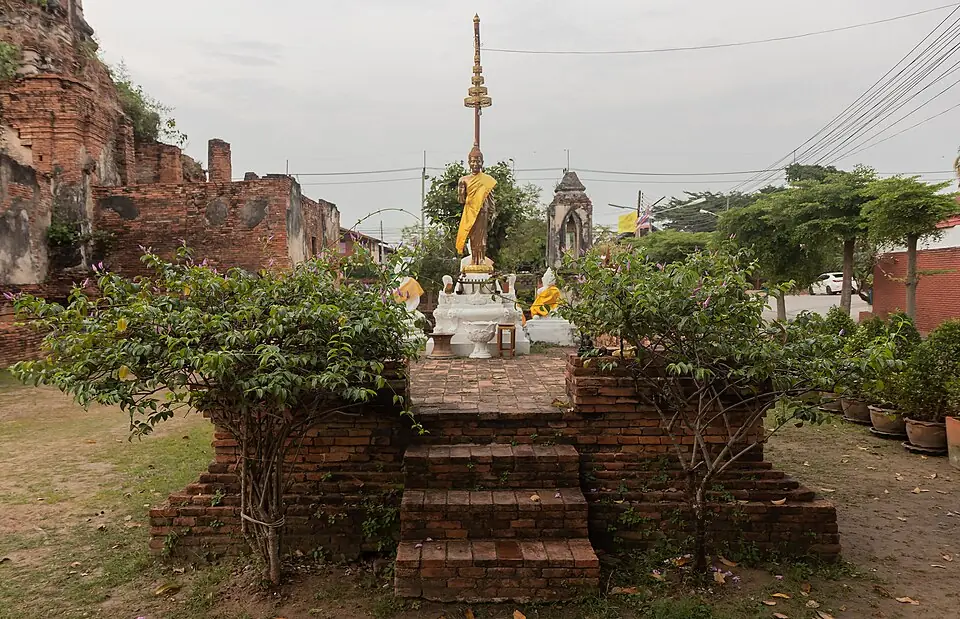
An active temple with a main prang, an ubosot (ordination hall) with a curved, boat-shaped base restored by the Fine Arts Department in 2019, several Ayutthaya-period subsidiary chedis, a sermon hall from the reign of King Rama IV, and a long Ayutthaya-period preaching seat decorated with glass inlay.
Origins and the legend of Wat Khoi Tha
No document records when Wat Choeng Tha was built or by whom. Its Khmer-style main prang (tower) has features that No Na Paknam, an expert on Thai art, regards as early Ayutthaya work that has since been repaired. Several other old temples along the canals in this area have similar prangs, so this temple is probably almost as old as the early years of the capital.
The name Wat Khoi Tha, 'the temple of waiting at the landing', comes from a folk legend. A rich man's daughter ran away with the man she loved, and her father kept watch for her at this landing; some versions say he built a bridal house and waited. But the daughter never came back, so the rich man built a temple on the spot. It is a legend with no confirming evidence, but it makes the temple's name easy to remember.
A temple of many names
Besides Wat Khoi Tha, the temple was also once called Wat Tin Tha, after the landing used to ferry grass for the elephants and horses of the Royal Palace on the opposite bank. In King Narai's reign it was called Wat Khlang, and then Chaophraya Kosathibodi (Pan), who led the embassy to King Louis XIV of France in 1686, restored the temple, so it came to be called Wat Kosawat.
A map based on information from Kaempfer, a German physician who came to Ayutthaya in 1690, calls this place Templum Novum, the 'New Temple'. Later King Borommakot had the temple repaired again, and in the reign of King Mongkut (Rama IV) it received the name Wat Choeng Tha, which is still used today.
Some researchers state that in the reign of King Phetracha, the landing on the palace side used for bathing horses was the official crossing point from the palace to this temple, which suggests the temple had rather close ties with the royal court.
Is it connected with King Naresuan?
No chronicle or contemporary record describes any event at Wat Choeng Tha in the reign of King Naresuan the Great, so this site does not count the temple as a place directly connected with him.
In terms of location, though, the temple stands across the river from the Royal Palace, where Naresuan came to the throne and lived throughout his reign, from 1590 to 1605. And if the prang really dates from the early Ayutthaya period, the temple already existed in his time and may have been a temple where people from the palace side crossed over to make merit. This, however, is only a guess based on its location.
The story of King Taksin at Wat Choeng Tha
According to traditional accounts, when Nai Sin, who later became King Taksin the Great, was about nine years old, he came to Wat Kosawat to study Thai and Khmer script under the monk Phra Achan Thongdi, and when he grew up he returned to be ordained at this temple before the fall of Ayutthaya.
The story is widely known and a source of pride for the temple, but it does not appear in the royal chronicles, so some researchers think it should be treated as a traditional account rather than a confirmed fact.
Wat Choeng Tha through the eras
The same spot on the map, across five eras
- Early Ayutthaya (1351–1488): the early Ayutthaya-style main prang suggests the temple probably already existed
- Naresuan's era (1548–1605): a temple across the river from the Royal Palace; no specific events recorded
- King Narai's era (1656–1688): restored by Chaophraya Kosathibodi (Pan) and known as Wat Kosawat
- The fall of Ayutthaya in 1767: according to tradition, Nai Sin was ordained here before the city fell
- Today: an active temple with restored historic ruins
What to see and visiting
The highlights are the Khmer-style main prang, the ubosot with its curved, boat-shaped base, which the Fine Arts Department restored extensively in 2019, and several Ayutthaya-period subsidiary chedis in front of the ubosot. By the river stands a sermon hall built in the reign of King Rama IV, with some damaged Rattanakosin-period murals inside.
Another piece not to miss is the long preaching seat, or sangkhet. A study in the Journal of Ayutthaya Studies (2022) dates it to the middle to late Ayutthaya period. It is decorated with glass inlay in several colours: beetle-wing green, jade green, amber yellow and white. The temple is free to visit; dress modestly, as monks still live here.
Where historians still disagree
- Age of the temple: the year of construction is unknown. Dating it to the early Ayutthaya period relies on the style of the prang, which has been repaired many times.
- King Taksin and Wat Choeng Tha: a widely told traditional account, but it does not appear in the royal chronicles.
- The funeral of Chaophraya Kosa Pan's mother in 1690: some sources link it to this temple, others to Wat Samana Kot.
- Order of the temple's names: sources do not quite agree on the order of the names Wat Khoi Tha, Wat Tin Tha, Wat Khlang and Wat Kosawat.
Visiting information
- Admission: Free admission (as of 2026)
- Dress modestly, and do not climb the prang or the subsidiary chedis
- If you want to see the preaching seat and the murals, ask the monks or temple staff first
- From the riverbank in front of the temple you can look across to the Royal Palace side
Opening hours and admission fees may change, so please check before you go.
Frequently asked questions
Why was Wat Choeng Tha once called Wat Khoi Tha?
A folk legend says a rich man waited at this landing for his daughter, who had run away with her lover, but she never came back, so he built a temple on the spot.
Did King Taksin really live at Wat Choeng Tha?
Traditional accounts say Nai Sin studied and was ordained at this temple, but this does not appear in the royal chronicles, so it remains an unconfirmed story.
Is Wat Choeng Tha connected with King Naresuan?
No record of a direct link has been found. The temple is across the river from the Royal Palace where he lived, and it probably already existed in his time.
Last updated 10 November 2026