Home › Places › Ancient Royal Palace
The Ancient Royal Palace (Grand Palace of Ayutthaya)
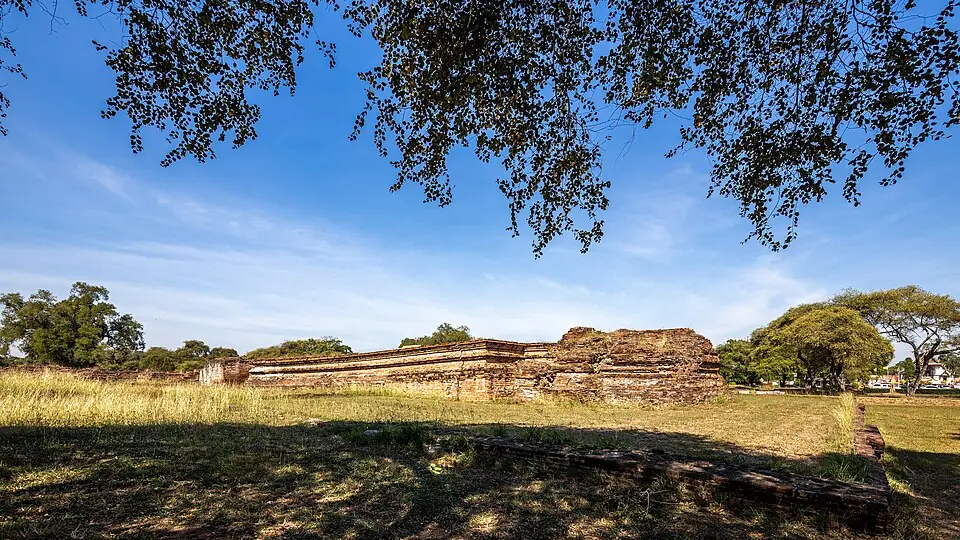
The Ancient Royal Palace was the centre of the Ayutthaya court for more than 400 years. It was the residence of the kings, including King Naresuan throughout his reign from 1590 to 1605. Although only the foundations of its buildings remain today, the palace layout still shows clearly how grand the capital once was.
This place through the eras
In King U Thong's time (the city was founded in 1351), the royal palace stood a little south of here, on the site of today's Wat Phra Si Sanphet. Later King Borommatrailokkanat gave the old palace grounds to become a temple and built a new royal palace further north, right up to Khlong Mueang, so this spot has been the royal palace ever since.
The centre of power in Ayutthaya. After the city fell in 1569, King Bayinnaung installed King Maha Thammaracha, Naresuan's father, to reign here over a city subject to Hanthawaddy. When Maha Thammaracha died (1590), Naresuan came to the throne in this palace, and he reigned until 1605.
King Narai lived both in this palace and in Lopburi. European envoys and merchants who were received at court wrote accounts and drew plans of the capital, and these are key evidence that still helps us locate the buildings inside the palace today.
Burned and destroyed in the fall of 1767. Later, under Kings Rama I–III, large quantities of brick were pulled out to build Bangkok, leaving only the foundations.
You can see the foundation lines of several throne halls, within Ayutthaya Historical Park, which UNESCO inscribed as a World Heritage Site in 1991. Wat Phra Si Sanphet is right next door.
King U Thong's first palace
When King Ramathibodi I, or King U Thong, founded Ayutthaya in 1350, the royal chronicles say he had the Phaithun, Phaichayon and Aisawan Maha Prasat throne halls built on the site of today's Wat Phra Si Sanphet. This first palace was probably built mostly of wood.
The chronicles also mention the Mangkhalaphisek and Trimuk throne halls in the early years of the city, and record fires in the palace in two successive years during the reign of King Borommaracha II; the second fire also destroyed the Trimuk Hall.
The palace moves under King Borommatrailokkanat
When King Borommatrailokkanat came to the throne in 1448, he gave the site of the old palace to become a sacred Buddhist precinct, which became Wat Phra Si Sanphet, the royal temple of the palace. He then had a new palace built just to the north, near the Lopburi River and the northern city moat.
The first two throne halls of the new palace were the Bencharat Maha Prasat and the Sanphet Maha Prasat. Separating the palace from the temple in this way is why the Ancient Royal Palace and Wat Phra Si Sanphet stand side by side as they do today.
The main throne halls
The Ancient Royal Palace gradually grew and gained more buildings over several reigns. By the late Ayutthaya period it had six main palaces and throne halls, each with a different role: holding royal audiences for state business, receiving foreign envoys and performing royal ceremonies.
- Bencharat Maha Prasat and Sanphet Maha Prasat: the first two throne halls of the new palace, from the time of King Borommatrailokkanat.
- Wihan Somdet (Mangkhalaphisek) group of halls: the evidence does not yet show clearly in which reign it was built.
- Suriyat Amarin Hall and Chakkrawat Phaichayon Hall: built under King Prasat Thong, who extended the palace so that it adjoined Wat Phra Si Sanphet.
- Banyong Rattanat Hall: most sources say it was begun under King Narai, but some chronicles say it was built under King Phetracha.
- Trimuk Pavilion: rebuilt on its original base under King Rama V; it is the only building that still has a roof.
The Ancient Royal Palace and King Naresuan
Before he became king, Naresuan lived at Chandra Kasem Palace, the Wang Na or Front Palace. When King Maha Thammaracha died in 1590, Naresuan came to the throne and lived in the Ancient Royal Palace throughout his reign, until his death in 1605.
During this time the Ancient Royal Palace was the centre for planning his major campaigns, including the response to the Burmese Crown Prince's army that led to the elephant duel, and the expeditions to Cambodia, to Mon country and to Hanthawaddy. Late in his reign he also received foreigners, such as the Dutch merchants who were granted an audience in 1604.
It is worth knowing that in Naresuan's time the palace did not yet have the throne halls built under King Prasat Thong and King Narai, so the palace he lived in was smaller than the layout shown on plans of the late Ayutthaya period.
The Ancient Royal Palace through the eras
The same spot on the map looked very different in each era.
- Founding era (1351–1488): the first palace stood where Wat Phra Si Sanphet is now; in 1448 a new palace was built to the north, on the site of the ruins you see today.
- Naresuan's era (1548–1605): it was the residence of King Maha Chakkraphat, King Maha Thammaracha and King Naresuan in turn.
- King Narai's era (1656–1688): the palace grew larger after King Prasat Thong added more throne halls, and King Narai built the Banyong Rattanat Hall.
- The fall of 1767: the Burmese army looted and burned the palace, leaving only building foundations, wall lines and broken brick.
- Today: the foundations of the throne halls rise only a little above the ground, and the Trimuk Pavilion is the only roofed building in the middle of the ruins.
From the fall of Ayutthaya to today
After the fall of the city in 1767, the Ancient Royal Palace was abandoned. When Bangkok was made the capital, King Rama I had bricks from the ruins of Ayutthaya loaded onto boats and taken there for building, and the layout of the Grand Palace in Bangkok followed the model of Ayutthaya's royal palace.
Around 1907 the base of the Trimuk Hall was found, and in 1908 King Rama V had the Trimuk Pavilion rebuilt on that base for a ceremony honouring the past kings of Ayutthaya, held to mark the 40th year of his reign.
Today the Ancient Royal Palace is part of Ayutthaya Historical Park. The surviving foundations let us see the layout of the court, from the outer zone of throne halls used for state business to the inner court where the king lived.
How to make sense of your visit
The palace grounds adjoin Wat Phra Si Sanphet, so you can walk from one to the other. Try standing at the base of each throne hall and picturing the tall, multi-tiered building that once stood there; you will see that the palace stretched from near the temple up towards the old course of the Lopburi River.
Because only the foundations are left, the Fine Arts Department's information signs and the site plans on the grounds are a great help. Allow at least an hour to walk slowly around both the palace and Wat Phra Si Sanphet.
Where historians still disagree
- When the Wihan Somdet (Mangkhalaphisek) group of halls was built: some sources attribute it to King Prasat Thong, but information from Phra Nakhon Si Ayutthaya province says there is no clear evidence of the reign in which it was built.
- Who built the Banyong Rattanat Hall: some chronicles say it was built under King Phetracha, while other sources say it was begun under King Narai.
Visiting information
- Combine your visit with Wat Phra Si Sanphet next door and Wat Worachettharam a short way to the west.
- The grounds are open with little shade, so come in the morning or late afternoon, with a hat and drinking water.
- Do not step on or climb the ancient foundations, and dress modestly, as this is a former royal palace next to a royal temple.
Frequently asked questions
Where is the Ancient Royal Palace in Ayutthaya?
It is in the northern part of the city island, next to Wat Phra Si Sanphet, within Ayutthaya Historical Park, near the old course of the Lopburi River.
Why is Wat Phra Si Sanphet right next to the palace?
Because the temple grounds were originally King U Thong's first palace. When King Borommatrailokkanat moved the palace north in 1448, he gave the old palace site to become a temple.
Did King Naresuan live in the Ancient Royal Palace?
Yes, throughout his reign from 1590 to 1605. Before he became king, he lived at Chandra Kasem Palace, the Wang Na or Front Palace.
Last updated 10 November 2026