Home › Places › Wat Thammikarat
Wat Thammikarat: A Temple Older Than Ayutthaya, Its Lion Chedi and the Story of Phra Si Sin
Wat Thammikarat is one of the oldest temples on Ayutthaya's city island, east of the Ancient Royal Palace. Legend says it existed before King U Thong founded Ayutthaya. Its highlight is the main chedi surrounded by stucco lions, and in the years when King Naresuan was still a child, the temple was also a setting for Phra Si Sin's revolt as told in the royal chronicles.
This place through the eras
A northern legend says Phraya Thammikarat, son of King Sai Nam Phueng, built this temple before King U Thong founded the capital; its original name was Wat Mukharat. The earliest art here is Early Ayutthaya, and the large bronze Buddha head found here was probably cast in this period.
The royal chronicles say that in King Maha Chakkraphat's reign, Phra Si Sin, younger brother of King Yot Fa, was held at this temple after plotting to seize the throne. He later escaped, gathered followers, attacked the palace and was killed, around 1561. Naresuan was then still a child living in Phitsanulok.
A painting by Johannes Vingboons from around 1665 shows the temple with a prang and two chedis, and Kaempfer's map of 1690 also records it. Some scholars suggest the lion-ringed chedi may have been built or remodelled in King Prasat Thong's reign.
In 1758 a senior monk from this temple was invited to help settle the dispute over the throne after King Borommakot's death. When the city fell in 1767, the temple was badly damaged by fire.
A restored historic site and active monastery. Highlights are the chedi surrounded by 52 stucco lions, the ruins of the great royal wihan, and the hall of the reclining Buddha.
A legend older than Ayutthaya
Wat Thammikarat lies in an area where a community is believed to have existed before King U Thong founded Ayutthaya in 1351. A northern legend says that Phraya Thammikarat, son of King Sai Nam Phueng, built the temple, and that it was named after its founder.
Information compiled by ayutthaya-history.com states that the temple's first name was Wat Mukharat, and that the art of its earliest structures is Early Ayutthaya in style. An article by Associate Professor Dr Sakchai Saising in the Damrong Journal (2007) proposes that the Buddha head found at this temple was probably cast in the Early Ayutthaya period, around the 15th century.
The story of a founder before the capital existed should therefore be read as legend, but the evidence of the art confirms that the temple was old and important from the city's earliest days.
How it connects to the age of King Naresuan
The event that places Wat Thammikarat in the history of Naresuan's era took place in the reign of King Maha Chakkraphat. The royal chronicles say that Phra Si Sin, younger brother of King Yot Fa, had once plotted to seize the throne and was therefore held at Wat Thammikarat.
Later, when he reached the age to be ordained, Phra Si Sin instead escaped from the temple, gathered followers and attacked the palace, and was killed in what became known as Phra Si Sin's revolt. Ayutthaya-history.com dates this to around 1561. At the time, Naresuan was still a child living in Phitsanulok.
This turmoil at court came as Hanthawaddy (Pegu, today's Bago) was expanding its power. A few years later came the War of the White Elephants (1563–1564), which led to Naresuan being taken to live in Hanthawaddy. Wat Thammikarat is thus a small stage in the era that shaped him.
The lion chedi and what to see
The main chedi is a bell-shaped stupa on an octagonal base; its spire has collapsed. It stands on a square terrace ringed by 52 Khmer-style stucco lions, 13 on each side. Chedis like this are very rare in Ayutthaya; the closest comparison is at Wat Mae Nang Pluem, north of the city island.
Some scholars suggest the chedi you see today may have been built or remodelled in King Prasat Thong's reign, over an older Early Ayutthaya bell-shaped chedi.
- The lion-ringed chedi: look at the faces and sitting poses of the individual lions lined up around the base.
- The ruins of the large royal wihan, with some brick walls and pillars still standing, which help you picture the scale of a royal temple in its day.
- The hall of the reclining Buddha, which houses a reclining Buddha about 12 metres long.
- The ubosot (ordination hall), still used for religious ceremonies, with a stucco principal Buddha image from the Rattanakosin (Bangkok) period.
- The many rooster figures left by worshippers as offerings, which some travel guides explain as a symbol linked to King Naresuan.
The bronze Buddha head of Wat Thammikarat
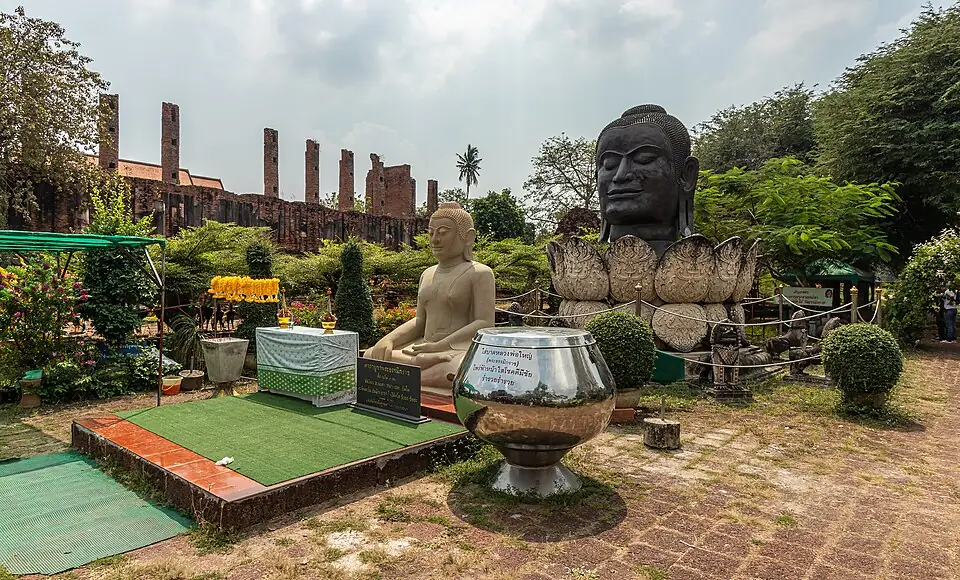
The temple's most famous find is a large bronze Buddha head in U Thong style, unearthed by Phraya Boran Ratchathanin. Ayutthaya-history.com gives its size as about 1.80 metres high and about 1.40 metres wide, which helps you imagine how enormous the complete Buddha image must have been.
The original head is no longer at the temple; the Fine Arts Department has made a replica for visitors to see instead. Online sources disagree on where the original is kept, with some saying it is at the Chao Sam Phraya National Museum, so if you want to see the real thing, check with the museum before you go.
Wat Thammikarat through the eras
This temple lived through almost every period of Ayutthaya. Follow it era by era.
- Founding of the capital (1351–1488): Legend says a temple already stood here before the capital was founded. The earliest art is Early Ayutthaya, and the large bronze Buddha head was probably cast in this period.
- Naresuan's era (1548–1605): In King Maha Chakkraphat's reign, Phra Si Sin was held at this temple before escaping to launch his revolt, and was killed around 1561.
- King Narai's era (1656–1688): A painting by Johannes Vingboons from around 1665 shows the temple with a prang and two chedis, and Kaempfer's map of 1690 also records it, showing it was still an important temple in the heart of the city.
- Fall of Ayutthaya (1767): Shortly before the fall, in 1758, a senior monk from this temple was invited to help settle a dispute over the throne. When the city fell, the temple was badly damaged by fire.
- Today: A restored historic site and active monastery. People come to pay respect to the Buddha images and to see the lion-ringed chedi.
Getting there and visiting
Wat Thammikarat is on U Thong Road in the north of the city island, east of the Ancient Royal Palace. It is an easy walk or bike ride from Wat Phra Si Sanphet and Wihan Phra Mongkhon Bophit.
Because monks live here, visitors should dress modestly and behave respectfully in and around the ubosot and the wihans. Mornings are shady and quiet, a good time to walk around the ruins of the royal wihan and the lion chedi.
Where historians still disagree
- Founder and age of the temple: a northern legend says Phraya Thammikarat built it before the capital was founded, but no contemporary evidence confirms this. The clearer evidence is its Early Ayutthaya art.
- Age of the lion-ringed chedi: some suggest it is work from King Prasat Thong's reign built over an older chedi, while some sources link the idea of a lion-ringed chedi to Khmer influence from the reign of Borommaracha II onwards, so its date cannot yet be settled.
- Date of Phra Si Sin's revolt: the different versions of the chronicles give different dates. The year 1561 is a scholar's correlation, not a figure that all versions agree on.
- Where the bronze Buddha head is kept: online sources disagree on where the original is held.
Visiting information
- This is an active monastery: dress modestly, and do not wear sleeveless tops or shorts into the ubosot area.
- Do not climb the chedi or sit on the stucco lions.
- Combine your visit with Wat Phra Si Sanphet and the Ancient Royal Palace, which are close by.
Frequently asked questions
What is there to see at Wat Thammikarat?
The highlights are the bell-shaped chedi ringed by 52 stucco lions, the ruins of the large royal wihan and the hall of the reclining Buddha. It is also an active monastery with resident monks.
How is Wat Thammikarat connected to King Naresuan?
There is no record of Naresuan visiting, but the temple features in Phra Si Sin's revolt of around 1561, in King Maha Chakkraphat's reign, when Naresuan was still a child.
Where does the name Wat Thammikarat come from?
A northern legend says it was built by Phraya Thammikarat, son of King Sai Nam Phueng, and the temple was named after its founder.
Last updated 10 November 2026