Home › Places › Wat Na Phra Men
Wat Na Phra Men: The Temple That Survived the Flames of War and Ayutthaya's Great Crowned Buddha
Wat Na Phra Men stands on the north bank of Khlong Mueang, opposite the Ancient Royal Palace, and is one of the few temples in Ayutthaya whose ubosot (ordination hall) survived the fires of war in 1767. Near this temple, King Maha Chakkraphat and King Bayinnaung negotiated the truce that ended the White Elephant War, the same war that sent the young Naresuan away to live in Hanthawaddy.
This place through the eras
This temple did not yet exist. It is thought to have been built in 1503, under King Ramathibodi II. The name tells us that the area lay in front of the royal cremation ground (Phra Men), where members of the royal family were cremated.
In the War of the White Elephant (1563–1564), when King Bayinnaung's army closed in on the capital, King Maha Chakkraphat had a pavilion built with two thrones of equal height on the ground between this temple and Wat Hatsadawat, then came out to negotiate a truce. Ayutthaya had to hand over white elephants and hostages to Hanthawaddy. In the same war Phitsanulok also surrendered, and Naresuan, aged about 9, was taken away to live in Hanthawaddy.
An important temple standing in front of the royal palace, on the other side of Khlong Mueang.
In 1760 King Alaungpaya's army set up cannon at this temple to fire into the royal palace, and according to local tradition, when the city fell in 1767 the Burmese used this area as their camp, so the temple was not burned.
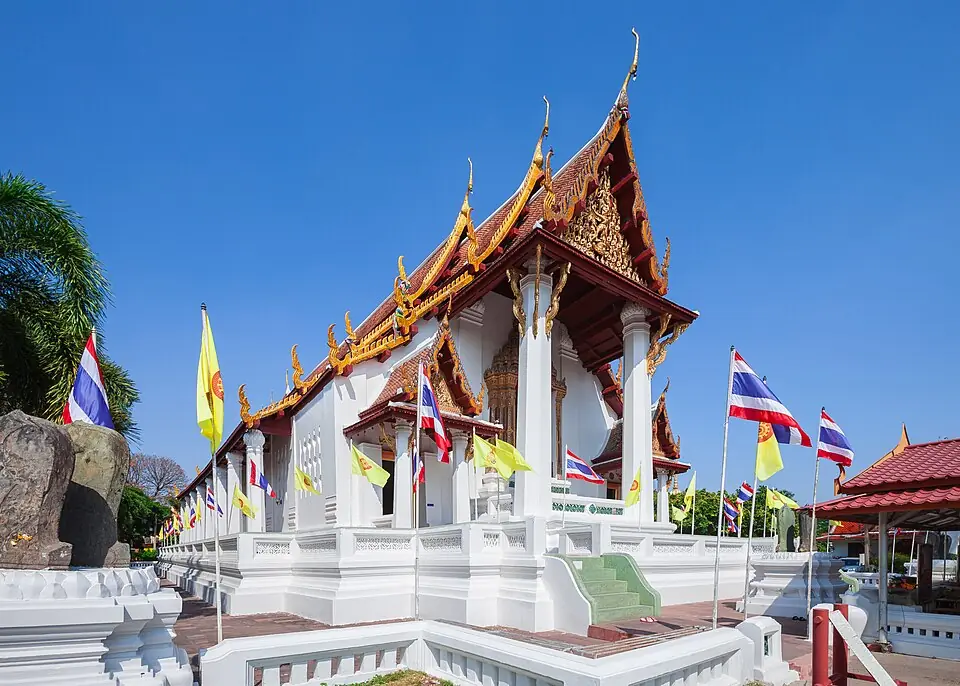
The Ayutthaya-style ubosot (ordination hall) is still in good condition and houses a large crowned and bejewelled Buddha image. The small wihan contains the Phra Khanthararat, a green-stone Buddha seated with legs pendant, in the Dvaravati style.
Origins: where does the name Na Phra Men come from?
There is no clear evidence of who built this temple or when. There is only a legend that it was built by Phra Ong In in 1503, in the reign of King Ramathibodi II, and that it was originally called Wat Phra Men Rachikaram.
The word phra men refers to a royal cremation site, so some suggest that the temple may have stood near a cremation ground of the early Ayutthaya period, but this remains only a hypothesis.
The temple stands off the city island to the north, opposite the royal palace. It is precisely this position, facing the palace with only a canal in between, that made the temple the stage for several episodes of war.
The White Elephant War and the truce of 1563–1564
In 1563 King Bayinnaung of Hanthawaddy marched on Ayutthaya with a great army, citing as his pretext that he had asked King Maha Chakkraphat for white elephants and been refused. The Hanthawaddy army took the northern cities, including Phitsanulok, then moved south and closed in on Ayutthaya.
According to the royal chronicles, King Maha Chakkraphat chose to negotiate rather than keep fighting. A pavilion was set up between Wat Phra Men Rachikaram and Wat Hatsadawat for the two kings to meet. Ayutthaya had to accept a number of harsh conditions and became a vassal state of Hanthawaddy in early 1564:
- Hand over 4 white elephants, more than had originally been demanded
- Send Prince Ramesuan, the king's son, together with senior nobles, as hostages
- Send 30 elephants and 300 chang of silver as tribute every year
- Grant Hanthawaddy the right to collect taxes at Mergui (Myeik)
What it has to do with King Naresuan
In this same war, when Phitsanulok surrendered, King Bayinnaung had Phra Maha Thammaracha, the governor of Phitsanulok (later King Maha Thammaracha), send his son Naresuan to Hanthawaddy as a hostage. Naresuan was then about 9 years old (he was born in 1555).
There is no evidence that Naresuan was present at the negotiations in front of this temple, since he was a hostage from the Phitsanulok side. But the negotiations here were the closing scene of the very war that took him far from home. He lived in Hanthawaddy for several years before returning in 1571.
In the reign of King Maha Thammaracha, around 1570, a Cambodian army once again set up its war elephants and troops around Wat Na Phra Men, but failed to take the capital and withdrew.
King Alaungpaya's cannon, and surviving 1767
In 1760 King Alaungpaya's army crossed to the Phu Khao Thong Field and set up cannon at Wat Na Phra Men and Wat Hatsadawat, firing into the royal palace and damaging the spires of its halls.
The Thai chronicles say that during this bombardment a cannon burst and King Alaungpaya was gravely wounded, so the Burmese army withdrew and he died on the way home. Burmese records, by contrast, say that he fell ill and died while the army was marching back.
When Ayutthaya fell in 1767, Wat Na Phra Men was one of the few temples that were not burned. It is believed this was because the Burmese army used the temple as a camp. The ubosot and the principal Buddha image therefore survived, even though the temple was then left abandoned for more than half a century.
In the reign of King Rama III, Phraya Chaiwichit (Phueak), the governor of the old capital, oversaw the restoration of the temple between 1835 and 1838, and built the small wihan (assembly hall) in 1838.
What to see: the crowned Buddha and the Phra Khantharat
The ubosot faces south and measures about 50 metres long and about 16 metres wide. Its carved and gilded wooden pediment shows Vishnu (Phra Narai) riding Garuda, surrounded by celestial beings. Inside are octagonal columns topped with lotus-bud capitals.
The principal Buddha image is Phra Phutthanimit Wichit Man Moli Si Sanphet Borommatrailokkanat, a bronze crowned Buddha in the posture of subduing Mara, about 6 metres tall with a lap about 4.4 metres wide, wearing a crown, earrings and a necklace. Scholars date it to the late Ayutthaya period, around the reign of King Prasat Thong.
In the small wihan beside the ubosot sits the Phra Khantharat, a green-stone Buddha image of the Dvaravati period, seated with legs pendant and making the gesture of the First Sermon. It is more than a thousand years old and is one of the most complete green-stone Buddha images of this kind in Thailand.
Wat Na Phra Men through the eras
This spot on the north bank of the canal, opposite the palace, has seen very different stories in each era:
- Founding of the city (1351–1488): there is no evidence yet that the temple existed; legend puts its construction in 1503, shortly after this period.
- Naresuan's time (1548–1605): the setting for the truce talks of the White Elephant War in 1563–1564, and a Cambodian army camp around 1570.
- King Narai's time (1656–1688): the crowned principal Buddha image, made or restored in the reign of King Prasat Thong, Narai's father, was probably already in place.
- The second fall of Ayutthaya (1767): the Burmese army had set up cannon here in 1760, and when the city fell it used the temple as a camp, so the temple escaped burning.
- Today: a working temple with resident monks, restored in the reign of King Rama III and on several later occasions, and registered as an ancient monument since the BE 2470s (1927–1936).
Where historians still disagree
- When the temple was built: the year 1503 and the builder's name come from legend; no contemporary document confirms them yet.
- King Alaungpaya's injury: the Thai chronicles say he was wounded when a cannon burst, while Burmese records say he fell ill. Even on the Thai side, some researchers point out that the chronicles do not state clearly that the cannon burst at Wat Na Phra Men.
- Where the Phra Khantharat came from: an inscription states that it was brought from Wat Mahathat in Ayutthaya, but a record from the reign of King Rama V says it came from Wat Phra Men in Nakhon Pathom, while the French scholar Jean Boisselier considered it unlikely to have come from Nakhon Pathom.
- Why the temple survived in 1767: the explanation that the Burmese used it as a camp is a belief handed down over time; no Burmese document confirms it directly.
Visiting information
- This is a working temple with resident monks, so dress modestly and behave respectfully.
- Take off your shoes before entering the ubosot and the small wihan.
- Look out for signs about photography inside the buildings, and do not use flash on the Buddha images.
- It is off the city island, across from the Ancient Royal Palace, so it is easy to combine with a visit to Wat Phra Si Sanphet.
Frequently asked questions
Why wasn't Wat Na Phra Men burned by the Burmese?
It is believed that the Burmese army used the temple as a camp in 1767 and so did not burn it, which is why the ubosot and the crowned principal Buddha image still survive.
What is King Naresuan's connection to Wat Na Phra Men?
Near this temple, the truce ending the White Elephant War of 1563–1564 was negotiated. That was the same war that led to Naresuan being taken to Hanthawaddy as a hostage at about 9 years old, although he was not present at the negotiations.
What is a crowned Buddha image?
It is a Buddha image adorned with royal regalia such as a crown and necklace, a style popular in the late Ayutthaya period. Some scholars link it to Maitreya, the future Buddha, or to the legend of King Jambupati.
Last updated 10 November 2026