Home › Places › Wat Phra Si Sanphet
Wat Phra Si Sanphet: The Temple Inside Ayutthaya's Royal Palace and Its Three Chedis
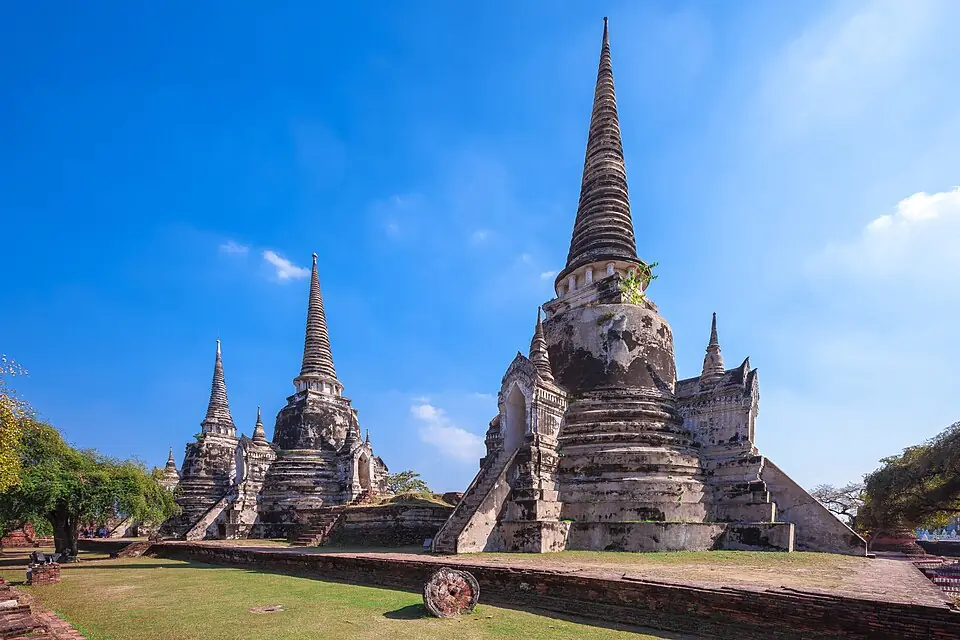
Wat Phra Si Sanphet was the royal temple inside the palace grounds of Ayutthaya, built on land that had once been King U Thong's own palace. Its signature sight is a row of three bell-shaped chedis (stupas) that held the ashes of kings, and it was once home to the Phra Si Sanphet, a huge standing Buddha image covered in gold. Today the image of the three chedis is the one people around the world picture when they think of Ayutthaya.
This place through the eras
This was King U Thong's first royal palace. Later King Borommatrailokkanat gave the old palace grounds to become a temple within the palace precinct. It had no resident monks and was used for the court's royal ceremonies, much like Wat Phra Kaew in Bangkok.
The three bell-shaped chedis already stood in a row. The first two were built under King Ramathibodi II (c. 1492) and the third in the following reign. The wihan (assembly hall) housed the Phra Si Sanphet, a huge standing Buddha image covered in gold, cast in 1500. The temple was used for the court's royal ceremonies throughout Naresuan's reign.
Still the royal temple of the palace. The gold-covered Phra Si Sanphet still stood in the wihan.
The Burmese burned the wihan and stripped off the gold that covered the Phra Si Sanphet; the image was so badly damaged that only fragments were left.
The three chedis in a row are the iconic image of Ayutthaya. King Rama I had the fragments of the Phra Si Sanphet brought to Bangkok and enshrined in a great chedi at Wat Phra Chetuphon (Wat Pho).
Origins: from King U Thong's palace to a temple within the palace
When King U Thong founded Ayutthaya in 1351, he built his palace in the Nong Sano area, near Bueng Phra Ram (the Phra Ram lake). The ground that is now Wat Phra Si Sanphet was therefore the residence of Ayutthaya's first kings for nearly a hundred years.
Later, when King Borommatrailokkanat came to the throne around 1448, he had a new palace built further north, close to the old course of the Lopburi River, which is today Khlong Mueang, and gave the old palace grounds over to become a temple precinct. That is how this temple came into being as a temple inside the royal palace.
Because it stood within the palace, Wat Phra Si Sanphet had no resident monks; instead it was used for the kingdom's most important royal ceremonies. Scholars regard it as the model for Wat Phra Si Rattana Satsadaram (Wat Phra Kaeo, the Temple of the Emerald Buddha) in the Grand Palace in Bangkok, which is likewise a palace temple with no resident monks.
The three chedis and the Phra Si Sanphet Buddha
According to the royal chronicles, King Ramathibodi II had the first two chedis built in 1492. The eastern chedi held the ashes of his father, King Borommatrailokkanat, and the middle one the ashes of his elder brother, King Borommaracha III.
Later, in the reign of King Borommaracha IV (1529–1533), a third chedi was added on the west to hold the ashes of King Ramathibodi II himself. All three are built of brick and stucco, with porches projecting on all four sides and a mondop (square shrine) set between each pair. They are regarded as key examples of the round, bell-shaped chedi of the Ayutthaya period.
In 1499 a large royal wihan (assembly hall) was built. The following year King Ramathibodi II had a great standing Buddha image cast to stand inside it, and at its dedication in 1503 he named it Phra Si Sanphet, the name by which the temple itself later came to be known.
Old records say the image stood about 8 wa high, roughly 16 metres, and was covered in 286 chang of gold. Converted into kilograms, sources give figures ranging from about 171 to more than 340 kilograms, depending on which chang weight is used.
What it has to do with King Naresuan
Throughout King Naresuan's reign (1590–1605), Wat Phra Si Sanphet was the temple of the royal palace in which he lived as king. The golden Phra Si Sanphet still stood in the royal wihan, and the three chedis of his royal ancestors rose prominently close to the palace halls.
After Naresuan's death, his younger brother King Ekathotsarot (reigned 1605–1610) had five more Buddha images made and presented to the temple, a sign that it continued to be looked after throughout the time of the two brothers.
Wat Phra Si Sanphet through the eras
If you stood on the very same spot and travelled back in time, this is how the view would change from era to era:
- Founding of the city (1351–1488): the palace of King U Thong and the kings after him, until around 1448, when the grounds were given over to become a temple.
- Naresuan's time (1548–1605): the three chedis and the golden Phra Si Sanphet were complete; a temple within the palace used for royal ceremonies.
- King Narai's time (1656–1688): still an important royal temple, after King Prasat Thong had it restored, with the work completed around 1631.
- The second fall of Ayutthaya (1767): less than thirty years after a major restoration under King Borommakot around 1742, the Burmese army burned the temple and stripped the gold from the Phra Si Sanphet; most of the buildings collapsed.
- Today: the Fine Arts Department has excavated the site and restored the three chedis, while the royal wihan survives only as its base and wall lines. The temple is part of the UNESCO World Heritage Site inscribed in 1991.
The fate of the Phra Si Sanphet: from Ayutthaya to Wat Pho
When Ayutthaya fell in 1767, the gold covering the Phra Si Sanphet was stripped off, and the metal body of the image underneath was badly damaged.
In the reign of King Phra Phutthayotfa Chulalok (Rama I), the pieces were brought down to Bangkok, but the damage was too great for the image to be restored. Instead, the king had a chedi built to enshrine the remains at Wat Phra Chetuphon Wimon Mangkhalaram (Wat Pho): the Phra Maha Chedi Si Sanphetdayan, the one decorated with green tiles.
So anyone who visits Wat Pho and sees the great green chedi is looking at the resting place of this important Buddha image from Wat Phra Si Sanphet, a link between the old capital and the new one that you can still see and touch.
What to see
Once inside the temple grounds, look at the three chedis from the front to see how they line up east to west, then walk around them to notice the porches on all four sides and the mondops joining one chedi to the next. After that, look for the base of the royal wihan where the Phra Si Sanphet once stood.
- The three bell-shaped chedis that held the ashes of kings
- The base of the royal wihan, the original home of the Phra Si Sanphet
- The remains of the Ancient Royal Palace just to the north
- Wihan Phra Mongkhon Bophit next door, where people still come to pay their respects
- Around 1932, a set of miniature stupas nested one inside another, together with relics, was found in the eastern chedi; they are now on display at the Chao Sam Phraya National Museum
Where historians still disagree
- When each chedi was built and by whom: different versions of the royal chronicles give different years for the enshrining of the royal ashes (1492 versus 1474). Prince Damrong Rajanubhab took the view that two chedis were built first and the third added later; some scholars suggest they may all have been built at the same time, and others believe the eastern chedi came first, as early as the reign of King Borommatrailokkanat.
- The weight of the gold on the Phra Si Sanphet: old records give 286 chang, but conversions into modern units vary widely, from about 171 to more than 340 kilograms.
- A large Buddha head believed to come from Wat Phra Si Sanphet, now in the National Museum, was once proposed to be the head of the Phra Si Sanphet itself, but other scholars argue that it is not, and it has been suggested that it may come from a different Buddha image.
Visiting information
- Admission: Information updated December 2025: Thai visitors THB 10, foreign visitors THB 80, or a combined ticket for 7 sites in the Historical Park at THB 40 for Thai visitors and THB 300 for foreign visitors (subject to change).
- Dress modestly, with shoulders and knees covered, as this is a religious site.
- Go in the morning or late afternoon to avoid the strongest sun, and bring a hat, an umbrella and drinking water.
- Do not climb the chedis or sit on the bases of the ancient structures.
- In heavy rain or strong wind, avoid standing under large trees.
- Check the latest opening hours on the Ayutthaya Historical Park page before you go.
Opening hours and admission fees may change, so please check before you go.
Frequently asked questions
Does Wat Phra Si Sanphet have resident monks?
No. Because it was a temple inside the royal palace, it was used for the king's royal ceremonies, much like Wat Phra Kaeo in Bangkok.
What do the three chedis of Wat Phra Si Sanphet contain?
According to the royal chronicles, they hold the ashes of King Borommatrailokkanat, King Borommaracha III and King Ramathibodi II.
Where is the Phra Si Sanphet Buddha now?
After it was destroyed in 1767, King Rama I had its remains brought to Bangkok and enshrined in the green Phra Maha Chedi Si Sanphetdayan at Wat Pho.
Are Wat Phra Si Sanphet and Wihan Phra Mongkhon Bophit the same place?
They stand side by side but are separate sites. Wihan Phra Mongkhon Bophit houses a large bronze Buddha image that people still come to worship, while Wat Phra Si Sanphet is an ancient ruin.
- WAT PHRA SRI SANPHET – Ayutthaya Historical Research
- Wat Phra Si Sanphet – Southeast Asian Art Database, Princess Maha Chakri Sirindhorn Anthropology Centre
- Wat Phra Si Sanphet – SchoolNet Electronic Library (NECTEC) (in Thai)
- Phra Maha Chedi Si Rajakarn – Wat Phra Chetuphon Wimon Mangkhalaram (Wat Pho)
- The large Buddha head in the National Museum is not the "Phra Si Sanphet" – Silpa Wattanatham (in Thai)
- Historical Park & Museum Fees – Ayutthaya Historical Research
Last updated 10 November 2026