Home › Places › Wihan Phra Mongkhon Bophit
Wihan Phra Mongkhon Bophit: The Colossal Buddha That Survived the Fires of Ayutthaya's Wars
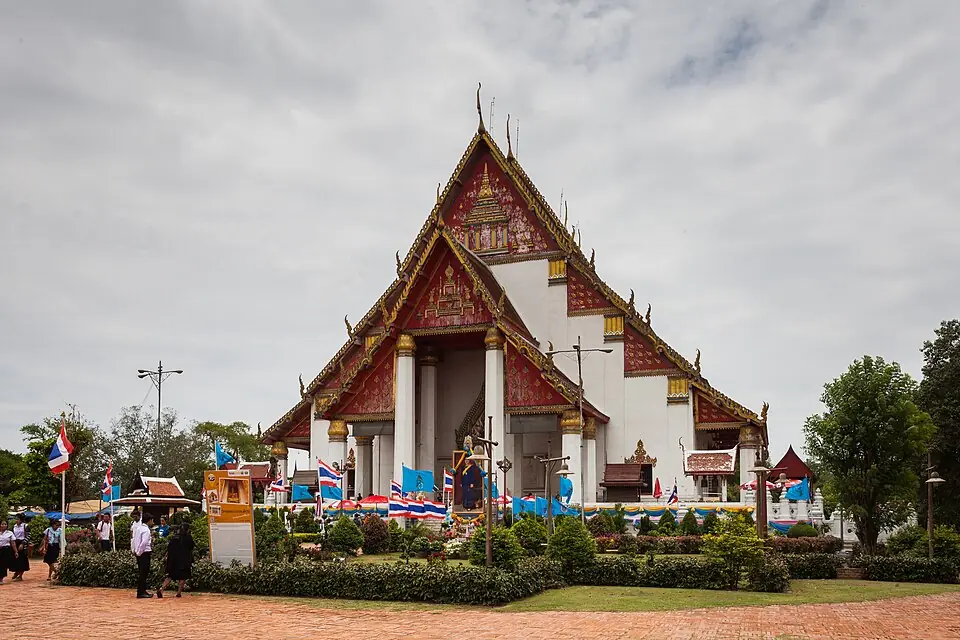
Wihan Phra Mongkhon Bophit stands in the middle of Ayutthaya's city island, south of Wat Phra Si Sanphet. Inside is Phra Mongkhon Bophit, a huge seated Buddha in the "subduing Mara" posture, about 9.5 metres across the lap. The image has survived being moved, being struck by lightning and the fires of the fall of Ayutthaya in 1767, and it is still worshipped by people today.
This place through the eras
Neither Phra Mongkhon Bophit nor this hall exists yet. The area is close to King U Thong's original palace, which King Borommatrailokkanat later gave over to become Wat Phra Si Sanphet.
Most sources say Phra Mongkhon Bophit was cast around 1538, in King Chairacha's reign, and first stood a little further east. The chronicles date its move westward, and the building of a mondop (square shrine) over it, to Chula Sakarat 965 (1603), late in Naresuan's reign, yet credit the work to King Songtham, so researchers think the date is probably wrong.
Phra Mongkhon Bophit sits in a mondop south of Wat Phra Si Sanphet, near the Ancient Royal Palace where King Narai lived. Van Vliet's account (1640) describes the old temple being pulled down and the image moved here, not long before this era.
Fire during the fall of Ayutthaya in 1767 brought the hall's roof crashing down, breaking the Buddha's head and right arm. Later, King Ekkathat's body was buried on the mound in front of the hall, until King Taksin had it exhumed and cremated.
The head and arm were repaired in 1920. Field Marshal Plaek Phibunsongkhram's government built a new hall in 1956–1957, with a donation from the Burmese prime minister of the time, and the whole image was gilded in 1992. Today it is worshipped by large numbers of people.
Where Phra Mongkhon Bophit came from
Most sources suggest that Phra Mongkhon Bophit was cast around 1538, in the reign of King Chairacha, citing the Luang Prasoet Chronicle. Other versions of the chronicles, however, give a date about 20 years earlier, so the year of casting is still unsettled.
The image is a seated Buddha in the "subduing Mara" posture (right hand touching the ground), cast in bronze over a brick core and then gilded. It is about 9.5 metres across the lap and about 12.5 metres high excluding the base; the provincial tourism information gives the height as 12.54 metres.
Phra Mongkhon Bophit did not originally stand here. Information compiled by ayutthaya-history.com says it was once enshrined at Wat Chi Chiang, a little further east, before being moved westward to its present position.
When it was moved here, and how it relates to Naresuan's era
The royal chronicles say the original temple was damaged by lightning, so King Songtham had Phra Mongkhon Bophit moved to the west and built a mondop (square shrine) over it. The chronicles date this event to Chula Sakarat 965 (BE 2146, 1603).
The problem is that 1603 still falls within the reign of King Naresuan (r. 1590–1605), not that of King Songtham, so the chronicle dates for this period are probably wrong. The researcher behind ayutthaya-history.com considers the account of Jeremias van Vliet (1640), which describes the temple being pulled down and the image moved, more reliable, and estimates that the move took place around 1637.
The chronicles also record that the open ground in front of the hall was set aside as the Sanam Na Chakkrawat, the royal ground for cremation ceremonies, in Chula Sakarat 968 (1606), the year after Naresuan's death. If that date is correct, it fits an observation by some scholars in the debate over where Naresuan was cremated: that at that time there was not yet a Sanam Na Chakkrawat for royal funerals.
In short, Phra Mongkhon Bophit already existed in Naresuan's time, but there is no firm evidence that he had any part in moving the image or building the mondop.
Lightning, the fires of war, and restoration
In the reign of King Suea, lightning struck the top of the mondop and set it ablaze. The roof fell in, breaking the image's neck and head. King Suea had the mondop pulled down and a large wihan (assembly hall) built in its place, which took about two years. The chronicles also mention a restoration in the reign of King Borommakot around 1742, which some scholars think is the same event retold under a different date.
When the city fell in April 1767, fire swept through the hall and the roof collapsed onto the image, breaking its head and right arm. Phra Mongkhon Bophit remained in that state for more than a hundred and fifty years.
Modern repairs began in 1920, in the reign of King Vajiravudh (Rama VI), when Phraya Boran Ratchathanin repaired the head and right arm. It was repaired again in 1931 with funds from devotees, and in 1956–1957 the government of Field Marshal Plaek Phibunsongkhram built a new hall, with the Burmese prime minister of the time contributing to the cost.
During that restoration, many small Buddha images were also found inside the great image; they were taken to the Chao Sam Phraya and Chandra Kasem National Museums for safekeeping. Later, in 1992, the Phra Mongkhon Bophit Foundation gilded the entire image to mark Queen Sirikit's 60th birthday.
Wihan Phra Mongkhon Bophit through the eras
See how this spot on the map changes in each era.
- Founding of the capital (1351–1488): Neither Phra Mongkhon Bophit nor this hall exists yet. The area is close to King U Thong's original palace, which later became Wat Phra Si Sanphet.
- Naresuan's era (1548–1605): Phra Mongkhon Bophit has been cast and stands nearby to the east. The chronicles date its move to this spot to 1603, but scholars think it probably happened later.
- King Narai's era (1656–1688): Phra Mongkhon Bophit sits in a mondop south of Wat Phra Si Sanphet, near the Ancient Royal Palace.
- Fall of Ayutthaya (1767): Fire swept through the hall and the roof collapsed onto the image. Later, King Ekkathat's body was buried on the mound in front of the hall, until King Taksin had it exhumed and cremated with full honours.
- Today: The new hall built in 1956–1957 and the fully gilded Buddha image are worshipped by Thais and visitors alike.
What to see
The hall you see today is a new building, but important ruins surround it.
- Phra Mongkhon Bophit: stand at the front door to see how large the image is compared with the hall itself.
- The open ground in front of the hall, which the chronicles say was once set aside as the Sanam Na Chakkrawat for royal cremation ceremonies.
- Wat Phra Si Sanphet, right next door to the north, the temple within the grounds of the Ancient Royal Palace.
- Wat Phra Ram across the road, the temple built on King U Thong's cremation site.
Getting there and visiting
Wihan Phra Mongkhon Bophit is in the middle of the city island, next to Wat Phra Si Sanphet, so it is often one of the first stops on a visit to the Historical Park. The Ancient Royal Palace and Wat Phra Ram are a short walk away.
Because it is an active place of worship, dress modestly and take off your shoes before entering the hall. Come in the morning if you want to pay respects in peace. Check opening times on the sign in front of the hall before you go.
Where historians still disagree
- Year the image was cast: most sources use 1538, following the Luang Prasoet Chronicle, but other versions of the chronicles give a date about 20 years earlier.
- Year the image was moved here: the chronicles give Chula Sakarat 965 (1603), which falls in Naresuan's reign, yet credit the work to King Songtham. Some trust van Vliet's account more and estimate that the move took place around 1637.
- Restorations under King Suea and King Borommakot: the chronicles describe two restorations under different dates; some think they are the same event recorded twice.
- Sanam Na Chakkrawat: the chronicle dates suggest the ground in front of the hall was set aside shortly after Naresuan's death, but the dates for this period are unreliable, so they cannot settle the question of where Naresuan was cremated.
Visiting information
- Dress modestly and take off your shoes before entering the hall.
- Mornings are less crowded and good for paying respects in peace.
- Combine your visit with Wat Phra Si Sanphet and Wat Phra Ram, right next door.
Frequently asked questions
When was Phra Mongkhon Bophit made?
Most sources suggest it was cast around 1538, in the reign of King Chairacha, but some versions of the chronicles give a different date.
How big is Phra Mongkhon Bophit?
It is about 9.5 metres across the lap and about 12.5 metres high excluding the base; figures vary slightly between sources.
How old is the present Wihan Phra Mongkhon Bophit?
The present hall was rebuilt in 1956–1957, replacing the original hall damaged by fire in the fall of Ayutthaya in 1767.
Last updated 10 November 2026