Home › Places › Wat Mae Nang Pluem
Wat Mae Nang Pluem: a lion-ringed chedi and the legend of the old woman who gave King Naresuan shelter
Wat Mae Nang Pluem is an old temple on Khlong Mueang, north of Ayutthaya's city island. Its highlights are a bell-shaped chedi with stucco lions ringing its base and Luang Pho Khao, a much-revered Buddha image. The temple's name is tied to the legend of an old woman named Pluem who gave King Naresuan the Great shelter on a stormy night. The story has roots in a Dutch account written in 1640, but it also has points that do not fit the royal chronicles, which are worth knowing about.
This place through the eras
Legend and provincial tourism information say the temple was built around 1377; its original name is unknown. The principal bell-shaped chedi is judged to be early Ayutthaya work with Sukhothai influence.
The chronicles mention this temple around 1548, when a herd of wild elephants came near it before being driven into the kraal at Wat Song. Van Vliet's account (1640) tells how King Naresuan, caught in a storm while travelling by boat, sheltered at an old woman's house and later took her into the palace and called her mother. Temple legend says he had the temple repaired and named it after her, although the name seems to appear in the chronicles before his reign.
The landing in front of the temple, Tha Khun Nang, was an important ferry crossing on the north side of the capital. Some researchers think the temple's lion-ringed chedi was built or remodelled after the lion-ringed chedi of Wat Thammikarat.
Local stories say this area was a Burmese camp before the fall of the capital, hence the name Khok Phama (Burmese Mound). The temple was not as badly damaged as others, so its key monuments survive.
The wihan was restored in the early Rattanakosin period, and in 2000 the Fine Arts Department restored the chedi, the wihan and the Buddha images. Today it is a working temple with resident monks, and Luang Pho Khao is a Buddha image people come to pray to for blessings.
Origins and the temple's name
Wat Mae Nang Pluem stands on Khlong Mueang, the old course of the Lopburi River north of the city island, near where Khlong Hua Ro joins it. In the Ayutthaya period the landing in front of the temple was called Tha Khun Nang, and it was an important ferry crossing on the north side of the capital, over to the Maha Chai Fortress bank.
Legend and provincial tourism information say the temple was built around 1377, in the early years of the Ayutthaya kingdom. Its original name is not known for certain; provincial information mentions the old names Wat Nang Pluem and Wat Som Pluem.
The royal chronicles mention this temple in an event of around 1548, when a herd of wild elephants came near the temple before being driven into the elephant kraal at Wat Song. The researcher behind ayutthaya-history.com points out that the chronicles already use the name Wat Mae Nang Pluem at that point.
The legend of Mae Pluem and King Naresuan
The story that made this temple famous has its roots in the account of the Dutchman Jeremias van Vliet, written in 1640. It tells how King Naresuan was once travelling by boat when he was caught in a rainstorm, and stopped to shelter at the house of a poor old woman, without anyone recognising that he was the king.
In that account, the king asked for liquor even though it was a period of religious observance. The old woman agreed to find some for him, saying she had bought it before the day it was forbidden. The next morning the king sent a royal barge to fetch her. She was terrified that she would be punished, but when she came before him he said that he would call her mother, and he had her live in the palace until her death, after which he gave her an honourable cremation.
The version told in Thailand is similar in outline. An article in Post Today says Mae Pluem was a woman who lived alone by the water on the outskirts of the capital. That night was a Buddhist holy day (wan phra), so she reminded her unknown guest to keep his voice down and asked him to keep her hospitality a secret. Temple legend goes on to say that when Mae Pluem died, King Naresuan had this abandoned temple repaired and gave it the name Wat Mae Nang Pluem in her memory.
There are points in this story to be careful about. Van Vliet's account does not name the temple; the link with this temple comes from the temple's own legend. And if the chronicles were already using the name Wat Mae Nang Pluem around 1548, the name existed before Naresuan came to the throne (1590), so the naming in his reign cannot be confirmed. Even so, the legend reflects how people remember King Naresuan: as a king who was close to ordinary people and never forgot those who showed him kindness.
The lion-ringed chedi and Luang Pho Khao
The principal chedi is a Sri Lankan-style bell-shaped chedi on a high base, with stucco lions lined up around the lower tier of the base. Provincial tourism information links the patterns on its lotus-moulded base to Khmer art of the Lopburi style. Chedis ringed with lions like this are very rare in Ayutthaya; the closest comparison is Wat Thammikarat on the city island.
The lions at the two temples look different, so the researcher behind ayutthaya-history.com suggests that the chedi here was built or remodelled after the lion-ringed chedi of Wat Thammikarat. The bell-shaped body of the chedi itself is judged to be early Ayutthaya work with Sukhothai influence, similar to the chedi of Wat Maheyong.
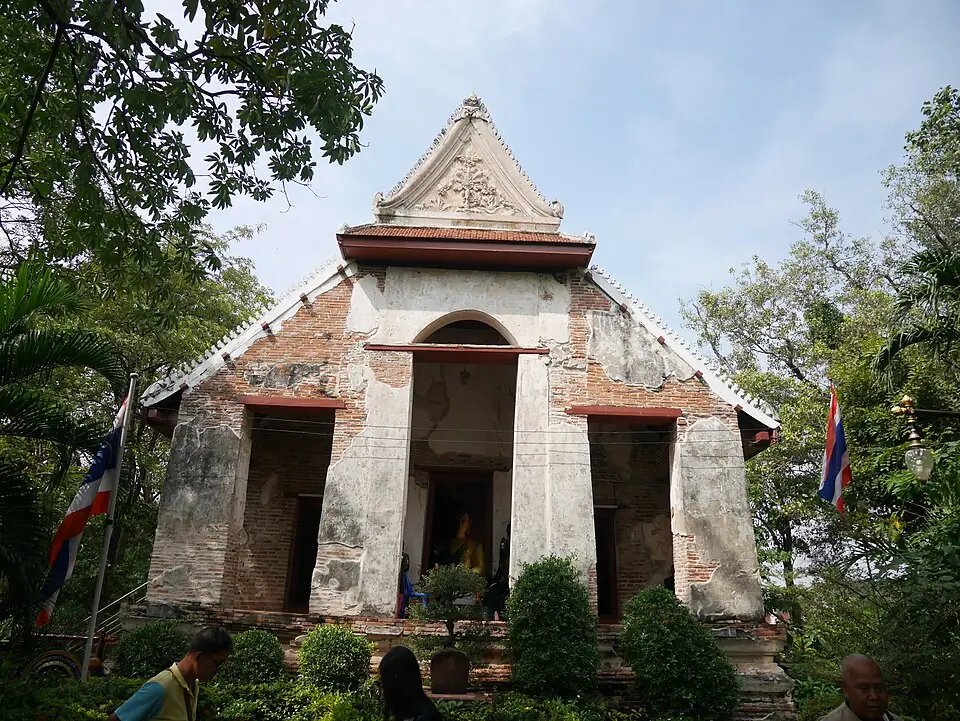
The wihan (assembly hall) houses Luang Pho Khao, or Phra Phutthanimit Mongkhon Si Rattanatrai, a Buddha image people come to pray to for blessings, often offering boiled eggs and flower garlands. The wihan's pediment has stucco decoration with a Chinese influence, in the style popular in the reign of King Rama III, while the carved wooden pediment from the back of the wihan is now kept at the Chao Sam Phraya National Museum.
Wat Mae Nang Pluem through the eras
This temple has a continuous story from the early years of the capital to the present day.
- Founding of the capital (1351–1488): legend says the temple was built around 1377, and the principal bell-shaped chedi is judged to be early Ayutthaya work.
- Age of King Naresuan (1548–1605): the chronicles mention the temple around 1548, and the legend of Mae Pluem says King Naresuan repaired the temple and named it after the old woman who gave him shelter.
- Age of King Narai (1656–1688): the landing in front of the temple was an important ferry crossing on the north side of the capital, and the lion-ringed chedi may have been remodelled during the middle to late Ayutthaya period.
- Second fall of Ayutthaya (1767): local stories say there was a Burmese camp here known as Khok Phama, but the temple was not very badly damaged.
- Today: a working temple with resident monks; the Fine Arts Department restored its monuments in 2000, and people come regularly to pay respects to Luang Pho Khao.
What to see
The temple is not large and does not take long to walk around, but it has details that are rare in Ayutthaya.
- The bell-shaped chedi with stucco lions around its base; compare it with the lion-ringed chedi of Wat Thammikarat.
- The wihan of Luang Pho Khao and its pediment's stucco decoration with Chinese influence.
- The bank of Khlong Mueang in front of the temple, once an important ferry crossing on the north side of the capital.
Getting there and visiting
The temple lies north of the city island, a short way across Khlong Mueang from the island side. It is in the same area as Wat Na Phra Men and on the way to the Elephant Kraal (Phaniat Khlong Chang), and is easy to reach by bicycle, motorbike or tuk-tuk.
The temple still has resident monks and people come regularly to pay respects to Luang Pho Khao, so dress modestly, and if you bring offerings, place them where the temple has set aside for them. If you are coming from Chandra Kasem Palace, you can continue to Wat Senasanaram and Wat Na Phra Men on the same route.
Where historians still disagree
- The legend of Mae Pluem: van Vliet's account (1640) tells of an old woman who gave King Naresuan shelter, but it does not name the temple; the link with this temple comes from the temple's own legend.
- Did the temple's name exist before Naresuan? Legend says King Naresuan gave the name, but some researchers point out that the chronicles already use the name Wat Mae Nang Pluem in an event of around 1548, before his reign.
- Age of the chedi and its lions: the chedi itself is judged to be early Ayutthaya work, but the lions around the base may have been added or remodelled later, and sources disagree on the date of the chedi's base.
- The Burmese camp: the story of Khok Phama is local lore; no clear traces of a camp have yet been found.
Visiting information
- Dress modestly, as this is a working temple with resident monks and people come here to worship.
- Do not climb the chedi or sit on the stucco lions.
- Combine your visit with Wat Na Phra Men and Chandra Kasem Palace on the same route.
Frequently asked questions
Who was Mae Nang Pluem?
According to legend, Mae Pluem was an old woman who gave King Naresuan shelter on a stormy night. He later took her into the palace and called her mother. The story has roots in van Vliet's account of 1640.
What is interesting about Wat Mae Nang Pluem?
Its bell-shaped chedi with stucco lions around the base, which is rare in Ayutthaya, and the wihan of Luang Pho Khao, a Buddha image people come to pray to for blessings.
Did King Naresuan really name Wat Mae Nang Pluem?
That is what the legend says, but there is no confirming evidence, and the chronicles seem to use the temple's name before his reign.
Last updated 10 November 2026