Home › Places › Wat Ratchaburana
Wat Ratchaburana: Chao Sam Phraya's Temple, Its Gold Treasure and the Murals Beneath the Prang
Wat Ratchaburana was built in 1424 by King Borommaracha II, better known as Chao Sam Phraya, on the spot where his two elder brothers were cremated after they killed each other fighting on elephant-back. Beneath its main prang lies a crypt that once held a great hoard of gold objects, along with rare early Ayutthaya-period mural paintings.
This place through the eras
Built in 1424 by Borommaracha II (Chao Sam Phraya) on the site where his two elder brothers, Chao Ai Phraya and Chao Yi Phraya, were cremated; they had fought each other on elephants over the throne and both died.
A royal temple still in its prime. Beneath the main prang was a crypt holding Buddha images and gold objects offered when the temple was built.
Still an important royal temple in the middle of the capital.
Burned like the other temples on the city island, but the crypt under the prang was not discovered.
In 1957 looters dug into the crypt, so the Fine Arts Department excavated the rest and found a large hoard of gold objects, such as a gold elephant in full regalia and royal utensils, which can be seen at Chao Sam Phraya National Museum. The crypt also contains early mural paintings.
Origins: three brothers and a fight for the throne
When King Intharacha died in 1424, two of his sons, Chao Ai Phraya and Chao Yi Phraya, each marched their forces into the capital to seize the throne. According to the royal chronicles, the two princes fought each other on elephant-back near the Pa Than Bridge, and both were killed.
Chao Sam Phraya, the youngest son, therefore came to the throne as King Borommaracha II. He had his two elder brothers cremated, built two chedis on the spot where they had fought, and built Wat Ratchaburana on the site of the cremation.
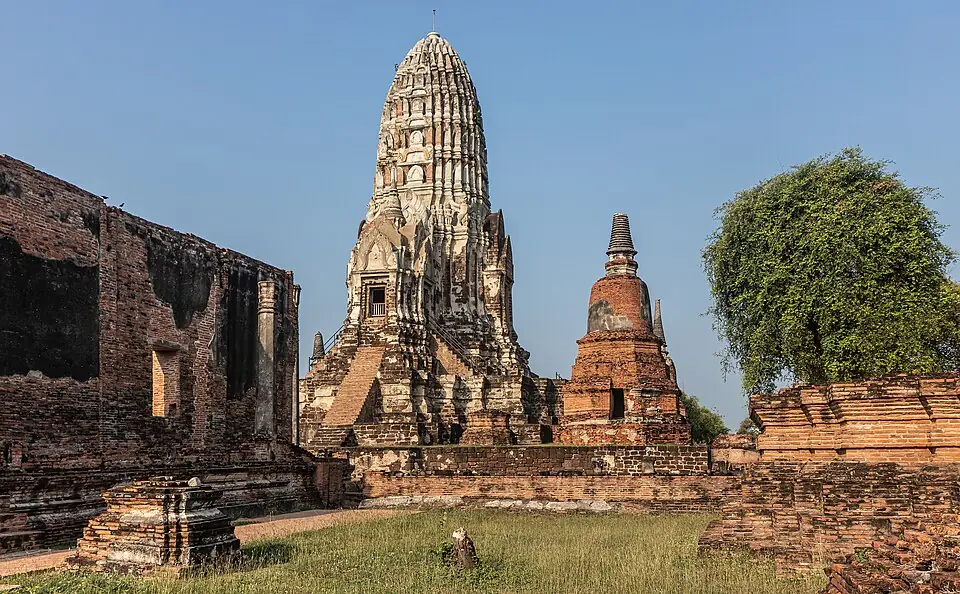
The main prang stands at the centre of the layout, surrounded by a gallery (cloister), following a plan inherited from Khmer art that represents Mount Meru. You can still see stucco figures of Garuda gripping nagas on the tower today.
The crypt beneath the prang: the 1957 looting
In the BE 2490s (1947–1956), looters frequently dug for treasure in the abandoned temples of Ayutthaya. In late September 1957, a gang broke into the crypt beneath the prang of Wat Ratchaburana and carried off a large quantity of gold objects.
Police arrested several of those involved but recovered only part of the haul. Much of the gold was sold on and has never been recovered to this day.
Immediately afterwards, Fine Arts Department staff inspected the crypt and found a lower chamber that the thieves had not reached, containing a gold stupa and many more valuables. The following year, 1958, the Fine Arts Department began systematic excavation and restoration and built a staircase down into the crypt.
Stories of curses striking those who dug into the crypt spread widely at the time, but they are better read as folklore than as historical fact.
The gold from the crypt and the Chao Sam Phraya National Museum
The finds from the crypt included royal regalia and utensils, jewellery, Buddha images and an enormous number of votive tablets. One standout piece is the Phra Saeng Khan Chai Si, a royal sword in early Ayutthaya style dating from around the 15th century (the 20th century of the Buddhist Era), whose decoration shows Persian-Islamic influence. There is also a gold model of a royal war elephant, a small crown (chulamongkut) and several hundred gold rings set with gems.
In 1959 the government sold some of the votive tablets to the public to help fund the building of a museum, which opened on 26 December 1961 and was named after the temple's founder: the Chao Sam Phraya National Museum.
Today the gold objects from the crypts of Wat Ratchaburana and Wat Mahathat are displayed together in the museum's Ayutthaya Gold Gallery, which has increased the number of pieces on show from about 1,000 to more than 2,000.
The mural paintings in the crypt
The crypt beneath the prang has several levels. One has faded paintings of figures in Chinese dress, with a few Chinese characters still legible. Another has clearer paintings of the Buddha, his disciples, trees, birds and floral patterns, some of them gilded.
An academic study published in 2024 describes the paintings on the second level of the crypt as divided into rectangular panels telling the life of the Buddha, the Jataka tales, the past Buddhas and the Eighty Great Disciples, along with a depiction of the Buddha's Footprint on Sumanakuta (Adam's Peak) in Sri Lanka. Very little early Ayutthaya painting of this kind survives.
Because the paintings in the real crypt are becoming more and more fragile, tile replicas have been made for display at the Chao Sam Phraya National Museum, and there has been talk that the crypt itself may have to be closed in future for conservation.
Wat Ratchaburana through the eras
This same prang has stood through nearly six hundred years of events. Picture it era by era:
- Founding of the city (1351–1488): in 1424 Chao Sam Phraya built the temple as a memorial to his elder brothers and placed gold objects in the crypt beneath the prang.
- Naresuan's time (1548–1605): a royal temple more than 160 years old, standing at the centre of the capital beside Wat Mahathat, on the banks of Khlong Pratu Khao Plueak, the canal that ran through the middle of the city.
- King Narai's time (1656–1688): still an important temple in the centre of the city, while the treasures in the crypt remained sealed underground.
- The second fall of Ayutthaya (1767): according to the royal chronicles, a great fire in late 1766 spread from Tha Sai as far as this temple, and the temple was destroyed when the city fell, but the crypt beneath the prang had still not been opened.
- Today: the prang has been restored. After the great flood of 2011, the Fine Arts Department worked with a German conservation project to repair the stucco and strengthen the foundations between 2011 and 2013.
What to see
Start by looking at the main prang from the front, then walk closer to see the stucco Garudas gripping nagas. After that, look at the remains of the wihan (assembly hall) and the ubosot (ordination hall), of which only walls and bases survive. If the crypt is open, the stairs are narrow and steep, so go down slowly and do not touch the painted walls.
- The main prang and its stucco Garudas gripping nagas
- The crypt beneath the prang and its mural paintings (depending on whether it is open to visitors at the time)
- The bases of the royal wihan and the ubosot
- Continue to the Ayutthaya Gold Gallery at the Chao Sam Phraya National Museum
Where historians still disagree
- Why the temple was built: the traditional explanation, based on the royal chronicles, stresses that it was built on the site where the two elder brothers were cremated, while some views drawing on evidence from the crypt hold that the prang was built to enshrine relics of the Buddha in the third level of the crypt, following the custom of building a relic temple at the centre of the capital. The two explanations need not contradict each other.
- How much gold was lost: no one knows for sure how much the thieves took, because most of it was sold on before the police could trace it.
Visiting information
- Admission: Information updated December 2025: Thai visitors THB 10, foreign visitors THB 80, or a combined ticket for 7 sites in the Historical Park at THB 40 for Thai visitors and THB 300 for foreign visitors (subject to change).
- Dress modestly and wear comfortable walking shoes.
- It is hot and stuffy inside the crypt; anyone who is claustrophobic or has knee problems should think twice before going down.
- Do not use flash, and do not touch the mural paintings.
- Combine your visit with Wat Mahathat opposite, then continue to the Chao Sam Phraya National Museum.
- Check the latest opening hours on the Ayutthaya Historical Park page before you go.
Opening hours and admission fees may change, so please check before you go.
Frequently asked questions
Who built Wat Ratchaburana, and when?
King Borommaracha II (Chao Sam Phraya) had it built in 1424 on the site where Chao Ai Phraya and Chao Yi Phraya were cremated.
Can you go down into the crypt at Wat Ratchaburana?
There is a narrow, steep staircase down into the crypt, but whether it is open to visitors depends on the Historical Park's announcements at the time, because the paintings inside are fragile. Ask before you go.
Where can I see the gold from the Wat Ratchaburana crypt?
It is on display in the Ayutthaya Gold Gallery at the Chao Sam Phraya National Museum in Phra Nakhon Si Ayutthaya province, not far from the temple.
- WAT RACHA BURANA – Ayutthaya Historical Research
- Wat Ratchaburana, Ayutthaya – Wikipedia
- Opening the records of the Wat Ratchaburana crypt: the cursed treasure – Sanook (in Thai)
- Gold treasures from the crypts of Wat Ratchaburana and Wat Mahathat – Thairath Online (in Thai)
- Once more with 'Four Spots in the Old Capital': from the gold treasures to the city's guardian temples – Thai Post (in Thai)
- The Buddha's Footprint in the mural paintings inside the prang crypt of Wat Ratchaburana – Ramkhamhaeng Journal, Humanities edition (in Thai)
Last updated 10 November 2026