Wat Mahathat, Ayutthaya: The Temple at the Heart of the Old Capital, the Buddha Head in the Tree Roots and the Relic Crypt
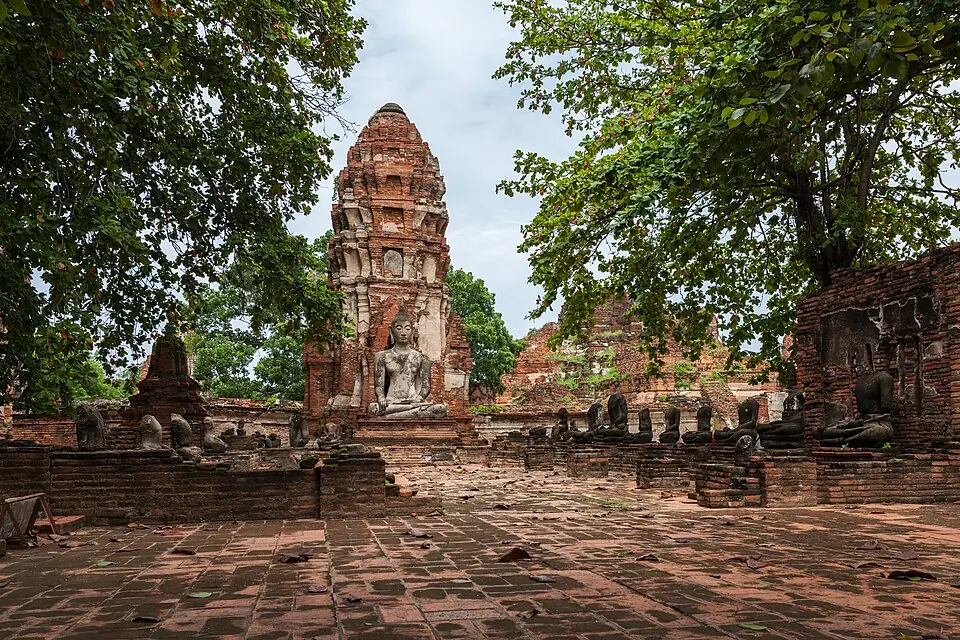
Wat Mahathat is a royal temple in the middle of Ayutthaya's city island. It once enshrined relics of the Buddha and was the seat of the Supreme Patriarch of the town-dwelling (Khamavasi) order of monks. Today people all over the world know it for the sandstone Buddha head cradled in the roots of a bodhi tree, which has become one of the defining images of Ayutthaya.
This place through the eras
An important temple at the heart of the capital since the city's early years. The chronicles disagree about who built it: some say Borommaracha I, others King Ramesuan. The main prang enshrined relics of the Buddha.
A royal temple in the middle of the capital, traditionally regarded as the seat of the Supreme Patriarch of the town-dwelling (khamawasi) monks, while the forest-dwelling (aranyawasi) monks were based at Wat Pa Kaeo (Wat Yai Chai Mongkhon).
Still an important royal temple in the middle of the capital.
Burned; many Buddha images were smashed and their heads cut off.
The Buddha head in the roots of a bodhi tree is an image known around the world. Sit or crouch down to take photos, and do not stand higher than the head. A crypt under the prang yielded a casket of Buddha relics in 1956, now on display at Chao Sam Phraya National Museum.
Origins: who built Wat Mahathat?
The Luang Prasoet Chronicle states that Wat Mahathat was built in the reign of Borommaracha I (Khun Luang Pha-ngua), in the year 736 of the Chula Sakarat (Lesser Era), which corresponds to 1374, about 23 years after the city was founded.
Chronicles compiled later, however, say that King Ramesuan founded the temple and enshrined relics of the Buddha beneath the prang in 1384. That year does not fall within his second reign (1388–1395), so most historians think the work may have begun under Khun Luang Pha-ngua and been completed under King Ramesuan.
This was the royal temple at the centre of the capital and the seat of the Supreme Patriarch of the Khamavasi order (monks who lived in town), paired with the Aranyavasi (forest-dwelling) order based at Wat Pa Kaeo, also known as Wat Yai Chai Mongkhon.
The main prang: collapsed, rebuilt and collapsed again
The main prang (Khmer-style tower) was the heart of the temple. Figures cited from the Luang Prasoet Chronicle give its height as about 46 metres. Later, in the reign of King Songtham, the top of the prang subsided and fell, taking nearly half the tower with it.
King Prasat Thong had it rebuilt in 1633, taller than before, and in the reign of King Borommakot the prang, the royal wihan (assembly hall) and the ubosot (ordination hall) were restored once again.
After the fall of Ayutthaya the temple was abandoned. On 25 May 1904 the upper part of the prang collapsed, and more of it fell in the reign of King Rama VI. What you see today is therefore only the base and lower part of the tower.
The crypt beneath the prang, 1956
In 1956 the Fine Arts Department began excavating and clearing Wat Mahathat. In a chamber beneath the base of the prang they found a gold lion, and after digging down about 17 metres they came upon an important crypt containing a large stone vessel that took several days to bring to the surface.
When the vessel was opened, it was found to hold a series of miniature stupas nested one inside another, made of many different precious materials. The innermost one contained relics of the Buddha immersed in sandalwood oil, along with gold objects, Buddha images and a large number of votive tablets. Later scientific examination found rare gemstones, such as spinel, set into the sixth layer.
Analysis also showed that the gold from the Wat Mahathat crypt and the gold from the Wat Ratchaburana crypt are of similar purity, supporting the view that both crypts were made in the early Ayutthaya period. Today the relics, the miniature stupas and the stone vessel are on display at the Chao Sam Phraya National Museum.
The Buddha head in the bodhi tree roots
The Ayutthaya-style sandstone Buddha head wrapped in the roots of a bodhi tree is the spot most visitors come specifically to see. The body of the image is long gone; only the head remains, embedded in the roots.
There is no firm evidence of how the head came to be here. Some believe it has lain here since the fall of Ayutthaya in 1767; others say thieves cut it from a Buddha image and left it behind; while some researchers state that workers placed the head under the tree during restoration work around 1968–1970 and the roots then slowly grew around it.
Today staff look after this spot, and Thais regard it as sacred. Whatever its origins, the sight of the serene Buddha face amid the tree roots is a reminder of how impermanent even a great kingdom can be.
Photo etiquette at the Buddha head
The head is the highest part of a Buddha image. The accepted custom when taking a photo with the Buddha head is to squat or kneel so that your own head is not higher than the Buddha's.
- Sit or kneel when taking a photo with the Buddha head
- Do not touch the Buddha head, lean against the tree or cross the barrier
- Do not strike funny or inappropriate poses
- Wait your turn and give others the chance to take photos
- Follow the instructions of the staff who look after this spot
Wat Mahathat through the eras
The site at the corner of Chikun Road and Naresuan Road has passed through many eras, as follows:
- Founding of the city (1351–1488): construction began around 1374–1384; a royal temple at the centre of the capital, with relics of the Buddha enshrined beneath the prang.
- Naresuan's time (1548–1605): one of the most important royal temples and the seat of the Supreme Patriarch of the town-dwelling order; the prang still stood tall before collapsing in the reign of King Songtham.
- King Narai's time (1656–1688): the prang, rebuilt in 1633, towered over the centre of the city.
- The second fall of Ayutthaya (1767): according to the royal chronicles, a great fire in late 1766 spread as far as this temple, and when the city fell the temple was burned and destroyed.
- Today: an ancient monument within Ayutthaya Historical Park, registered as an ancient monument since the BE 2470s (1927–1936).
Where historians still disagree
- Who built it and when: the Luang Prasoet Chronicle says Borommaracha I built it in 1374, while later versions say King Ramesuan built it in 1384, which does not match his reign. Most historians settle on a compromise: work began in the earlier reign and was finished in the later one.
- How the Buddha head got into the tree roots: some say it has lain there since the fall of Ayutthaya, others that thieves left it behind, and some sources say workers placed it there during restoration work around 1968–1970. There is still no clear evidence to confirm any of these.
Visiting information
- Admission: Information updated December 2025: Thai visitors THB 10, foreign visitors THB 80, or a combined ticket for 7 sites in the Historical Park at THB 40 for Thai visitors and THB 300 for foreign visitors (subject to change).
- Dress modestly, with shoulders and knees covered.
- Go in the morning, when there are fewer people and the sun is not yet strong.
- Cross the road to Wat Ratchaburana opposite, so you can see both in one visit.
- Stop by the Chao Sam Phraya National Museum to see the relics of the Buddha found at this temple.
- Check the latest opening hours on the Ayutthaya Historical Park page before you go.
Opening hours and admission fees may change, so please check before you go.
Frequently asked questions
Which temple in Ayutthaya has the Buddha head in the tree roots?
Wat Mahathat, in the middle of Ayutthaya's city island. The head lies under a bodhi tree beside the wihan, opposite Wat Ratchaburana.
How should I take a photo with the Buddha head in the tree roots?
Squat or kneel so that your head is lower than the Buddha's, do not touch the Buddha head, and avoid inappropriate poses.
Where are the relics of the Buddha from Wat Mahathat now?
The relics and miniature stupas found in the crypt in 1956 are on display at the Chao Sam Phraya National Museum in Phra Nakhon Si Ayutthaya province.
- WAT MAHA THAT – Ayutthaya Historical Research
- The Relics of the Buddha (Wat Maha That) – Ayutthaya Historical Research
- Wat Mahathat, Ayutthaya – TrueID Travel (in Thai)
- Gold treasures from the crypts of Wat Ratchaburana and Wat Mahathat – Thairath Online (in Thai)
- The Buddha's head in the tree: Wat Phra Mahathat in Ayutthaya – Thailandblog
- Historical Park & Museum Fees – Ayutthaya Historical Research
Last updated 10 November 2026