Phet Fortress: A Surviving Corner Bastion of Ayutthaya's City Walls
Phet Fortress stands at the southeastern corner of Ayutthaya's city island, where the Pa Sak River flows into the Chao Phraya River. In the past it guarded the landing where foreign merchant ships moored before entering the capital. Today only a stretch of riverside wall remains, yet it is one of just two forts to have survived from all of Ayutthaya's city walls.
This place through the eras
The fort did not exist yet. According to Prince Damrong Rajanubhab, in the early period the capital did not yet have the kind of brick walls and forts seen later.
Phet Fortress came into being in this era. Prince Damrong Rajanubhab suggested it was built in the reign of King Maha Chakkraphat, after the war of 1548 in which Queen Suriyothai, Naresuan's grandmother, died. Later, in the reign of King Maha Thammaracha, the city wall was extended out to the riverbank (1580). These defences were what Naresuan relied on to hold the capital when King Nanda Bayin besieged it in 1586–1587.
King Narai had the Sicilian Jesuit Tommaso Valguarnera improve the walls and forts from 1663 onward. Later the French engineer de Lamare, who arrived in 1685, may have changed the fort from round to angular. The fort controlled the landing where foreign ships moored for inspection and to unload their cargo.
During the final siege, the Burmese army could not break into the capital by way of this fort; the wall was breached on the northeast side instead. After the city fell, most of the walls and forts were dismantled and their bricks taken to build Bangkok under King Rama I.
What remains is a stretch of fort wall by the river in a public park. It is one of only two surviving forts of Ayutthaya, the other being Pom Pratu Khao Pluek. From here you can look across the river to Wat Phanan Choeng.
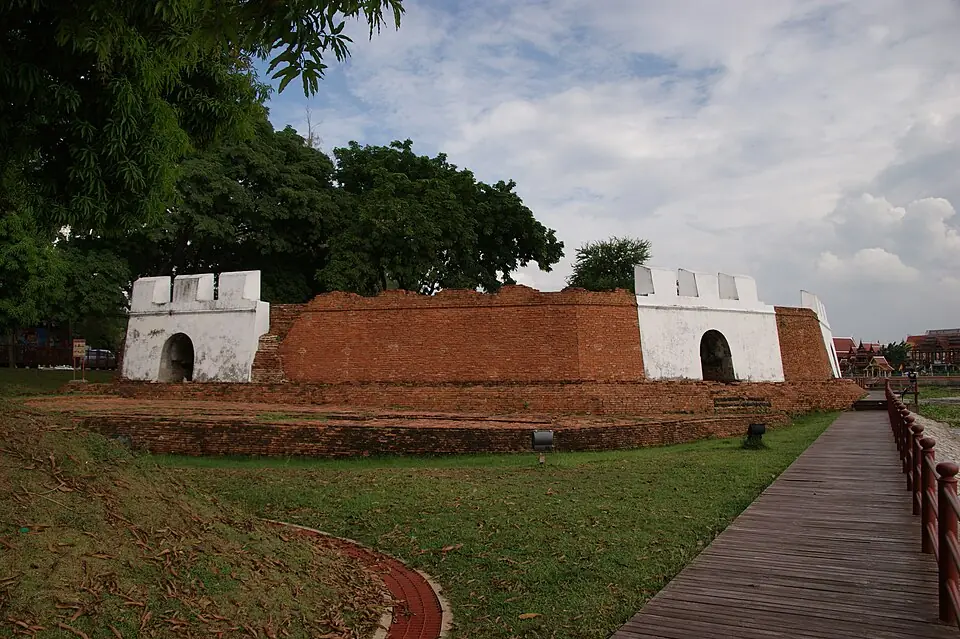
Where Phet Fortress is and what it was for
Ayutthaya's city island is ringed by three rivers: the Chao Phraya, the Pa Sak and the old Lopburi River. Phet Fortress stands at the southeastern corner, where the Pa Sak River flows into the Chao Phraya River, with Wat Phanan Choeng and the Bang Kracha area on the opposite bank.
This position was crucial, because ships coming from the sea had to pass this point before reaching the capital. In front of the fort was the landing where foreign merchant ships moored to await inspection and unload their cargo, so the fort served both to defend against enemies and to control river trade. Students of Ayutthaya's history rank Phet Fortress as one of the three most important forts of the capital.
When was it built?
No inscription records when Phet Fortress was built. In his Thai Rop Phama (Our Wars with the Burmese, 1917), Prince Damrong Rajanubhab suggested that it was built in the reign of King Maha Chakkraphat, after King Tabinshwehti's army besieged the capital in 1548–1549, because that war had shown that the capital needed stronger walls and forts than before.
After the first fall of Ayutthaya in 1569, King Maha Thammaracha obtained permission from Hanthawaddy to build a new city wall, citing the threat from the Khmer, and the chronicles record that in 1580 the wall was extended out to the riverbank. Some scholars read this as meaning that the new line of wall linked up with Maha Chai Fortress and Phet Fortress.
A Dutch painting of Ayutthaya published around 1665 is the oldest image to show this fort, and it shows it as round. As for the diamond-like shape behind the fort's name (phet means diamond), some believe it was the result of improvements made in King Narai's time.
Is it connected with King Naresuan?
If Prince Damrong's suggestion is correct, Phet Fortress came into being right in Naresuan's era, after the war of 1548 in which Queen Suriyothai, his grandmother, died on elephant back. The extension of the wall to the riverbank in 1580 also took place in the reign of his father, around the same time that Chandra Kasem Palace was built as Naresuan's residence.
When King Nanda Bayin besieged Ayutthaya from late 1586 into 1587, the walls and forts around the city island were the defensive line that let the capital hold out for about five months, until the Hanthawaddy army had to withdraw. However, no record has yet been found that describes fighting at Phet Fortress specifically during that war.
Phet Fortress through the eras
The same spot on the map, across five eras
- Early Ayutthaya (1351–1488): the fort did not exist yet
- Naresuan's era (1548–1605): the fort was built in this era, if the suggestion is right, and formed part of the defences when King Nanda Bayin besieged the capital
- King Narai's era (1656–1688): walls and forts improved by European engineers; the fort controlled a busy landing for foreign ships
- The fall of Ayutthaya in 1767: the Burmese could not break in by this fort, but the walls were breached elsewhere and the city fell
- Today: a stretch of fort wall in a riverside public park
Visiting
Phet Fortress is an open space in a public park, and you can walk along the riverside wall. The area has suffered from riverbank erosion and has since been repaired. Evening is a good time to come, when you can watch the two rivers meet and see Wat Phanan Choeng on the opposite bank. You can walk on to nearby Wat Suwan Dararam.
Where historians still disagree
- Date of construction: Prince Damrong Rajanubhab suggested it was built under King Maha Chakkraphat, but no inscription or chronicle gives the year directly. Some link it to the extension of the wall to the riverbank in 1580, under King Maha Thammaracha.
- Designer: some have suggested that the first, round fort may have been built with advice from the Portuguese, but no confirming evidence has been found.
- Origin of the name: some say it comes from the diamond-like shape the fort took after the King Narai-era improvements, others that it stands for indestructible strength.
Visiting information
- Do not climb on the ancient walls, especially on the river side
- In the evening the light is lovely and it is cooler than in the middle of the day
- Combine your visit with nearby Wat Suwan Dararam
Frequently asked questions
When was Phet Fortress built?
Prince Damrong Rajanubhab suggested that it was built in the reign of King Maha Chakkraphat, after the war of 1548, and it was improved again in King Narai's time.
Why is it called Phet Fortress?
There is no settled answer. Some say the name comes from its diamond-like shape after the improvements, others that it refers to strength like that of a diamond (phet).
How many of Ayutthaya's forts survive?
Only two can still be seen: Phet Fortress and Pom Pratu Khao Pluek. Most of the walls and forts were dismantled and their bricks taken to build Bangkok.
Last updated 10 November 2026