Home › Places › Japanese Village
The Japanese Village, Ayutthaya: A Japanese Community on the Chao Phraya, from Naresuan's Era to Yamada Nagamasa
On the east bank of the Chao Phraya River, south of Ayutthaya's city island, there was once a Japanese community thousands strong: traders, volunteer soldiers and religious refugees. Many people think first of Yamada Nagamasa, but the story of the Japanese in Ayutthaya began earlier, in the late years of King Naresuan the Great. This article sorts out what happened in which reign.
This place through the eras
There was no Japanese community here yet. The riverbank around Ko Rian was still open land outside the capital to the south.
Some versions of the royal chronicles mention around 500 Japanese volunteers in King Naresuan's army early in his reign, and Japanese records show that in 1604 the shogun Tokugawa Ieyasu issued trading licences to Japanese merchants living in Siam, so there were already Japanese in Ayutthaya by the end of his reign. The riverside community here reached its full size in the following reigns, after the Ayutthaya court opened official contact with the shogun in 1606.
The community was burned in 1630, and some of the Japanese later came back to resettle, but Japan then banned its people from travelling abroad, so the community shrank. In King Narai's time, the best-known person of Japanese descent was Maria Guyomar, or Thao Thong Kip Ma, wife of Constantine Phaulkon.
By the time of the fall of Ayutthaya, the Japanese community had all but disappeared. From around the early 18th century, later generations of Japanese had blended into Siamese society.
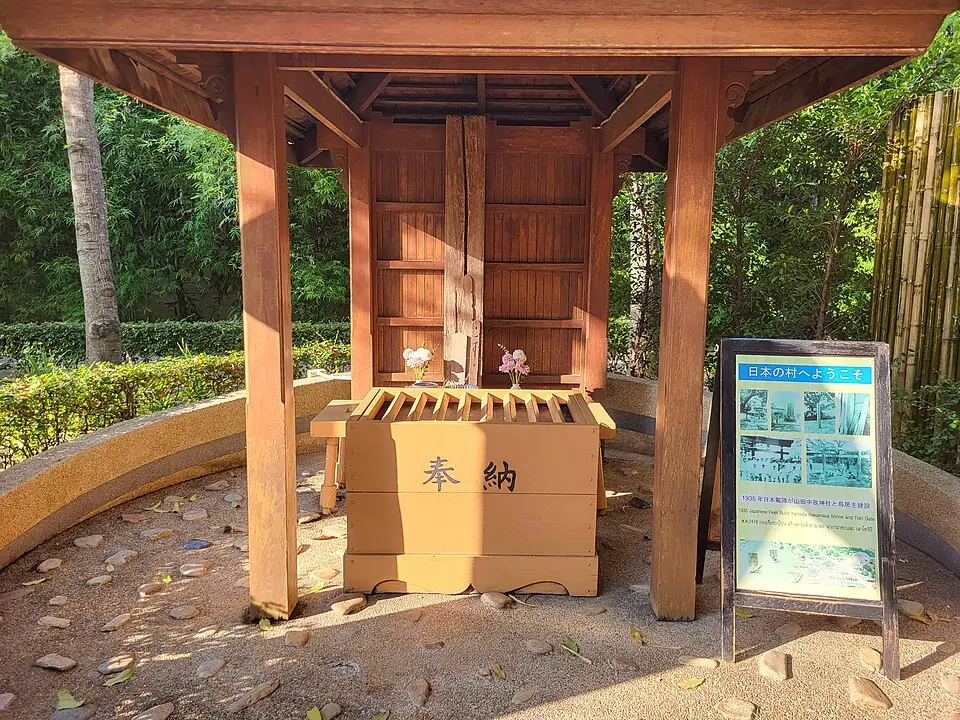
A memorial park and exhibition building of the Ayutthaya Historical Study Centre, on land located and bought by the Thai-Japanese Association (founded 1935). Exhibitions on Yamada Nagamasa and Thao Thong Kip Ma, opened in 2015, and a Japanese-style garden.
When did the Japanese come to Ayutthaya?
There is still no evidence from the Ayutthaya side that says clearly when the first Japanese arrived. Most sources say Japanese traders began to settle in the late 16th century, which falls in King Naresuan's era. One of the earliest pieces of evidence with a clear date comes from 1604, when the shogun Tokugawa Ieyasu issued three trading licences to Japanese merchants living in Siam.
The Japanese community lay in the Ko Rian area on the east bank of the Chao Phraya River, with the Portuguese Settlement on the opposite bank. To the north, Khlong Suan Phlu separated it from the Dutch and English communities. The community stretched about 1 km along the river and was at its most prosperous in the early 17th century, with a population of around 1,000–1,500. Goods shipped to Japan included sappanwood, lead, tin, forest products and deerskins, which Japanese warriors made into jackets, gloves and gun cases.
The Japanese under Naresuan and Ekathotsarot
Some versions of the royal chronicles mention around 500 Japanese volunteers in King Naresuan's army early in his reign. A study in the Journal of Ayutthaya Studies (2021) cites the chronicles as placing them in the campaign of 1590, while other sources usually say it was the campaign of the elephant duel in 1593. It is therefore safe to say that Japanese served as soldiers in this period, but the details of their numbers and of the campaigns they fought in do not yet agree.
Just one year after Naresuan's death, relations between the two courts began officially. In 1606 the shogun Ieyasu sent a letter to King Ekathotsarot asking for aromatic wood and cannon, along with gifts of armour and swords. Several more exchanges followed. King Ekathotsarot allowed the Japanese to settle along the Chao Phraya River, and the study mentioned above states that the first junk from Ayutthaya reached Japan in 1612.
Yamada Nagamasa belongs to a later era than Naresuan
The name best known to Thais is Yamada Nagamasa, but he arrived in Ayutthaya around 1612, some seven years after King Naresuan died. He rose to prominence in the reign of King Songtham, becoming head of the Japanese community and of the Japanese volunteer regiment, and received the title Okya Senaphimuk.
When King Prasat Thong came to power around 1629, Yamada was sent to be governor of Nakhon Si Thammarat, and he died there in 1630. Several sources say he was poisoned. Not long afterwards, on accusations of plotting rebellion, the Japanese community at Ayutthaya was burned, and many Japanese were killed or fled to Cambodia.
After 1630 and in King Narai's time
A few years later, around 400 Japanese came back to found a new community, but in the 1630s the shogunate banned Japanese from travelling abroad, so the community received no newcomers and gradually shrank. Earlier, in 1627, a Portuguese missionary recorded holding religious services for around 400 Japanese Christians, many of whom had fled the suppression of Christianity in Japan.
In King Narai's time, the best-known person of Japanese descent was Maria Guyomar de Pinha, of mixed Japanese and Portuguese ancestry and the wife of Constantine Phaulkon. She later served in the royal kitchens and became known as Thao Thong Kip Ma. After that, later generations of Japanese blended into Siamese society, until the community had all but disappeared by the early 18th century.
The Japanese Village through the eras
Look at this stretch of riverbank across the five eras on the map
- Early Ayutthaya (1351–1488): no Japanese community yet
- Naresuan's era (1548–1605): Japanese volunteers appear in the chronicles, and Japanese merchants were living in Siam by 1604
- King Narai's era (1656–1688): the community had shrunk after it was burned in 1630 and Japan closed its borders
- The fall of Ayutthaya in 1767: the Japanese community had long since blended into Siamese society
- Today: a memorial park, an exhibition building and a Japanese-style garden
Visiting today
The Thai-Japanese Association, founded in 1935, used records of the Dutch East India Company to locate the site of the old community and bought about 7.5 rai (about 1.2 hectares) of land. Later, in 1987, the Japanese government funded the Ayutthaya Historical Study Centre to mark the 60th birthday of King Bhumibol Adulyadej (Rama IX) and 100 years of Thai-Japanese diplomatic relations, with part of its buildings located at the Japanese Village.
On 11 February 2015, Princess Maha Chakri Sirindhorn opened the exhibition building on Yamada Nagamasa and Thao Thong Kip Ma. No Ayutthaya-period buildings survive today; what you see is a garden, memorials and exhibitions that help you picture the original community.
Where historians still disagree
- Japanese volunteers in Naresuan's army: some versions of the chronicles mention around 500, but sources tie them to different campaigns, some to the campaign of 1590 and others to the elephant-duel campaign of 1593, and no contemporary Japanese evidence confirming this figure has been found.
- Yamada Nagamasa and Naresuan: some entertainment media have led people to believe that Yamada lived in Naresuan's time, but the evidence shows that he arrived around 1612 and was active from the reign of King Songtham into the early reign of King Prasat Thong.
- Population: the figure of 1,000–1,500 is the most widely cited, but some Japanese documents estimate that there were several thousand Japanese.
- The year the Japanese came back to resettle: some sources say 1632, others 1633.
Visiting information
- Admission: Adults THB 50 (as of 2026; rates may change)
- Sources disagree on opening hours, so check before you go
- Watch the video and see the exhibition first, then stroll through the riverside garden
- Baan Hollanda and Wat Phanan Choeng are on the same bank and easy to combine with your visit
Opening hours and admission fees may change, so please check before you go.
Frequently asked questions
Since when have the Japanese lived in Ayutthaya?
They began to appear in the late 16th century, in Naresuan's era. The first clearly dated evidence is from 1604, when Japanese merchants were already living in Siam. The community was at its most prosperous in the early 17th century.
Did Yamada Nagamasa live in King Naresuan's time?
No. Yamada arrived around 1612, after Naresuan had died, and was active in the reign of King Songtham before he died in Nakhon Si Thammarat in 1630.
What is there to see at the Japanese Village in Ayutthaya?
There is an exhibition building on Thai-Japanese relations, Yamada Nagamasa and Thao Thong Kip Ma, along with a Japanese-style garden by the river. No Ayutthaya-period buildings survive.
- The Japanese in Ayutthaya - Ayutthaya Historical Research
- Relations between Ayutthaya and Japan, 1606–1767 - Journal of Ayutthaya Studies (in Thai)
- Historical events 1600 CE - Ayutthaya Historical Research
- Background information on the Japanese Village - Thai-Japanese Association
- HRH Princess Maha Chakri Sirindhorn opens new attraction commemorating Thai-Japanese relations - TAT News
- Japanese Village (Ayutthaya) - Wikipedia
Last updated 10 November 2026