Home › Places › Wat Suwan Dararam
Wat Suwan Dararam: the temple of the Chakri dynasty's ancestors and its murals of King Naresuan's elephant duel
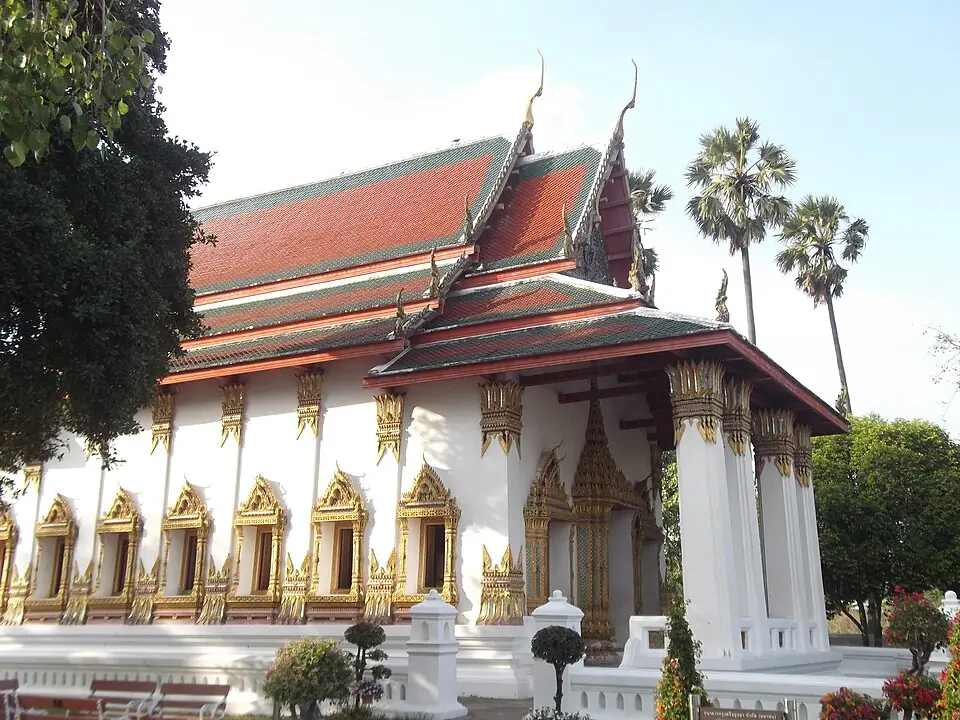
Wat Suwan Dararam Ratchaworawihan lies on the south-eastern side of Ayutthaya's city island. It was originally called Wat Thong and is closely tied to the ancestors of King Rama I (King Phutthayotfa Chulalok), founder of the Chakri dynasty. For anyone following in the footsteps of King Naresuan the Great, the temple has something special: murals of his life on the walls of the wihan, including the famous elephant duel. They were painted in the reign of King Rama VII, not in the Ayutthaya period.
This place through the eras
This temple did not yet exist. The spot was a riverside quarter in the south-east of the city island.
No evidence yet that the temple existed in Naresuan's time. But nearly 340 years after the elephant duel (1592), his story would be painted on the walls of this temple's wihan, including the duel with the Burmese Crown Prince.
The researcher behind ayutthaya-history.com notes that a temple at this spot appears in a Dutch painting of c. 1665, so the temple may be older than its own history says.
Known as Wat Thong. The temple's history says ancestors of King Rama I built or supported it in the late Ayutthaya period. After the city fell in 1767 it was abandoned.
King Rama I restored it and gave it the name Suwan Dararam in memory of his father and mother. The wihan holds 20 mural scenes of King Naresuan's life by Phraya Anusat Chitrakon, painted in 1930–1931 under King Rama VII.
From Wat Thong to Wat Suwan Dararam
The temple's own history says it was built in the late Ayutthaya period, was originally called Wat Thong, and was connected with the ancestors of King Rama I. Sources differ slightly on who built it: some say it was the king's father, others his grandfather.
The researcher behind ayutthaya-history.com observes that a temple at this spot already appears in a Dutch painting of around 1665, which is earlier than the generation of those ancestors. The temple may therefore have existed before and only later come under the patronage of this family.
When the city fell in 1767 the temple was abandoned. After Bangkok was founded, King Rama I gathered craftsmen from the old capital to restore it and gave it a new name, Wat Suwan Dararam, in memory of his father Thongdi and his mother Daoruang. Suwan means gold (thong), and dara means star (dao).
Cared for over many reigns
The temple has been looked after by many kings of the Chakri dynasty. Information compiled by ayutthaya-history.com says that King Rama II restored the whole temple, King Rama III completed the unfinished sermon hall (sala kanparian), King Rama V restored the ubosot (ordination hall) and the monks' quarters, and King Rama VI had the roofs covered with glazed tiles. As for the wihan, sources differ on whether it was built under King Rama II or King Rama IV.
The ubosot has a base with a gentle downward curve, and inside are older murals. The upper walls show an assembly of celestial beings, and the lower walls show Jataka tales such as Vessantara, Temiya and Suvannasama. The wall facing the principal Buddha image shows the Victory over Mara, with the Earth Goddess (Mae Thorani) wringing out her hair, and the wall behind it shows the Traiphum, the Buddhist cosmology of the Three Worlds.
The pediment of the ubosot is carved with Vishnu (Narai) riding Garuda, and in front of the ubosot stands a bodhi tree said to have been grown from a sapling that King Rama IV brought back from India.
The murals of King Naresuan's life in the wihan
What puts this temple on the King Naresuan trail is the murals in the wihan. The upper walls show an assembly of celestial beings, while the lower walls tell the life and deeds of King Naresuan in 20 scenes, each with a short caption.
Key scenes include the cockfight with Mang Sam Kiat, the declaration of independence at Mueang Khraeng, the "sword in the teeth" assault on the Burmese camp, and the elephant duel with the Burmese Crown Prince in 1592, which is placed directly opposite the principal Buddha image.
The murals were painted by Phraya Anusat Chitrakon (Chan Chitrakon) in 1930–1931, in the reign of King Prajadhipok (Rama VII), who commissioned them. An article in Bangkok Biz News relates that the 59-year-old painter spent about two years on the work and took his sketch for each scene to Prince Damrong Rajanubhab for advice before he began painting.
They are painted in oils rather than the traditional tempera, and use Western perspective, body proportions and skies. The series later became the model for many illustrations in Thai history textbooks, and the Fine Arts Department has also reproduced it for display at the Don Chedi Royal Monument in Suphan Buri province.
It is worth remembering that these pictures are a Rama VII-era artist's interpretation of history, not images from Naresuan's own time. Details such as the costumes and backgrounds therefore also reflect the knowledge and ideas of the period in which they were painted.
Wat Suwan Dararam through the eras
Scroll through the map one era at a time and you will see that this temple is linked to King Naresuan through memory rather than through events of his own time.
- Founding of the capital (1351–1488): this temple did not yet exist; the spot was a riverside quarter in the south-east of the city island.
- Age of King Naresuan (1548–1605): no evidence yet that the temple existed, but nearly 340 years after the elephant duel his story would be painted on the walls of this temple's wihan.
- Age of King Narai (1656–1688): some point out that a temple at this spot appears in a Dutch painting of c. 1665, so there may already have been a temple here in this era.
- Second fall of Ayutthaya (1767): Wat Thong, tied to the ancestors of King Rama I, was abandoned after the city fell.
- Today: a royal temple restored by King Rama I, with murals of King Naresuan's life painted in 1930–1931.
What to see
The temple is still a royal temple with resident monks and one of the temples in Ayutthaya that teaches Buddhist scriptural studies (Pariyattidhamma). Visitors should dress modestly and behave respectfully.
- The murals of King Naresuan's life in the wihan, especially the elephant duel scene opposite the principal Buddha image.
- The murals of the celestial assembly, the Jataka tales, the Victory over Mara and the Traiphum in the ubosot.
- The pediment of Vishnu riding Garuda, and the ubosot with its curved base.
- The principal bell-shaped chedi behind the wihan, surrounded by ten white subsidiary chedis.
- The bell tower, which has a touch of Western architecture.
Getting there and visiting
The temple is on the south-eastern side of the city island, on U Thong Road, not far from Phet Fortress. There are two entrances from U Thong Road, and it is easy to reach by bicycle or tuk-tuk from the centre of the island.
If you are following King Naresuan's trail, this temple is a good place to get an overview of his life before or after visiting the real sites, such as Chandra Kasem Palace, Wat Yai Chai Mongkhon and Wat Worachettharam. Check the wihan's opening times with the temple before you go.
Where historians still disagree
- Who built the temple: most sources say ancestors of King Rama I built it in the late Ayutthaya period, but they differ on whether it was his father or his grandfather, and some point out that the temple already appears in a Dutch painting of c. 1665, so it may be older still.
- When the wihan was built: one source says under King Rama II; another thinks it was more likely under King Rama IV.
- The King Naresuan murals: they were painted according to the historical interpretation of the Rama VII era, in consultation with Prince Damrong Rajanubhab, so they reflect the knowledge and outlook of that time and are not contemporary evidence.
Visiting information
- Dress modestly and take off your shoes before entering the wihan and the ubosot.
- Do not touch the murals, and ask the temple before taking photos inside the buildings.
- Check the wihan's opening times with the temple before you go.
Frequently asked questions
When were the elephant duel murals at Wat Suwan Dararam painted?
They were painted in 1930–1931, in the reign of King Rama VII, by Phraya Anusat Chitrakon. They are not from the Ayutthaya period.
What was Wat Suwan Dararam originally called?
It was originally called Wat Thong. King Rama I gave it the new name Suwan Dararam in memory of his father Thongdi and his mother Daoruang.
How many scenes of King Naresuan's life are painted in the temple?
According to an article in Bangkok Biz News there are 20 scenes, each with a caption, and the elephant duel scene is opposite the principal Buddha image.
Last updated 10 November 2026