Home › Places › Portuguese Settlement
The Portuguese Settlement, Ayutthaya: An Early European Community on the Chao Phraya
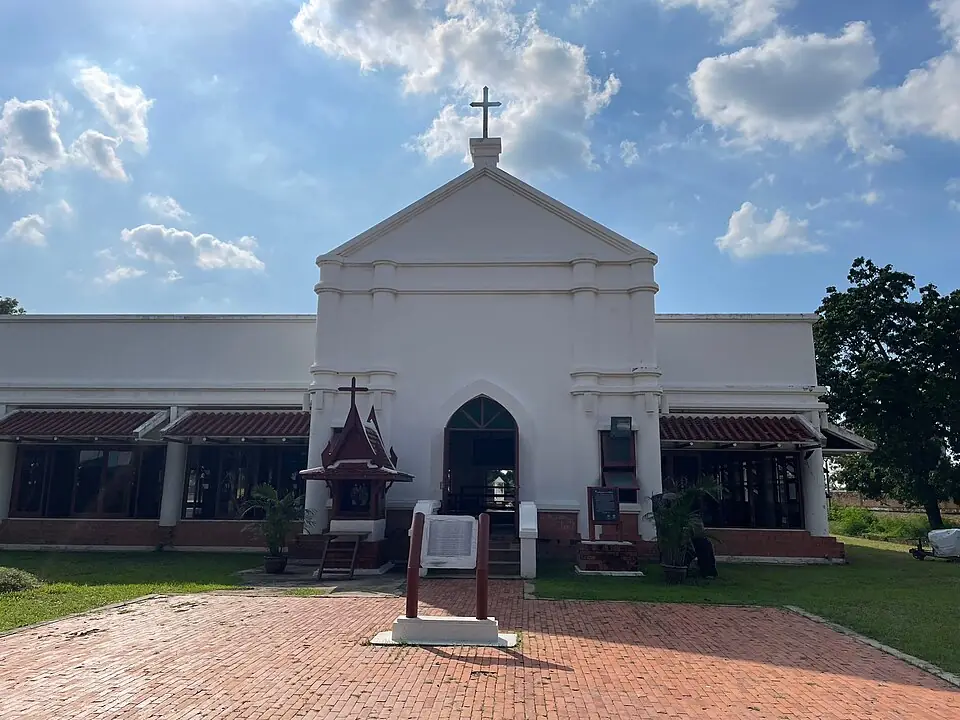
The Portuguese Settlement is the site of the Portuguese community south of Ayutthaya's city island, on the west bank of the Chao Phraya River. It began with volunteer soldiers who served King Chairacha in 1538 and grew into one of the largest Western communities in the kingdom of Ayutthaya. Today what remains are the ruins of the San Petro church and a cemetery where more than 200 skeletons have been excavated.
This place through the eras
There was no Portuguese community yet. The Portuguese first made contact with Ayutthaya in the reign of King Ramathibodi II.
The Portuguese were granted land to found a community in the reign of King Chairacha (c. 1538), because Portuguese volunteer soldiers fought for Ayutthaya and taught the use of firearms. In the war of 1548 about 50 Portuguese soldiers helped defend the capital. Dominican friars arrived in 1567, and after Naresuan declared independence in 1584, Franciscans came and built a church north of the village. Burmese chronicles also say that on the day of the elephant duel it was Portuguese gunners in Naresuan's bodyguard who shot the Burmese Crown Prince, which differs from the Thai chronicles.
The largest Western community in Ayutthaya, with Dominican, Jesuit and Franciscan churches.
Destroyed in the fall of 1767.
You can see the ruins of the Dominican church (St Peter's) and the burial ground where more than 200 skeletons were excavated.
Portugal, the first European nation to reach Siam
The Portuguese captured Malacca in 1511 and sent an envoy to Ayutthaya in the same year, during the reign of King Ramathibodi II. They were the first Europeans to make official contact with the Ayutthaya court.
In 1516 another Portuguese mission arrived. The Portuguese promised to supply guns and ammunition, while Ayutthaya guaranteed religious freedom and made it easy for the Portuguese to settle and trade.
120 volunteer soldiers and a royal land grant
In 1538, in the reign of King Chairacha, about 120 Portuguese soldiers entered royal service as bodyguards and military advisers, training Siamese troops to use Western-style firearms.
After they had fought alongside the Siamese in important battles, King Chairacha granted them trading and residence rights, along with land south of the capital on which to found a community. The settlement covered more than half a square kilometre and was bounded by canals on its other three sides. Most of its population were soldiers, shipbuilders and merchants. In 1685 Father Tachard was told that it had about 4,000 inhabitants.
In the war of 1548, in the reign of King Maha Chakkraphat, the war in which Queen Suriyothai was killed, about 50 Portuguese soldiers helped defend the capital, while the Burmese side also had Portuguese mercenaries of its own.
The churches of three religious orders
The Dominicans came first: Fathers Jerónimo da Cruz and Sebastião da Canto, in 1567. Their church was called San Petro, and local people called it Ban Jacobin. Father da Cruz was killed when the Burmese attacked Ayutthaya in 1569.
The Franciscans arrived in 1584, after King Naresuan's declaration of independence, and built a church on the north side of the village. The Jesuits built a residence and the church of San Paulo after Father Tomas Valguarnera arrived in 1655.
Having churches of three different orders in a single community shows how open Ayutthaya was, both in religion and in trade, and why many groups of foreigners settled side by side around the city island.
The Portuguese in the wars of King Naresuan's time
Portuguese mercenaries were in demand in many kingdoms of the period, including Burma, Siam and Arakan, because of their expertise with firearms. On the battlefield, musketeers often served as guards for commanders riding on elephants or horses.
Dr. Phamaree Surakiat, who has studied the Burmese chronicles, points out that the Burmese account of the elephant duel of 1593 differs from the Thai chronicles: it says the Burmese Crown Prince was shot by a Portuguese mercenary serving in King Naresuan's bodyguard, whereas the Thai chronicles say Naresuan struck the Crown Prince down with his royal halberd (ngao).
After Naresuan took Longvek, the Cambodian capital, around 1594, Portuguese and Spanish prisoners were brought to Ayutthaya, and Malacca later sent a mission asking for their release. Relations with the Portuguese in this reign therefore involved both cooperation and tension.
This spot through the eras
This point on the map tells the life story of a foreign community, from before it was founded to the day only the ruins of its church were left.
- Founding of the city (1351–1488): there were no Europeans in Ayutthaya yet; the Portuguese did not arrive until 1511. This was riverside land south of the city island.
- Naresuan's era (1548–1605): the village had been founded shortly before this era. Portuguese soldiers fought in the war of 1548, the Dominicans arrived in 1567 and the Franciscans in 1584.
- King Narai's era (1656–1688): the community was at its height, with the Jesuits' San Paulo church added and a population of several thousand.
- Second fall of Ayutthaya (1767): the Burmese army surrounded the village, and the priests and Christians surrendered in March 1767. The churches were looted; some of the inhabitants were carried off to Burma, while others followed King Taksin and resettled at Kudi Chin in Thonburi.
- Today: the foundations of the San Petro church and the cemetery remain, with a white building covering the excavation pit for visitors to see.
The excavation and what you can see today
The Fine Arts Department began excavating around the San Petro church on 2 March 1984, led by Patiphat Phumphongphaet and funded by the Calouste Gulbenkian Foundation of Portugal. The land here belongs to the Roman Catholic mission. Work continued until 1995.
The excavation uncovered 253 skeletons, of both Europeans and Asians, men, women and children, as well as crosses, rosaries, medals bearing religious images, tobacco pipes, glassware, spectacle lenses and Chinese ceramics. These artefacts are kept at the Chao Sam Phraya National Museum.
On 2 April 1995, Princess Galyani Vadhana presided over the opening of the archaeological site. After the great flood of 2011 the real skeletons were badly damaged, so the Fine Arts Department made resin skeletons to display in their place, while the originals are kept at the museum.
Traces of the Portuguese live on in everyday Thai life. Local scholars point to sweets such as foi thong (golden threads of egg yolk) and to loanwords such as pang in khanom pang (bread) and sabu (soap).
Where historians still disagree
- Who killed the Burmese Crown Prince: the Thai chronicles say Naresuan struck him down with his royal halberd from the back of his elephant, but the Burmese chronicles say he was shot by a Portuguese soldier on the Siamese side. Comparative studies of the evidence find that the events at Nong Sarai are recorded by several sides in very different ways.
- Which war earned the land grant: some sources say it was a reward after a war with Burma, others that it followed the Chiang Mai campaign in the reign of King Chairacha.
- The age of the San Petro church: some scholars date the building seen today to around the late 16th century, while others suggest it was built and extended in several phases throughout the 17th century as the community grew.
Visiting information
- Opening hours and admission fees may change, so ask before you go.
- The building covers graves, so be quiet and respectful of the dead.
- You can combine it in one day with the Japanese Settlement (Japanese Village) on the opposite bank and nearby Wat Chaiwatthanaram.
- Stop by the Chao Sam Phraya National Museum to see the real artefacts from the excavation.
Frequently asked questions
When was the Portuguese Settlement in Ayutthaya founded?
It began with about 120 Portuguese soldiers who entered the service of King Chairacha in 1538, after which they were granted land south of the capital on which to found their community.
Are the skeletons at the Portuguese Settlement real?
After the 2011 flood the real skeletons were damaged, so the Fine Arts Department made resin skeletons to display instead. The originals are kept at the Chao Sam Phraya National Museum.
How were the Portuguese connected with King Naresuan?
The Burmese chronicles say that Portuguese musketeers in King Naresuan's bodyguard played a part in the elephant duel, and the Franciscans came to build a church in the village after his declaration of independence.
- THE PORTUGUESE SETTLEMENT - Ayutthaya Historical Research
- THE DOMINICAN CHURCH OF SAN PETRO - Ayutthaya Historical Research
- Excavation of the Portuguese Settlement - Ayutthaya Historical Research
- Western Firearms and Mercenaries in Burmese History, with Reference to the Elephant Duel - Silpa Wattanatham (in Thai)
- Portuguese Mercenaries Who Brought Military Technology and Strategy to Ayutthaya - Silpa Wattanatham (in Thai)
- The Mae Mali Ancestral Bathing House Opens at the Portuguese Settlement - Matichon (in Thai)
Last updated 10 November 2026