Home › Places › Wat Phutthaisawan
Wat Phutthaisawan: A Riverside Prang on the Site of the Wiang Lek Residence
Wat Phutthaisawan stands on the south bank of the Chao Phraya River, across from Ayutthaya's city island. It is known for its main prang (a Khmer-style tower) and a two-storey residence that still holds Ayutthaya-period murals. Another point of interest is that the old sources disagree about who built it, and one of them says it was King Naresuan the Great.
This place through the eras
Royal chronicles compiled in the Rattanakosin (Bangkok) period say King Ramathibodi I (King U Thong) lived at the Wiang Lek residence here before founding the city, then had a temple built on the spot in 1353. The older Luang Prasoet Chronicle, however, does not mention this temple.
The evidence for this temple in Naresuan's time contradicts itself. The Sangitiyavamsa, written in 1789 by Somdet Phra Phonnarat of Wat Phra Chetuphon (Wat Pho), says King Naresuan built it, while the Testimony of the Old Capital's People names King Songtham, and the later chronicles say it had existed since 1353. So it is still impossible to say whether this was already a temple in Naresuan's reign or was newly built during it.
Art historian Piriya Krairiksh thinks the temple as we see it today was probably completed around 1685–1686, in King Narai's reign, in memory of a queen who had died. He cites a French priest's account and French maps that call this place the temple of the late queen.
The Burmese burned the capital in 1767, but the main prang and the residence of Somdet Phra Phutthakhosachan, a late-Ayutthaya building, have survived to the present day.
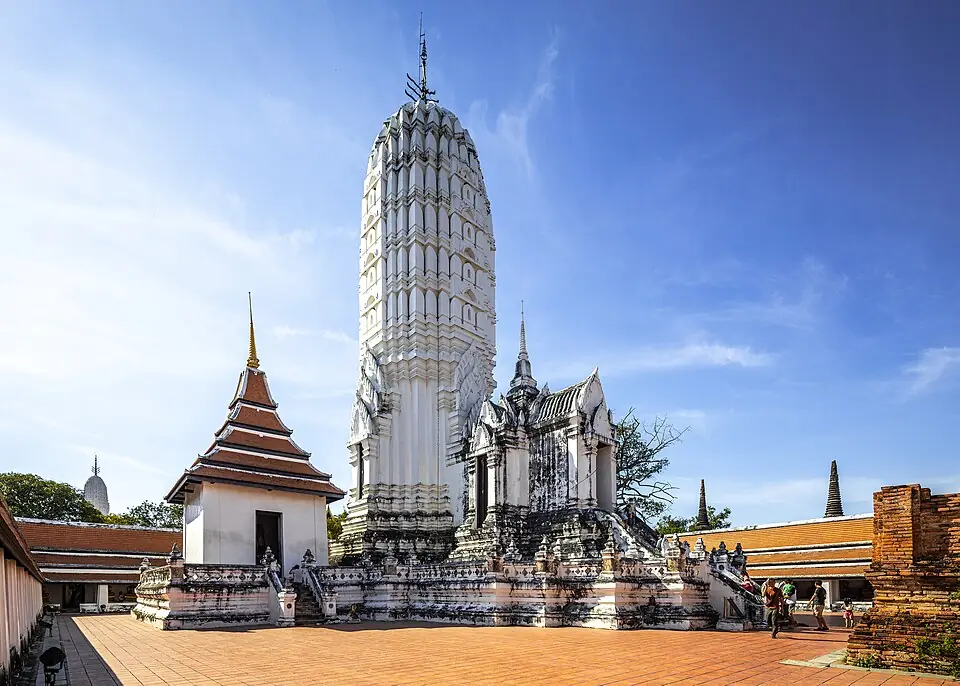
An active temple with monks. The Khmer-style main prang was restored in the reign of King Chulalongkorn (Rama V); a gallery lined with Buddha images surrounds it, and the two-storey residence still has late-Ayutthaya murals to see.
Origins according to the royal chronicles
The royal chronicles of Ayutthaya compiled in the Rattanakosin period relate that before founding Ayutthaya, King U Thong, or King Ramathibodi I, lived at the Wiang Lek residence on the south bank of the river. Later, in 1353, a few years after founding the city, he had a monastery built on the site of his former residence and gave it the name Wat Phutthaisawan.
This has led to the temple being described as one of the city's very first, but the story needs to be read with care: the Luang Prasoet Chronicle, written in 1680, and the account of the Dutch merchant Jeremias van Vliet from around 1640 do not mention this temple at all.
Who really built it? The conflicting evidence
Besides the royal chronicles, at least three other lines of evidence tell the story differently. The first is the Sangitiyavamsa, written in Pali in 1789 by Somdet Phra Phonnarat of Wat Phra Chetuphon (Wat Pho), which says King Naresuan built this temple. The second is the Testimony of the Old Capital's People, recorded from the accounts of Ayutthaya people carried off to Burma after 1767, which names King Songtham.
The third comes from French sources. The missionary priest Nicolas Gervaise wrote of a new gallery built in memory of the late queen, and a map based on a survey made in 1687 also calls this place the temple of the late queen. Art historian Piriya Krairiksh therefore proposes that the temple in its present form was probably completed around 1685–1686, in the reign of King Narai the Great. He notes that its layout, a large prang flanked by smaller ones, resembles Wat Phra Si Rattana Mahathat in Lopburi, which King Narai restored.
These views do not all have to cancel each other out, since a temple may have had an earlier shrine that was rebuilt or enlarged in a later reign. But the honest thing to say is that there is still no contemporary evidence showing clearly who the original builder was.
What is its connection to King Naresuan?
The link to Naresuan comes from the Sangitiyavamsa, written about 180 years after his reign by a senior monk deeply versed in the history of Buddhism. It is evidence worth taking seriously, but it is not contemporary evidence.
On this site's map, Wat Phutthaisawan is therefore marked as connected with Naresuan as a place that a document attributes to him, not as a place he is certain to have built. Readers should treat this as information that is still being debated.
What to see
The Khmer-style main prang rises from a redented (indented-corner) base and is surrounded by a gallery lined with lacquered and gilded Buddha images. The prang was restored in the reign of King Chulalongkorn (Rama V), around 1898, with funds donated jointly by the people of Ayutthaya. The ubosot (ordination hall) stands to the west of the prang.
The residence of Somdet Phra Phutthakhosachan is a two-storey building whose base curves like the hull of a Chinese junk, in late-Ayutthaya style. The upper-floor walls carry murals, most of them now faded: Jataka tales, scenes of Somdet Phra Phutthakhosachan travelling to venerate the Buddha's Footprint in Lanka (Sri Lanka), the Traiphum (Three Worlds) cosmology, and the Buddha's victory over Mara. Late-Ayutthaya murals like these survive in only a few places.
Wat Phutthaisawan through the eras
The same spot on the map, but the scene changes with each era.
- Early Ayutthaya (1351–1488): according to the royal chronicles, this was King U Thong's Wiang Lek residence, which became a temple in 1353.
- Naresuan's era (1548–1605): the Sangitiyavamsa says King Naresuan built this temple, but other sources contradict it.
- King Narai's era (1656–1688): French sources mention a new gallery built in memory of the late queen.
- The fall of Ayutthaya in 1767: the capital was burned, but this temple's prang and residence survived.
- Today: an active temple with monks, with its prang, its gallery and a residence that still has old murals.
Getting there and visiting
The temple lies outside the city island on the south side, a short distance across the bridge from the island; you can also come on one of the boat tours around the island, which often stop here. The residence (Tamnak Somdet) may be closed at times, so if you want to see the murals, ask the temple staff first.
Where historians still disagree
- Who built the temple: the later royal chronicles say King U Thong, in 1353; the Sangitiyavamsa (1789) says King Naresuan; the Testimony of the Old Capital's People says King Songtham; and Piriya Krairiksh, drawing on French sources, proposes that the temple in its present form was completed in King Narai's reign, around 1685–1686.
- The residence of Somdet Phra Phutthakhosachan: some say it was built in the reign of King Phetracha, but no document has yet been found that confirms the year it was built.
Visiting information
- Dress modestly, and do not climb on the prang or the bases of the ancient structures.
- The murals in the residence are fragile: do not use flash and do not touch the walls.
- Come in the morning or late afternoon for good light and less intense heat.
Frequently asked questions
Who built Wat Phutthaisawan?
The later royal chronicles say King U Thong built it in 1353, but other sources name different builders, among them King Naresuan, King Songtham and King Narai, so the question is still debated.
How is Wat Phutthaisawan connected with King Naresuan?
The Sangitiyavamsa, written in 1789, says King Naresuan built this temple, but it is not contemporary evidence and it conflicts with other sources.
What is the Tamnak Somdet at Wat Phutthaisawan?
A two-storey late-Ayutthaya building, believed to have been where Somdet Phra Phutthakhosachan stayed during the rains retreat. Inside are old murals.
Last updated 10 November 2026