Wat Phra Ram: The Temple on King U Thong's Cremation Site, Beside Bueng Phra Ram
Wat Phra Ram is a large temple in the middle of Ayutthaya's city island, beside the lake of Bueng Phra Ram. According to the royal chronicles, King Ramesuan had it built on the site where his father, King Ramathibodi I (King U Thong), the first king of Ayutthaya, was cremated. The custom of building a temple on a royal cremation site, seen so clearly here, also became an important clue when historians went looking for the place where King Naresuan was cremated more than two hundred years later.
This place through the eras
King Ramesuan had his father, King U Thong, cremated here and then founded Wat Phra Ram on the spot. The Luang Prasoet Chronicle gives the date as Chula Sakarat 731 (1369); chronicles revised later place the story in King Borommatrailokkanat's reign.
An old royal temple in the heart of the capital, not far from the Ancient Royal Palace where Naresuan came to the throne (1590). No events specific to the temple are recorded in this era, but the custom seen here of building a temple on a cremation site became a key idea when historians searched for the place where Naresuan was cremated after his death in 1605.
Father Tachard, who came with the French embassy, recorded in 1685 that the temple lay about a hundred paces south of the palace, and Bellin's French map calls it the "Grande Pagode".
King Borommakot carried out a major restoration in 1741, only about 26 years before the city fell. After the fall in 1767 the temple was abandoned along with the city.
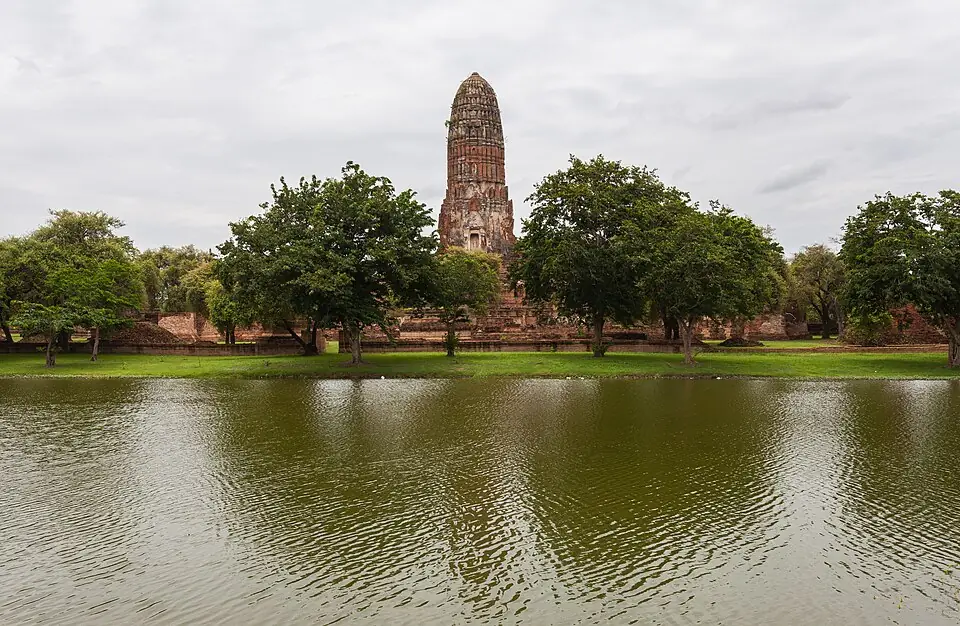
A historic ruin in Ayutthaya Historical Park. The main prang still stands out beside Bueng Phra Ram, which was dredged and turned into a public park in 1956–1957.
A temple on the first king's cremation site
King U Thong founded Ayutthaya in 1351 and reigned until his death in 1369. His son, King Ramesuan, had his body cremated in the heart of the capital and then founded a temple on the cremation site, naming it Wat Phra Ram.
The Luang Prasoet Chronicle of the old capital, the oldest version with dates attached, gives the year as Chula Sakarat 731, a Year of the Rooster, which corresponds to 1369. Most scholars therefore take it that King Ramesuan began the temple.
However, King Ramesuan's first reign lasted only about a year before he handed the throne to Borommaracha I. Construction may therefore have continued in the next reign, or been completed when King Ramesuan returned to the throne in 1388–1395.
The chronicles disagree
Chronicles revised in later periods tell the story of Wat Phra Ram differently, placing its construction early in the reign of King Borommatrailokkanat (Trailok). Some explain this by suggesting that Trailok may have carried out a major restoration rather than founding the temple.
Clearer evidence comes from the major restoration in the reign of King Borommakot in 1741, only about 26 years before the fall of Ayutthaya. Traces of repairs from many periods mean the ruins you see today are layered work from several eras.
The layout of Wat Phra Ram follows the Khmer-influenced idea of Mount Meru: a main prang at the centre, surrounded by courtyards and a gallery (cloister), a plan found at several important temples of the early capital.
How it connects to King Naresuan
There is no record of any important event at Wat Phra Ram during King Naresuan's reign. In his day it was an old royal temple in the heart of the capital, not far from the Ancient Royal Palace where he came to the throne in 1590.
But Wat Phra Ram matters in another way: it is one of the earliest examples of the custom of Ayutthaya kings building temples on royal cremation sites. Some versions of the chronicles say that Wat Ratchaburana was likewise built on the site where the princes Chao Ai Phraya and Chao Yi Phraya were cremated.
When Naresuan died in 1605, the chronicles say King Ekathotsarot built a monastery on the cremation site, but they do not name the temple. Historians have therefore used this custom as a guiding principle, and debate between Wat Worachettharam on the island, Wat Worachet Thep Bamrung outside the island and Wat Sop Sawan. One observation often raised is that before King Prasat Thong's reign, royal cremations were usually held within the city, as at Wat Phra Ram.
Bueng Phra Ram and the legend of Nong Sano
The large lake in front of the temple is named after it. It was originally called Bueng Wat Phra Ram (the lake of Wat Phra Ram), which people later shortened to Bueng Phra Ram. Some old documents call this area Nong Sano or Dong Sano, and Phraya Boran Ratchathanin suggested that the original name of the whole lake was Bueng Chi Khan, a name that appears in the Palace Law.
Van Vliet's account (1640) and the British Museum version of the chronicles link King U Thong's founding of the city to this pond. But some scholars, such as Sumet Jumsai, have questioned whether the lake really existed when the city was founded, because the maps of Kaempfer and Bellin do not show it.
Phraya Boran Ratchathanin believed the lake grew larger because earth was dug out here to fill the grounds of the palace and several important temples. Later, in 1956–1957, the government of Field Marshal Plaek Phibunsongkhram dredged the lake and turned it into the public park you see today.
Wat Phra Ram through the eras
This spot on the map has a story for every era, from the first king to the present day.
- Founding of the capital (1351–1488): King Ramesuan had King U Thong cremated here and built Wat Phra Ram on the spot in 1369, according to the Luang Prasoet Chronicle.
- Naresuan's era (1548–1605): An old royal temple in the heart of the capital, near the Ancient Royal Palace where Naresuan reigned (1590–1605). No events specific to the temple are recorded in this era.
- King Narai's era (1656–1688): Father Tachard, who came with the French embassy, recorded in 1685 that the temple lay about a hundred paces south of the palace. Bellin's French map calls it the "Grande Pagode".
- Fall of Ayutthaya (1767): Not long after the major restoration of 1741, the temple was abandoned along with the city.
- Today: A historic ruin in Ayutthaya Historical Park. In the late 1950s, artefacts were found in its crypt, and Bueng Phra Ram in front became a public park.
What to see and visiting
The highlight is the main prang on its high base, still standing tall, surrounded by the ruins of the gallery, smaller chedis and subsidiary buildings. The most beautiful view is from the edge of Bueng Phra Ram, where the prang is reflected in the water, especially in the morning and in the soft light of late afternoon.
Wat Phra Ram is across the road from the entrances to Wihan Phra Mongkhon Bophit and Wat Phra Si Sanphet, so you can walk between them in half a day. To get a clearer sense of the custom of building temples on cremation sites, go on to Wat Ratchaburana, and to Wat Worachettharam, which is linked to King Naresuan.
Where historians still disagree
- Date and builder: the Luang Prasoet Chronicle gives Chula Sakarat 731 (BE 1912 / 1369), in King Ramesuan's reign, while chronicles revised later place the story in King Borommatrailokkanat's reign. Most scholars follow the Luang Prasoet Chronicle and see Trailok as having restored the temple.
- Did Bueng Phra Ram exist when the capital was founded? Van Vliet's account and some versions of the chronicles link the founding of the city to this pond, but some European maps from the Ayutthaya period do not show the lake, and some believe it grew larger later because earth was dug out of it.
Visiting information
- View the prang from the edge of Bueng Phra Ram in the morning or late afternoon for reflections in the water.
- Do not climb the prang or the bases of the ruins, and watch your step on the uneven brick floors.
- Combine your visit with Wihan Phra Mongkhon Bophit and Wat Phra Si Sanphet across the road.
Frequently asked questions
Who built Wat Phra Ram?
The Luang Prasoet Chronicle says King Ramesuan had it built in 1369 on the site where his father, King U Thong, was cremated.
How is Bueng Phra Ram related to Wat Phra Ram?
The lake is named after the temple. It was originally called Bueng Wat Phra Ram and the name was later shortened. It was turned into a public park in 1956–1957.
Is Wat Phra Ram connected to King Naresuan?
There is no direct record, but the custom of building a temple on a cremation site, seen at Wat Phra Ram, is one of the guiding ideas in the search for the place where Naresuan was cremated.
- WAT PHRA RAM (1) - Ayutthaya Historical Research
- BUENG PHRA RAM - Ayutthaya Historical Research
- Wat Phra Ram - Go Ayutthaya
- Wat Phra Ram - Wikipedia
- Where Was King Naresuan the Great Cremated? - Silpa Wattanatham (in Thai)
- Principal Prang of Wat Ratchaburana - Southeast Asian Art Database, Princess Maha Chakri Sirindhorn Anthropology Centre
Last updated 10 November 2026