Home › Places › Wat Worachet (outside the island)
Wat Worachet outside the island (Wat Worachet Thep Bamrung): a prang in the fields and the mystery of King Naresuan's cremation
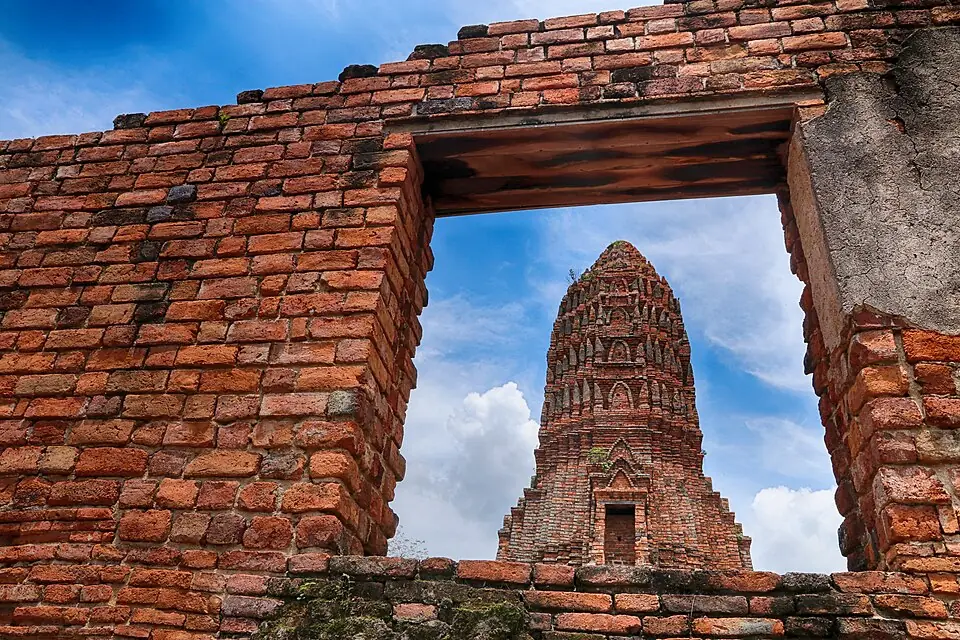
Wat Worachet outside the island, also called Wat Worachet Thep Bamrung, stands in the middle of Thung Prachet, west of Ayutthaya's city island. Its huge main prang has been a landmark in the fields for centuries. A Fine Arts Department sign says that King Ekathotsarot built the temple and dedicated it to King Naresuan the Great, and some historians believe this is where Naresuan's body was cremated, but the question has never been settled.
This place through the eras
No evidence yet that this temple existed. The area was open rice fields west of the capital, later known as Thung Prachet.
The chronicles name the Wat Worachet field, or Thung Prachet, as a Hanthawaddy army camp in the war of 1563–1564. When King Naresuan died in 1605, King Ekathotsarot had him cremated and built a monastery for forest-dwelling monks. The Fine Arts Department sign here says this temple was built in 1605 and dedicated to Naresuan, but an identical sign stands at Wat Worachettharam on the island, so the cremation site is still unresolved.
A large temple in the fields outside the capital. Its main prang closely resembles that of Wat Chaiwatthanaram (built 1630), and Kaempfer's map (1690) shows the temple about 1,500 m from the river.
In the late Ayutthaya period the stair balustrades and the prang's base were enlarged. In late 1766 the Burmese army camped at Ban Pom, in this area, to bombard the capital with cannon. After the city fell in 1767 the temple was abandoned.
The Fine Arts Department restored the prang and chedis. After 2008 a new monastery was established here, and in 2013 it received a royal land grant for its ordination boundary. A King Naresuan shrine draws worshippers who honour the site as one of the places where he may have been cremated.
Origins and a confusing name
The temple stands in the middle of the wide rice fields west of the city island, known as Thung Prachet or Thung Worachet. In the Ayutthaya period a canal, Khlong Wat Pom, ran from the temple to the river, so the temple could be reached by boat.
The temple's name is a major source of confusion, because both this temple and a temple on the city island have been called Wat Worachet or Wat Worachet Thep Bamrung in various documents. Today this one is usually called Wat Worachet outside the island (Wat Worachet Nok Ko), and the one on the island Wat Worachettharam.
No evidence has been found of when the temple was built. The chronicle quoted by ayutthaya-history.com, from Cushman's translation, mentions the Wat Worachet field as the camp of the Hanthawaddy army in the war of 1563–1564. Information from the provincial tourism office, meanwhile, says the buildings date from the middle Ayutthaya period and were restored in the late Ayutthaya period.
This temple and King Naresuan's cremation
King Naresuan died on 25 April 1605 at Mueang Hang. The royal chronicles relate that King Ekathotsarot held a magnificent royal funeral and then built a monastery with a great stupa, a wihan, monks' quarters and a complete set of the Tipitaka (Buddhist scriptures) for monks of the forest-dwelling (aranyavasi) order. They do not, however, give the temple's name.
Those who believe it was this temple, such as No Na Paknam (Prayoon Uluchata), point out that aranyavasi means a forest monastery outside the city, which suits a site in the middle of the fields, and that this temple is much larger than the one on the island. The researcher behind ayutthaya-history.com likewise finds that the chronicle's description fits this temple better. An article in Silpa Wattanatham magazine, based on the work of Kamphon Champaphan, argues that open ground in the fields could more plausibly hold the large crowds of a royal funeral.
Those who disagree point out that Thung Wat Worachet appears in the chronicles about 40 years before Naresuan died, so the temple may already have existed, and that no record has been found of a king being cremated outside the city island before the reign of King Prasat Thong. The Testimony of Khun Luang Ha Wat, for its part, names a different temple altogether: Wat Sop Sawan.
The Fine Arts Department sign at this temple, as reported by Manager Online in 2007, admits that the place of the cremation and the place where the royal relics were enshrined remain unclear and cannot be identified with certainty. The temple is therefore best seen as a contender with a reasonable case, not as the final answer.
A story from the Dutch records
Another thing that makes this temple intriguing comes from the records of Jeremias van Vliet, head of the Dutch East India Company's trading post. On 10 December 1636 a group of Dutch employees went on an outing to a place called Boeretiet, across the river from the Rear Palace (Wang Lang). There they got into a fight with palace servants and were arrested.
King Prasat Thong sentenced them to death, and van Vliet had to go and beg for a royal pardon before the Dutchmen were released. The researcher behind ayutthaya-history.com suggests that the name Boeretiet may be a corruption of Worachet. If that is right, the story offers a glimpse of life around this temple some 30 years after Naresuan's death.
Wat Worachet outside the island through the eras
Here is what this temple in the fields meant in each era shown on the map.
- Founding of the capital (1351–1488): no evidence yet that this temple existed; the area was open rice fields west of the capital.
- Age of King Naresuan (1548–1605): the Wat Worachet field was a Hanthawaddy army camp in the war of 1563–1564. After Naresuan died in 1605, according to the Fine Arts Department sign, King Ekathotsarot built this temple and dedicated it to him, a claim that is still debated.
- Age of King Narai (1656–1688): a large temple in the fields outside the capital. Its main prang closely resembles that of Wat Chaiwatthanaram, and Kaempfer's map of 1690 still shows the temple.
- Second fall of Ayutthaya (1767): in late 1766 the Burmese army camped at Ban Pom, in this area, to bombard the capital with cannon, and the temple was abandoned after the city fell.
- Today: a restored historic ruin, with a newly established monastery beside the ruins that received a royal land grant for its ordination boundary in 2013.
What to see
Although the temple is off the main tourist route, the ruins are fairly complete and the temple's layout is easy to make out.
- The Khmer-style main prang on a high base, with a terrace around it that you can walk around. Some researchers compare it to the prang of Wat Chaiwatthanaram.
- A large ubosot (ordination hall) to the west of the prang, where fragments of Buddha images remain, including a large Buddha head in fairly good condition.
- Two chedis north of the prang. One is a redented chedi with stucco floral decoration that provincial tourism information links to Lanna art.
- The King Naresuan shrine and the buildings of the newly established monastery.
Getting there and visiting
The temple lies west of the city island: cross the bridge over the Chao Phraya River and follow the Ayutthaya–Suphan Buri road a short way. The entrance sign can be easy to miss, so use a navigation app. The most convenient ways to get there are by car, by motorbike or by chartered tuk-tuk.
It pairs well with Wat Worachettharam on the island, so you can compare the size and setting of the two temples with your own eyes. Along the way you can also stop at Wat Kasattrathirat, and at Wat Chaiwatthanaram, whose prang is similar in style.
Where historians still disagree
- King Naresuan's cremation site: supporters of this temple (such as No Na Paknam) point to the word aranyavasi (forest-dwelling), the temple's large size and its location in open fields that could hold large crowds. Opponents argue that the temple probably already existed by around 1563 and that royal funerals were traditionally held within the capital. The other two temples that have been proposed are Wat Worachettharam on the island and Wat Sop Sawan.
- Age of the prang: the sign gives 1605, but some researchers think the prang's style is closer to the reign of King Prasat Thong, and there are traces of enlargement in the late Ayutthaya period.
- The temple's name: both this temple and the one on the island have been called Wat Worachet or Wat Worachet Thep Bamrung, so information in different sources is easily mixed up.
- Boeretiet in the Dutch records: the idea that this refers to this temple is only a hypothesis; there is no confirming evidence yet.
Visiting information
- The temple sits in open fields with strong sun and little shade, so come in the morning or late afternoon.
- It is both a historic site and a working temple with resident monks: dress modestly, and do not climb the prang or the chedis.
- If you bring flowers, incense and candles to offer at the shrine, use the area the temple has set aside for them.
Frequently asked questions
What is the difference between Wat Worachet outside the island and Wat Worachettharam?
Wat Worachet outside the island (Wat Worachet Thep Bamrung) stands in the middle of Thung Prachet, west of the city island, and its principal monument is a prang. Wat Worachettharam is on the city island, behind the Ancient Royal Palace, and its principal monument is a bell-shaped chedi.
Was King Naresuan cremated at Wat Worachet outside the island?
There is no settled answer. Some scholars believe it was this temple, but others have proposed Wat Worachettharam on the island and Wat Sop Sawan, and the Fine Arts Department sign at the temple itself admits that the site cannot be identified with certainty.
How do I get to Wat Worachet outside the island?
Cross the bridge over the Chao Phraya River and head west from the city island along the Ayutthaya–Suphan Buri road. The temple is in Ban Pom subdistrict; a car or a chartered tuk-tuk is the most convenient way to get there.
- WAT WORACHET - Ayutthaya Historical Research
- WAT WORACHET - Ayutthaya Historical Research
- Where Was King Naresuan the Great Cremated? - Silpa Wattanatham (in Thai)
- Naresuan's Cremation Site and the Forgotten Wat Worachet - Manager Online, 2007 (in Thai)
- Wat Worachettharam (out of town) - Go Ayutthaya
- THUNG PRACHET - Ayutthaya Historical Research
Last updated 10 November 2026