Home › History › Suphannaphum dynasty
The Suphannaphum Dynasty: Ayutthaya's Longest-Ruling Royal House
The Suphannaphum dynasty ruled Ayutthaya for longer than any other royal house. It produced 13 kings, who reigned in two periods totalling almost 180 years. Its story covers the expansion of the kingdom, the laying down of a system of government and the arrival of the Europeans, right up to the first fall of Ayutthaya in 1569.
Kings of the dynasty (1370–1388 and 1409–1569 (not continuous))
| No. | King | Reign | Key events |
|---|---|---|---|
| 3 | King Borommaracha I (Khun Luang Pha-ngua) | 1370–1388 | Formerly ruler of Suphan Buri. He made war on Sukhothai until it submitted as a dependency, and died on the way back from Kamphaeng Phet. |
| 4 | King Thong Lan | 1388 (7 days) | Son of Khun Luang Pha-ngua. After seven days on the throne he was overthrown by King Ramesuan, who had him executed at Wat Khok Phraya. |
| 6 | King Intharacha (Chao Nakhon In) | 1409–1424 | Had personally led embassies to China, and brought the Suphannaphum dynasty back to rule Ayutthaya without interruption. |
| 7 | King Borommaracha II (Chao Sam Phraya) | 1424–1448 | Came to the throne after his two elder brothers were killed fighting on elephant-back. He had Wat Ratchaburana built and captured Angkor, the Khmer capital, in 1431. |
| 8 | King Borommatrailokkanat (Trailok) | 1448–1488 | Separated the military and civil administration, fixed the sakdina ranks, gave the old palace to become Wat Phra Si Sanphet, and lived at Phitsanulok during the war with Lanna. |
| 9 | King Borommaracha III (Intharacha II) | 1488–1491 | Looked after Ayutthaya while his father lived at Phitsanulok, and led an army that captured Tavoy (Dawei). |
| 10 | King Ramathibodi II | 1491–1529 | Built chedis and cast the Phra Si Sanphet image at Wat Phra Si Sanphet. It was in his reign that Portugal became the first European nation to send an envoy. |
| 11 | King Borommaracha IV (No Phutthangkun) | 1529–1533 | Died of smallpox after only a short reign. |
| 12 | King Ratsadathirat | 1533–1534 (about 5 months) | Came to the throne as a child and was executed after about five months. |
| 13 | King Chairacha | 1534–1546 | Took about 120 Portuguese soldiers into royal service and granted them land for a village. He died after a campaign against Chiang Mai. |
| 14 | King Yot Fa (Kaeo Fa) | 1546–1548 | Came to the throne at about 10 or 11 years old, with Thao Si Sudachan governing on his behalf, and was done away with when Khun Worawongsathirat rose to power. |
| 15 | King Maha Chakkraphat | 1548–1568 | Early in his reign came the war in which Queen Suriyothai was killed. After the War of the White Elephants he had to accept terms of friendship with Hanthawaddy, and he died while the capital was under siege. |
| 16 | King Mahinthrathirat | 1568–1569 | King at the time of the first fall of Ayutthaya. He was taken away to Hanthawaddy and died on the journey. |
Khun Luang Pha-ngua and the subjugation of Sukhothai (1370–1388)
King Borommaracha I, better known as Khun Luang Pha-ngua, had previously ruled Suphan Buri and was a formidable warrior. After taking the throne in 1370 he led several campaigns to the north and captured Phitsanulok, and in 1378 the king of Sukhothai submitted to him at Chakangrao. Sukhothai thus became a dependency of Ayutthaya.
He died on the way back from Kamphaeng Phet in 1388. His son, King Thong Lan, had reigned for only seven days when King Ramesuan seized power, and the throne passed back to the U Thong dynasty for about another 21 years.
Back in power: King Intharacha and Chao Sam Phraya
In 1409 Chao Nakhon In of Suphan Buri took the throne as King Intharacha. Before becoming king he had personally led several embassies to China. During his reign a number of embassies from Ming China came to Ayutthaya, and Ayutthaya was able to step in and mediate a succession dispute in Sukhothai.
When King Intharacha died in 1424, his sons Chao Ai Phraya and Chao Yi Phraya fought each other on elephant-back for the throne near the Pa Than Bridge, and both were killed. Their younger brother, Chao Sam Phraya, then became king as King Borommaracha II, and had Wat Ratchaburana built on the site where his elder brothers were cremated. Later, in 1431, he captured Angkor, the Khmer capital.
King Borommatrailokkanat: putting the kingdom in order (1448–1488)
Before becoming king, Borommatrailokkanat had gone to govern Phitsanulok, so when he came to the throne in 1448, Ayutthaya and Sukhothai were under one and the same king. He divided the nobility into military and civil branches, created the Kalahom (military) and Mahatthai (civil) ministries, and fixed the sakdina (official rank) attached to each noble post.
A long-drawn-out war with King Tilokkarat of Lanna led him to live at Phitsanulok from around 1463, and for a time he was ordained as a monk at Wat Chulamani. In Ayutthaya itself, he gave the old palace to the Buddhist order to become Wat Phra Si Sanphet, and built a new palace to the north.
King Ramathibodi II and the first Europeans
King Ramathibodi II (r. 1491–1529) had two chedis built at Wat Phra Si Sanphet to hold the ashes of his father and his elder brother, and cast the Phra Si Sanphet Buddha image in 1500. In 1511, having captured Malacca, the Portuguese sent an envoy to Ayutthaya, and five years later a treaty was signed allowing the Portuguese to trade and live in Siam.
After that the throne changed hands several times. King Borommaracha IV died of smallpox; the boy king Ratsadathirat reigned for about five months before he was executed; and King Chairacha came to the throne in 1534. He took about 120 Portuguese soldiers into service as his bodyguard and as firearms instructors, and granted them land to found a village.
Succession crisis, war with Hanthawaddy and the fall of the city
After King Chairacha died, King Yot Fa, who was only about 10 or 11 years old, came to the throne, with Thao Si Sudachan governing on his behalf. Thao Si Sudachan then raised Khun Worawongsathirat to power, and so in 1548 Khun Phirenthorathep and a group of nobles did away with them both and invited Prince Thianracha to take the throne as King Maha Chakkraphat.
Only a few months later the army of King Tabinshwehti reached the capital, and Queen Suriyothai was killed on the back of her elephant while coming to her husband's aid. After this war the king strengthened the capital's defences. Later, in the War of the White Elephants of 1563–1564, Ayutthaya had to hand over white elephants and send the king's son Ramesuan to Hanthawaddy as a hostage.
King Maha Chakkraphat became a monk and handed the affairs of state to King Mahinthrathirat, but he later returned to power and once again defied Hanthawaddy. King Bayinnaung's army therefore came and laid siege to the capital at the end of 1568. The king died during the siege, and Ayutthaya fell in 1569. King Mahinthrathirat was taken away to Hanthawaddy and died on the journey, and so the Suphannaphum dynasty came to an end.
Traces of the Suphannaphum dynasty you can visit
Many of the ancient monuments in the middle of the city island date from this dynasty.
- Wat Ratchaburana: built in 1424, in the time of Chao Sam Phraya
- Wat Mahathat: begun under Khun Luang Pha-ngua, according to the Luang Prasoet Chronicle
- Wat Phra Si Sanphet and the Ancient Royal Palace: King Borommatrailokkanat turned the old palace into a temple, and King Ramathibodi II built the chedis and cast the Phra Si Sanphet image
- Wat Maheyong: built in the reign of King Borommaracha II, according to the chronicles
- The Portuguese Settlement and Wihan Phra Mongkhon Bophit: linked to the reign of King Chairacha
- Queen Suriyothai Chedi and Wat Na Phra Men: linked to the wars of King Maha Chakkraphat's reign
Where historians still disagree
- When Wat Maheyong was built: the Luang Prasoet Chronicle says 1438, while later chronicles say 1424, the year Chao Sam Phraya came to the throne.
- King Borommatrailokkanat: sources disagree on the year he was ordained, giving both 1461 and 1465, and some also give a year of death other than 1488.
- The death of King Yot Fa: the Luang Prasoet Chronicle says it was an accident; later chronicles say he was executed at Wat Khok Phraya; and the accounts of the Portuguese Pinto and of van Vliet say he was poisoned.
- Khun Worawongsathirat: the standard list of 33 kings leaves him out, but some lists count him as a king.
- The end of King Maha Chakkraphat's reign: Thai textbooks give an unbroken reign from 1548 to 1568, but many sources say he handed the throne to King Mahinthrathirat around 1564 and then returned to power before he died. Thai and Burmese sources also give different dates for his death.
Historic sites from this era on the map
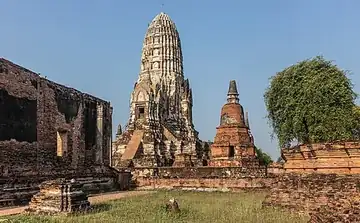 TempleWat RatchaburanaThe temple built where two royal brothers were cremated, with a crypt of gold treasures found in 1957
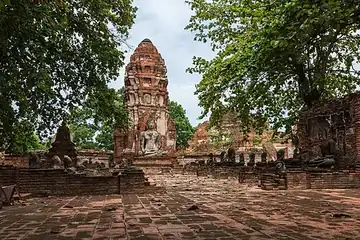 TempleWat MahathatThe royal temple at the heart of the capital, home of the famous Buddha head in the tree roots
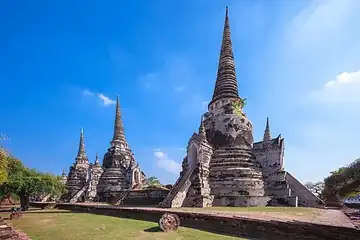 TempleWat Phra Si SanphetThe temple within the palace grounds, whose three chedis are Ayutthaya's iconic image
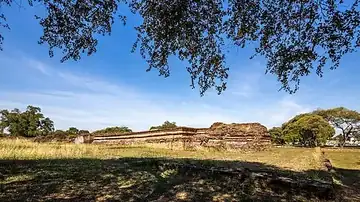 PalaceAncient Royal Palace★The centre of power in Ayutthaya, where Naresuan came to the throne
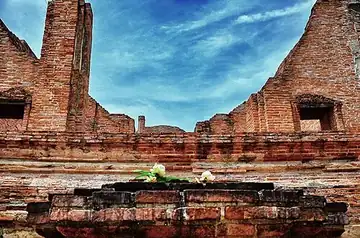 TempleWat Maheyong★A chedi ringed by some 80 elephants, and the site of King Bayinnaung's royal camp when Ayutthaya first fell in 1569
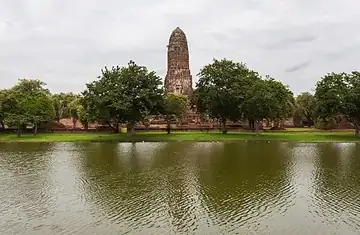 TempleWat Phra RamThe temple built on King U Thong's cremation site, its main prang rising beside Bueng Phra Ram in the middle of the city island.
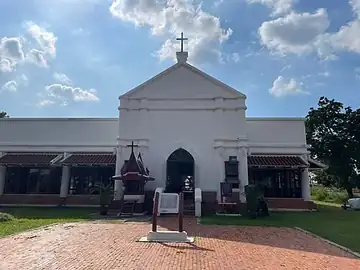 Foreign settlementPortuguese Settlement★Ayutthaya's first European community, home of musketeers who served Siam from before Naresuan's time
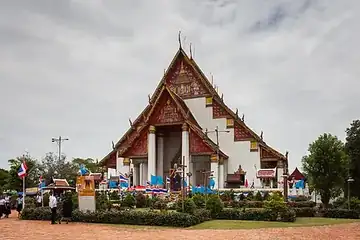 TempleWihan Phra Mongkhon BophitA seated Buddha about 9.5 metres across the lap that survived lightning and the fires of war, and is still worshipped today.
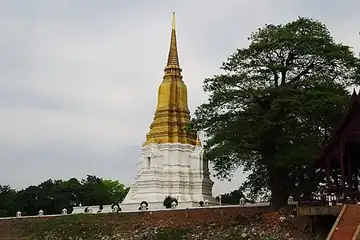 TempleSuriyothai Chedi★A memorial to Queen Suriyothai, King Naresuan's grandmother
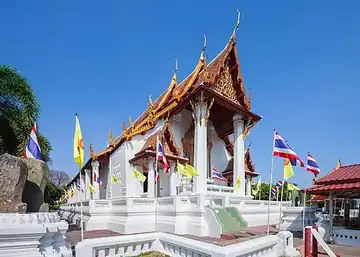 TempleWat Na Phra Men★Where the truce of the War of the White Elephant was negotiated, the start of Naresuan's journey to Hanthawaddy
Frequently asked questions
How many kings did the Suphannaphum dynasty have?
Thirteen, from King Borommaracha I (Khun Luang Pha-ngua) to King Mahinthrathirat. They reigned in two periods: 1370–1388 and 1409–1569.
How is Wat Ratchaburana connected with the Suphannaphum dynasty?
King Borommaracha II (Chao Sam Phraya) had it built in 1424 on the site where his two elder brothers were cremated, after they were killed fighting each other on elephant-back for the throne.
Why did Ayutthaya fall the first time?
The main factor was the superior strength of King Bayinnaung's army, combined with conflict at home — both over the royal succession and in the rift between Ayutthaya and Phitsanulok.
Last updated 10 November 2026