Home › Places › Wat Yai Chai Mongkhon
Wat Yai Chai Mongkhon (Wat Pa Kaeo): The Temple of Victory in the Memory of King Naresuan
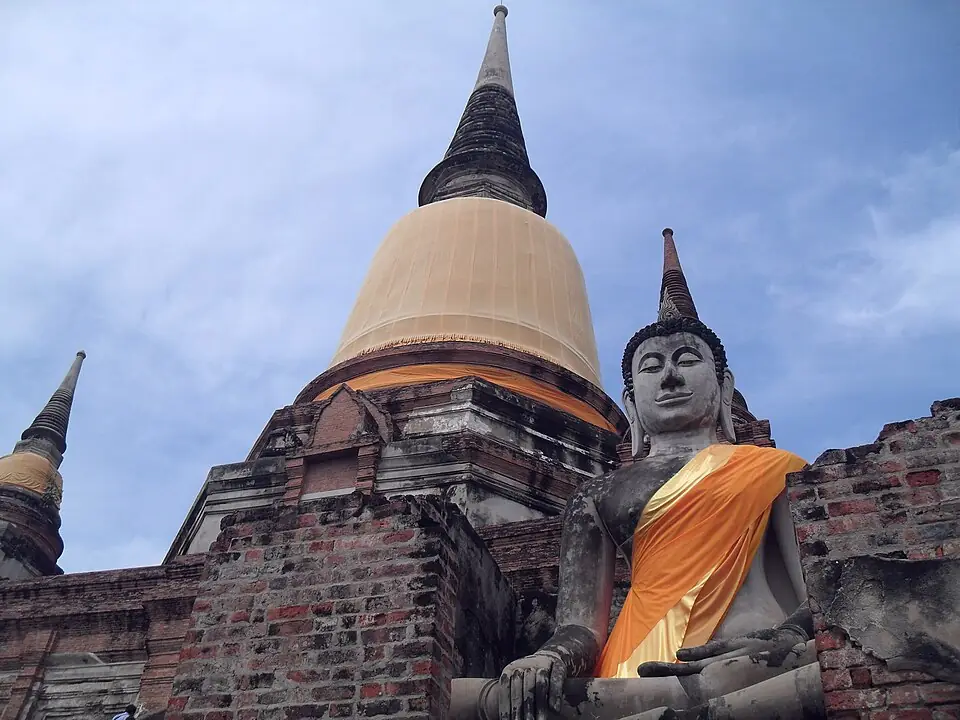
Wat Yai Chai Mongkhon is an old temple outside the city island to the southeast of Ayutthaya, with a huge bell-shaped chedi that can be seen from far away. Originally called Wat Pa Kaeo, it was home to monks of the Sri Lankan lineage from the early days of the kingdom, and it is bound up with King Naresuan through the story of Somdet Phra Phonnarat pleading for the pardon of his commanders after the elephant duel. Today it is still a working temple with resident monks, and people come to pay their respects every day.
This place through the eras
King U Thong is usually said to have had it built in 1357 (some chronicles say 1363). Its original name was Wat Pa Kaeo, for monks who had gone to Sri Lanka to be ordained and study, and it was a major centre of the forest-dwelling (aranyawasi) monks, who focus on meditation.
According to the royal chronicles, after Naresuan won the elephant duel at Nong Sarai (1593), he intended to punish the commanders who had failed to keep up with him. Somdet Phra Phonnarat of Wat Pa Kaeo asked him to pardon them, and Naresuan then had a great chedi built at this temple to commemorate the victory, which is why it is called the Chai Mongkhon (auspicious victory) chedi. Some scholars, however, think the chedi may predate Naresuan's time.
Still an important temple of the forest-dwelling monks.
Abandoned after the fall of the city, until monks came back to live here again in 1957.
The main chedi is one of the tallest and most prominent in Ayutthaya. Behind the temple there is a royal pavilion and a royal monument to King Naresuan where visitors pay their respects.
Background: Wat Pa Kaeo and the Sri Lankan monastic lineage
According to the royal chronicles, in the reign of King Ramathibodi I, the founder of Ayutthaya, Prince Kaeo and Prince Thai died in an epidemic. The king had them cremated and then established a temple on the cremation site, named Wat Pa Kaeo. The year usually given is 1357.
Wat Pa Kaeo was the seat of a community of monks who were ordained and trained in the Sri Lankan tradition and who put the emphasis on meditation practice. Its head held the ecclesiastical title of Somdet Phra Wannarat, which the Ayutthaya-period chronicles write as Phra Phonnarat of Pa Kaeo. That is why the temple had another name, Wat Chao Phraya Thai.
Prince Damrong Rajanubhab suggested that the words "Pa Kaeo" were a translation of the Pali word vanarata, and some explain the title Wannarat as meaning "one who delights in dwelling in the forest". The name therefore points to a forest lineage of monks, usually described as the forest-dwelling (araññavāsī) order, as distinct from the town-dwelling (gāmavāsī) monks who lived in the city.
Somdet Phra Phonnarat and the aftermath of the elephant duel
In 1593, King Naresuan defeated the Burmese Crown Prince of Hanthawaddy in the elephant duel; according to the royal chronicles it took place at Nong Sarai. But on that day several army commanders failed to keep up with the royal elephant, leaving Naresuan and Ekathotsarot to face the enemy on their own, and so they faced severe punishment under martial law.
The chronicles tell how Somdet Phra Phonnarat of Wat Pa Kaeo, together with 25 other senior monks, went to the king to plead for the commanders to be pardoned. Naresuan agreed, but on one condition: they must first "go and take Tenasserim and Tavoy to redeem themselves".
This episode made Wat Pa Kaeo a symbol of the mercy that stood beside victory, and it is a key reason why people still link this temple with Naresuan to this day.
The Chai Mongkhon chedi: when was it really built?
The most familiar explanation comes from Prince Damrong Rajanubhab in his book Phra Phuttha Chedi Sayam: the main chedi was built in Naresuan's reign to celebrate his victory, hence the name Chedi Chai Mongkhon ("chedi of auspicious victory"), and the temple became known as Wat Yai Chai Mongkhon. However, the royal chronicles do not record its construction, so some explain that the king may instead have restored and enlarged an existing chedi.
In 2024, Assoc. Prof. Dr. Rungrot Phiromanukun of Ramkhamhaeng University proposed that the chedi was probably built in the reign of Ramathibodi I, or even before the founding of the kingdom. His reasons: its shape resembles the chedi of Wat Phra Kaeo in Sankhaburi; the miniature chedis at the corners of the terrace resemble the bronze miniature chedis found in Suphanburi; and the bell, which is hollow right through to the harmika (the square platform above the bell), resembles the technique used in the tops of early prangs (Khmer-style towers).
He also asked how, after the continuous wars from 1548 onwards had greatly reduced the population of the Chao Phraya basin, and with men still being conscripted to fight, anyone could have found the enormous labour force needed to build a chedi of this size. The debate has not been settled.
This spot through the eras
This temple has lived through times of glory, times of abandonment, and a return to life. Follow it era by era on the map.
- Founding of the city (1351–1488): Wat Pa Kaeo was founded in the reign of King U Thong as the seat of the Sri Lankan-lineage monastic community.
- Naresuan's era (1548–1605): Somdet Phra Phonnarat pleaded for the pardon of the commanders after the elephant duel. The wihan (assembly hall) of the reclining Buddha is believed to have been built in this reign, and according to the traditional account the Chai Mongkhon chedi was also built or enlarged in this era.
- King Narai's era (1656–1688): it remained an important temple outside the capital. Kaempfer's map of 1690, made shortly after this reign, labels the temple "Tiampiatay", which comes from the name Wat Chao Phraya Thai.
- Second fall of Ayutthaya (1767): the temple was looted and damaged by the enemy, and abandoned along with the capital.
- Today: monks returned to live here in 1957. The reclining Buddha was remodelled and repaired in 1965, and a new ubosot (ordination hall) was built on the old foundations around 1979.
What to see
You can see everything in about an hour. Don't miss the following.
- The Chai Mongkhon chedi: a bell-shaped chedi on a tall square base, with a smaller chedi at each of its four corners. A stairway on the east side leads up to a terrace and an opening into the chamber inside the chedi.
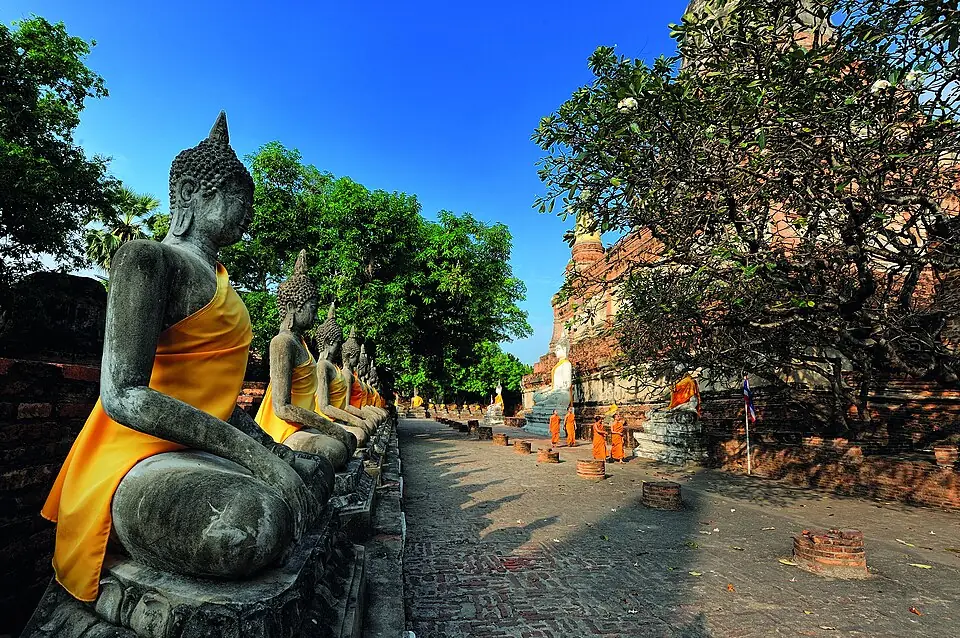
- Buddha images around the chedi: only the column bases of the gallery (cloister) remain. Inside it, rows of newly made gilded Buddha images stand in place of the original images, which have been lost.
- The reclining Buddha: a white reclining Buddha in the ruins of a wihan. The original was damaged by people digging illegally for valuables, so it was remodelled. Visitors often bring cloth to drape over it as an offering.
- The ubosot (ordination hall): home to the Phra Phuttha Chai Mongkhon, a Buddha image deeply revered by the people of Ayutthaya.
- King Naresuan shrine-pavilion: at the back of the temple, it houses a statue of the king for the public to venerate. It is a modern building, and worshippers often bring statues of fighting cocks as offerings.
Getting there and visiting
From the Wat Sam Pluem chedi roundabout on Rojana Road, turn south onto Route 3059; the temple is on the east side of the road. A tuk-tuk or a bicycle from the city island is convenient.
This is a working temple with resident monks, not just a historic site, so dress modestly and behave respectfully. The temple regularly holds traditional ceremonies, such as the Tak Bat Thewo alms-giving after the end of Buddhist Lent, when monks walk down from the chedi to receive alms.
Where historians still disagree
- When the Chai Mongkhon chedi was built: Prince Damrong Rajanubhab explained in Phra Phuttha Chedi Sayam that it was built in the reign of King Naresuan. One view holds that Naresuan may only have restored and enlarged an existing chedi, since the chronicles do not mention its construction. Assoc. Prof. Dr. Rungrot Phiromanukun, on the basis of its artistic style and building technique, proposes that it was probably built in the reign of Ramathibodi I or before the founding of the kingdom.
- The year the temple was founded: 1357 is the year usually cited, but the Phra Chakkraphatdiphong (Chat) version of the Royal Chronicles of Ayutthaya gives 1363, in the same reign.
Visiting information
- Opening hours: Daily, approximately 8:00 am–5:00 pm (as of 2026)
- Admission: Free for Thai visitors; foreign visitors pay a maintenance fee (THB 20 as of 2026)
- This is a working temple with resident monks, so dress modestly and cover your shoulders and knees.
- Mornings are cooler and less crowded than late morning.
- The stairs up the chedi are quite steep; take them slowly and be careful when they are wet.
- You can combine this with Wat Phanan Choeng or Baan Hollanda (Dutch settlement), south of the city island, in a single day.
Opening hours and admission fees may change, so please check before you go.
Frequently asked questions
What was Wat Yai Chai Mongkhon originally called?
It was originally called Wat Pa Kaeo and, according to the chronicles, was built in the reign of King Ramathibodi I. It was also known as Wat Chao Phraya Thai, after the ecclesiastical title of the head of the Pa Kaeo order.
Was the Chai Mongkhon chedi really built by King Naresuan?
Prince Damrong Rajanubhab explained that it was built in Naresuan's reign, but the chronicles do not record it, and some scholars suggest the chedi is older than that. The question is still debated.
How is Somdet Phra Phonnarat connected with King Naresuan?
After the elephant duel of 1593, Somdet Phra Phonnarat of Wat Pa Kaeo and 25 senior monks pleaded with the king to pardon the commanders who had failed to keep up with him. Naresuan agreed, on condition that they redeem themselves by taking Tenasserim and Tavoy.
Are there still monks at Wat Yai Chai Mongkhon?
Yes. The temple was abandoned after the fall of Ayutthaya in 1767, and monks came back to live here in 1957. Today it is both a historic site and a working temple.
- The Main Chedi of Wat Yai Chai Mongkhon Was Not Built in King Naresuan's Time!? - Silpa Wattanatham (in Thai)
- WAT YAI CHAI MONGKHON - Ayutthaya Historical Research
- Somdet Phra Wannarat: Where Does This Important Monastic Title Come From, and Since When Has It Been Used? - Silpa Wattanatham (in Thai)
- Wat Yai Chai Mongkhon Holds Tak Bat Thewo Alms-Giving - Naewna (in Thai)
- Crowds Bring Fighting-Cock Statues to Pay Respects to King Naresuan the Great - Channel 8 (in Thai)
Last updated 10 November 2026