Home › Places › Wat Phu Khao Thong
Wat Phu Khao Thong and the Phu Khao Thong Field: A Chedi of Many Reigns and a Battlefield Outside Ayutthaya
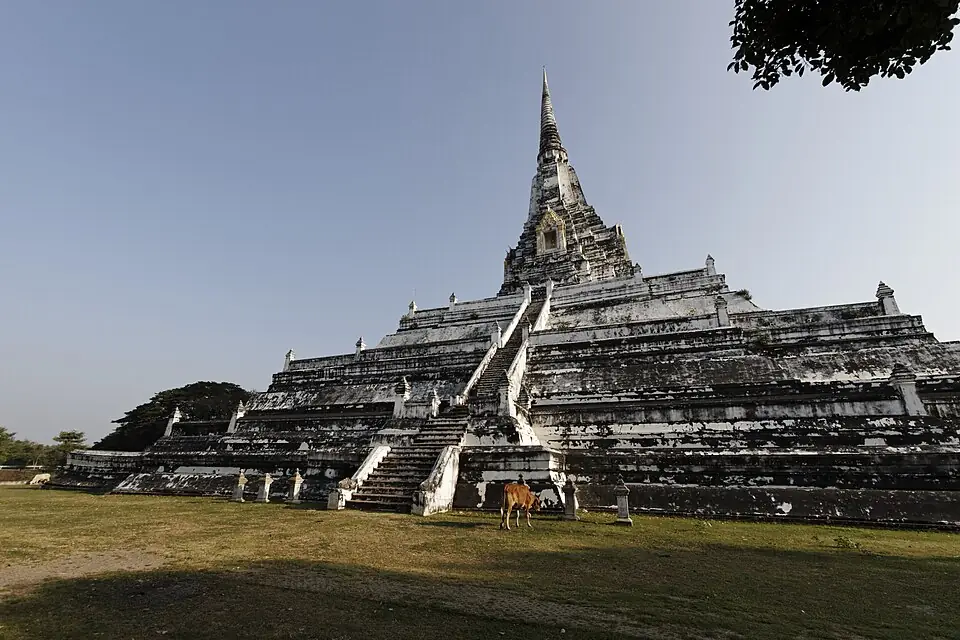
Wat Phu Khao Thong stands in the middle of open fields north-west of Ayutthaya's city island. Its great white chedi is the work of many reigns layered one on top of another: from the founding of the temple under King Ramesuan, according to the chronicles, through a chedi base believed to have been built by King Bayinnaung to celebrate his victory, to the restoration under King Borommakot. The fields around the temple were a battlefield many times over, and today they are home to the Monument of King Naresuan the Great.
This place through the eras
The chronicles say King Ramesuan had this temple built in Chula Sakarat 749, which is 1387.
The fields around the temple were a battlefield many times. After King Bayinnaung took Ayutthaya in 1569, he had a large Mon-Burmese-style chedi built at this temple to commemorate his victory, so this chedi towered over the north of the capital throughout Naresuan's reign.
The Mon-Burmese-style chedi was still a prominent landmark in the fields north of the capital.
In 1744 King Borommakot had it restored. The upper part became a Thai-style chedi with redented corners, but it still stands on the original Mon-Burmese base. Twenty-three years later the city fell again.
On the Phu Khao Thong Field nearby stands the royal monument to King Naresuan the Great (an equestrian statue), a project in honour of King Rama IX that was completed in 1999.
Origins: a temple in the fields outside the capital
Several versions of the chronicles state that Wat Phu Khao Thong was founded in the reign of King Ramesuan, in the year 749 of the Chula Sakarat (Lesser Era), which corresponds to 1387.
However, the art historian Piriya Krairiksh has pointed out that the temple may not have been built in this reign, because it is first mentioned in a chronicle revised much later, the Phan Chanthanumat version, in 1795.
The temple stands in the middle of the Phu Khao Thong Field, bounded by the Chao Phraya River to the west, Khlong Maha Phram to the north and Khlong Mahanak to the east. This wide plain was therefore the route enemy armies usually took to close in on the capital.
The Phu Khao Thong chedi: the work of many reigns
The Testimony of the Old Capital's People (Khamhaikan Chao Krung Kao) relates that after Ayutthaya fell to Hanthawaddy in 1569, King Bayinnaung had this chedi built. Many sources describe it as a large Mon-Burmese-style chedi built to celebrate his victory, but only the base had been completed when he returned to Hanthawaddy, so the chedi was left unfinished.
Several sources state that around 1587, after declaring independence but before coming to the throne, Naresuan had a Thai-style chedi built on top of that earlier base. Archaeological investigation found bases from four different periods built one over another, and scholars say the layer consisting of a twelve-sided chedi with a Burmese-style lotus base is probably the work of Naresuan's time.
The chedi later fell into disrepair. The chronicles record that King Borommakot had it restored in 1744, a job that took about ten months. The square base with indented corners that you see today largely comes from that restoration.
In 1956 the government of Field Marshal Plaek Phibunsongkhram restored the chedi and placed a golden orb weighing about 2.5 kilograms on its spire to mark the 25th Buddhist century. It was restored again in 2016–2017.
The Phu Khao Thong Field: a battlefield outside the capital
Because it was a wide open space in front of the capital, the Phu Khao Thong Field served many times as a camp for both Ayutthaya's armies and its enemies. The main events recorded in the sources are:
- Reign of King Maha Chakkraphat: when the Hanthawaddy army advanced, Phra Mahanak, a monk of Wat Phu Khao Thong, left the monkhood to set up a camp and lead people in digging a defensive moat, which later came to be called Khlong Mahanak (according to the royal chronicles).
- Around 1590: King Naresuan assembled troops, war elephants and a large number of warhorses on the Phu Khao Thong Field to go out and meet the Hanthawaddy army. The chronicles give a different date, but modern researchers have corrected it to this year.
- 1759–1760: King Alaungpaya's army crossed over and camped on the Phu Khao Thong Field, setting up cannon near Wat Na Phra Men and Wat Hatsadawat to fire into the royal palace.
- 1766–1767: the Burmese general Ne Myo Thihapate set up his vanguard at Wat Phu Khao Thong and at temples to the west of the capital, using cannon to bombard the city before it fell.
What it has to do with King Naresuan
The Phu Khao Thong chedi tells the story of Naresuan's life remarkably well. The base believed to date from 1569 reflects the day Ayutthaya fell for the first time, while the body of the chedi, believed to have been built in his time, reflects the winning back of independence. Engelbert Kaempfer, a German who visited in 1690, recorded that the chedi was a memorial to a victory over the Burmese, which is why some people connect it with Naresuan.
To the east of the chedi stands the Monument of King Naresuan the Great, completed in 1999. It shows the king on horseback in a battle pose, recalling the moment he killed Lakwai Thammu, a Hanthawaddy commander. Around the base are 11 relief panels telling the story of his life, such as the declaration of independence at Mueang Khraeng.
Around the monument's plaza stand large numbers of fighting-cock statues offered by the public, following a popular story that the young Naresuan won a cockfight against a Hanthawaddy prince. On 25 April, the anniversary of his death, Phra Nakhon Si Ayutthaya province usually holds a wreath-laying ceremony here to pay homage to him.
Wat Phu Khao Thong through the eras
If you stood in the middle of this field and went back in time, you would see very different scenes:
- Founding of the city (1351–1488): the chronicles say the temple was founded in 1387; the earliest chedi base, which is square without indented corners, may come from this period.
- Naresuan's time (1548–1605): in 1569 Hanthawaddy's victory chedi base appeared; around 1587 a Thai-style chedi was built over it, and around 1590 this field was a mustering ground for troops.
- King Narai's time (1656–1688): the chedi towered over the fields; Kaempfer saw it in 1690, just two years after the end of King Narai's reign.
- The second fall of Ayutthaya (1767): not long after the major restoration of 1744, the Burmese army used the temple as a vanguard base for bombarding the capital.
- Today: a white chedi topped with a golden orb, and the Monument of King Naresuan the Great on the Phu Khao Thong Field.
Getting there and visiting
The temple lies about 2 kilometres north-west of the city island. The access road branches off Highway 309 (Ayutthaya–Ang Thong), and it is easiest to get there by private car, hired vehicle or bicycle.
The monument plaza has almost no shade, so come in the morning or evening. The chedi has stairs leading up to a terrace halfway up, from which you can look out over the rice fields and the town.
Where historians still disagree
- Who built the temple and the chedi: the chronicles say King Ramesuan founded it, but Piriya Krairiksh has raised doubts. The story that King Bayinnaung built the chedi base comes from the Testimony of the Old Capital's People; some researchers counter that if it really were an enemy victory monument, later Ayutthaya kings might well have torn it down. The archaeological evidence points to work from several periods layered one on another.
- The year of the restoration under King Borommakot: the chronicles give 1744, while the astrologers' annals (pum hon) record the following year.
- The occasion for building the King Naresuan monument: sources differ. Some say it was built to honour King Rama IX's 50 years on the throne, others that it marked his sixth-cycle (72nd) birthday anniversary, which coincides with the year it was completed, 1999.
- The height of the chedi: figures in documents from different periods vary widely, from about 50 metres to about 90 metres, so there is still no settled figure.
Visiting information
- Dress modestly when entering the temple grounds and paying respects at the monument.
- The open plaza gets extremely hot in the middle of the day, so bring a hat, an umbrella and drinking water.
- If you climb the chedi stairs, wear shoes with good grip and take it slowly.
- Combine your visit with Wat Na Phra Men, which is also off the city island to the north.
Frequently asked questions
Who built the Phu Khao Thong chedi?
The chronicles say King Ramesuan founded the temple in 1387. King Bayinnaung is believed to have built the chedi base in 1569, many scholars think part of the chedi was built in Naresuan's time, and its present shape comes from the restoration of 1744.
Where is the King Naresuan monument in Ayutthaya?
It is on the Phu Khao Thong Field, to the east of the Phu Khao Thong chedi, off the city island to the north-west. It was completed in 1999.
Why are there so many fighting cocks at the King Naresuan monument?
People bring fighting-cock statues as offerings, following a popular story that the young Naresuan won a cockfight against a Hanthawaddy prince.
- WAT PHUKHAO THONG – Ayutthaya Historical Research
- THUNG PHUKHAO THONG – Ayutthaya Historical Research
- Who built Phu Khao Thong in Ayutthaya? – Silpa Wattanatham (in Thai)
- Chedi Phukhao Thong – Wikipedia
- Monument of King Naresuan the Great – Go Ayutthaya (Phra Nakhon Si Ayutthaya Province)
- Memorial King Naresuan – Ayutthaya Historical Research
Last updated 10 November 2026